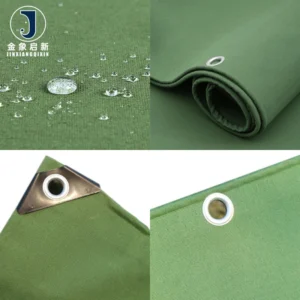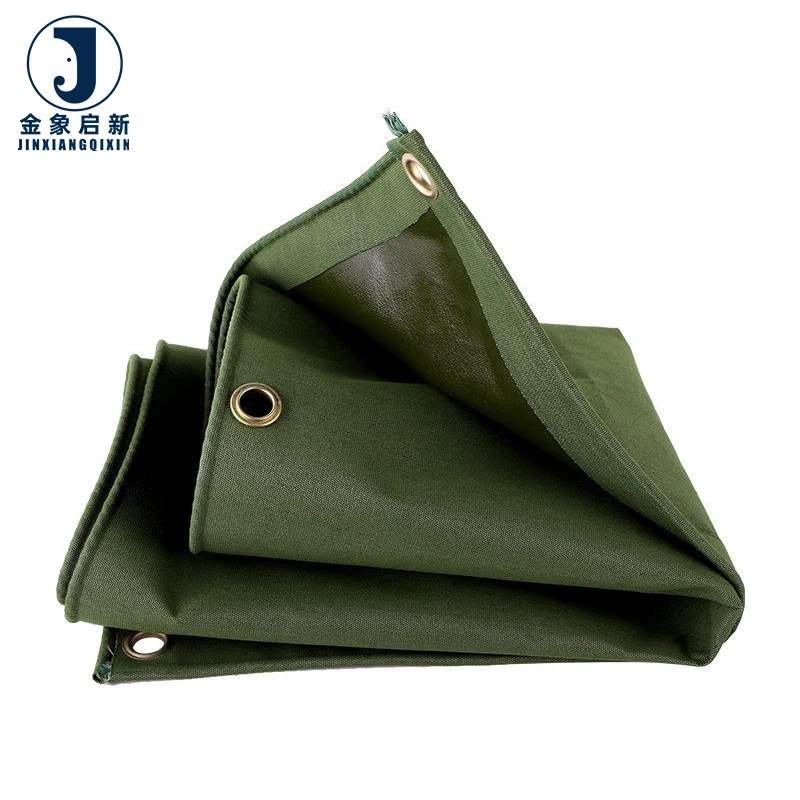
Verified Weight Integrity — Every roll of Heavy Duty Woven Canvas Laminated Tarpaulin undergoes 100% pre-shipment inspection, confirming the 600 GSM weight on arrival matches the specification you approved.
Technical Specifications
| Parameter | Value |
|---|---|
| Product Type | Canvas Tarpaulin |
| Material | Woven plain canvas with laminated coating |
| Weight | 600 GSM |
| Treatment | UV resistant (test basis to confirm), waterproof |
| Edge Construction | Reinforced edges |
| Flame Retardancy | Flame retardant grade (grade to confirm with test report) |
| Application Grade | Heavy duty industrial |
Application Suitability
| Application | Exposure & Requirement |
|---|---|
| Truck and trailer load covering | Constant road vibration, tie-down flex stress, UV exposure, weather ingress |
| Construction site equipment covers | Abrasive contact with scaffolding and steel, prolonged sun and rain exposure |
| Outdoor camping and temporary shelters | Wind loading, repeated folding, ground moisture contact |
| Industrial equipment protection | Dust ingress, chemical splash risk, sustained outdoor storage |
Why a Stated GSM Does Not Guarantee Tarpaulin Survival on the Road
A 600 GSM canvas tarpaulin only performs as expected when the weight is verified roll by roll before it leaves the factory floor.
Fleet operators frequently receive tarpaulins that measure lighter than the quoted specification once unrolled at the depot [NEED_CITE: common GSM deviation in imported coated fabrics]. The shortfall might seem marginal on a laboratory scale, but under highway wind loading and repeated tie-down tension, the deficit accelerates tear propagation at the hems. This Heavy Duty Woven Canvas Laminated Tarpaulin addresses that gap by locking the 600 GSM target into the production control sheet and confirming it with a pre-shipment test record. The reinforced edges add a second layer of insurance at the stress points where generic covers typically fail first.
Covering a Moving Load Demands More Than a Flat Sheet
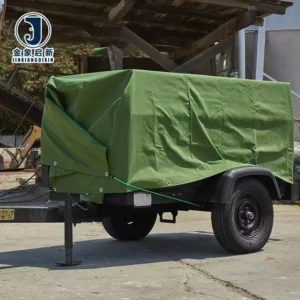
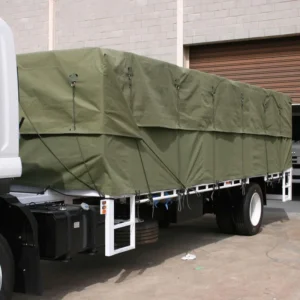
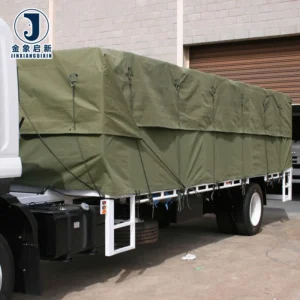
Transport fleets expose covers to forces that static site covers never encounter. A flatbed load shifts under braking, causing the Heavy Duty Woven Canvas Laminated Tarpaulin to flex and abrade against the cargo surface hundreds of times per journey. The laminated coating bonded to the woven canvas base resists this micro-abrasion, preventing the surface breakdown that lets water penetrate the fabric structure. Reinforced edges distribute the concentrated load from ratchet straps, reducing the chance of a tear starting at the tie-down point.
Matching the Cover to the Trailer Profile
A generic rectangle draped over a curtain-side trailer leaves loose fabric that flaps at speed, generating fatigue at the eyelet line. This canvas tarpaulin aftermarket supplier provides custom cut sizes matched to individual trailer models, so the fabric sits taut without over-stretching [NEED_CITE: trailer model dimensions and cover fitment tolerances]. When the cover fits the load profile, wind drag drops, fuel consumption stays predictable, and the reinforced edges remain aligned with the strap positions designed into the trailer body.
Reading the Specification Beyond the Weight Figure
The 600 GSM figure combines the woven plain canvas base fabric and the laminated coating into a single areal density. That total weight alone does not reveal the base fabric denier or weave density, which govern tear strength independently of the coating mass. A heavier coating on a lighter base may meet the GSM target yet tear more easily than a balanced construction. The laminated coating method bonds two outer layers to the scrim under heat and pressure, producing high peel strength that supports heat-welded seams without delamination. The UV resistant treatment slows polymer degradation from sustained sun exposure, though the specific test basis and duration should be confirmed against your market’s climatic expectations. Flame retardant grades are available — confirm the grade required for your site or regional fire safety regulation before ordering.
The Hidden Cost of Skipping Specification Verification
When a batch of tarpaulins arrives below the quoted weight, the first sign of trouble is usually a seam failure at the flex point rather than a clean fabric tear [NEED_CITE: weld and seam failure modes in coated fabrics]. The repair cost on a roadside incident — recovery vehicle, load delay, replacement cover — dwarfs the savings from a lower unit price. Flame retardant grades claimed without a supporting test report create a different liability: a site inspector rejecting the cover after installation leaves the contractor scrambling for compliant material at short notice. Roll-to-roll colour variation discovered after multiple covers are fitted side by side forces a full replacement rather than a partial return.
Why Sourcing This Canvas Tarpaulin Here Reduces Procurement Risk
Three full production lines and 36 sets of professional equipment give the factory the capacity to run your container load without subcontracting to an uncontrolled secondary source. A 10-person R&D team handles the pattern development, custom sizing, and sample approval before bulk production begins. Every roll passes through dedicated QA/QC at each production stage, with a 100% inspection gate before dispatch. ISO and CE certification underpins the management system, while the pre-shipment inspection record gives you documented proof that the 600 GSM weight and reinforced edge specification match the approved sample.
Documentation & Verification
- Weight verification per roll against the stated 600 GSM before dispatch
- Flame retardant test report matching the grade specified on the purchase order
- UV resistant treatment test basis and exposure duration documented
- Roll packing list with certificate of origin and customs clearance support
- Pre-shipment inspection record photographing edge reinforcement and surface condition
Fabrication, Handling & Storage
- Heat-weld seams using temperature settings matched to the laminated coating to prevent delamination at flex points
- Reinforce eyelet areas with additional canvas patches to spread tie-down loads across the 600 GSM base
- Store rolls upright on pallets to avoid permanent creasing in the laminated surface layer
- Unfold in ambient temperatures above freezing to prevent coating crack at the fold line
- Clean with mild detergent and soft brush to preserve the UV resistant treatment surface
- Cut panels with allowance for the reinforced edge overlap to maintain hem integrity after fabrication
What to Include in Your Enquiry
Provide the trailer model or load dimensions, the strap and tie-down configuration, and the operating climate so we can confirm the UV resistant treatment basis and edge reinforcement layout. If your site or jurisdiction mandates a specific fire safety grade, state the standard reference so the correct flame retardant formulation is selected. Specify whether you need finished cut sizes or roll stock, and whether colour matching across multiple rolls is required for your fleet livery.
Frequently Asked Questions
Q: How is the 600 GSM weight verified before the canvas tarpaulin ships?
A: Each roll is weighed per unit area during the pre-shipment inspection, and the result is recorded on the inspection report that accompanies your dispatch documents. This gives you a measurable check against the quotation rather than relying on a claimed figure. You can re-verify on arrival using a standard fabric scale.
Q: Does the flame retardant grade come with a test certificate?
A: A test report is issued with the shipment, stating the grade achieved and the test standard applied. Because fire safety regulations vary by market, confirm the specific grade your site requires — such as M2, B1, NFPA 701, or DIN 4102 — before production begins so the correct formulation is used.
Q: Can custom widths and lengths be produced without high minimums?
A: Custom sizing is supported through the R&D team’s sample development process, with minimums that scale to the order volume. For multi-roll orders, the production lines are set to maintain consistent GSM and colour across the batch, reducing the risk of variation between covers fitted to the same fleet.
Q: How is colour consistency maintained across multiple rolls in one order?
A: All rolls for a single order are produced in the same batch run using matched coating compound and colour masterbatch. The pre-shipment inspection includes a visual comparison under controlled lighting, and a roll packing list identifies the production batch for traceability if a future reorder is needed.
Q: What reinforcement options are available for high-stress edge areas?
A: The reinforced edges are standard, but additional patch reinforcement can be applied at eyelet positions and corner stress points where tie-down straps concentrate load. The reinforcement specification is confirmed during the sample approval stage to match your trailer’s strap layout and tension requirements.