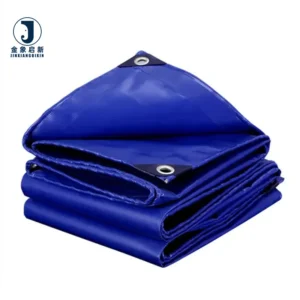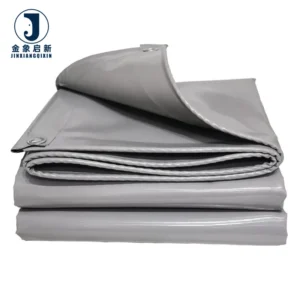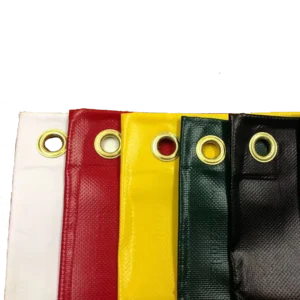
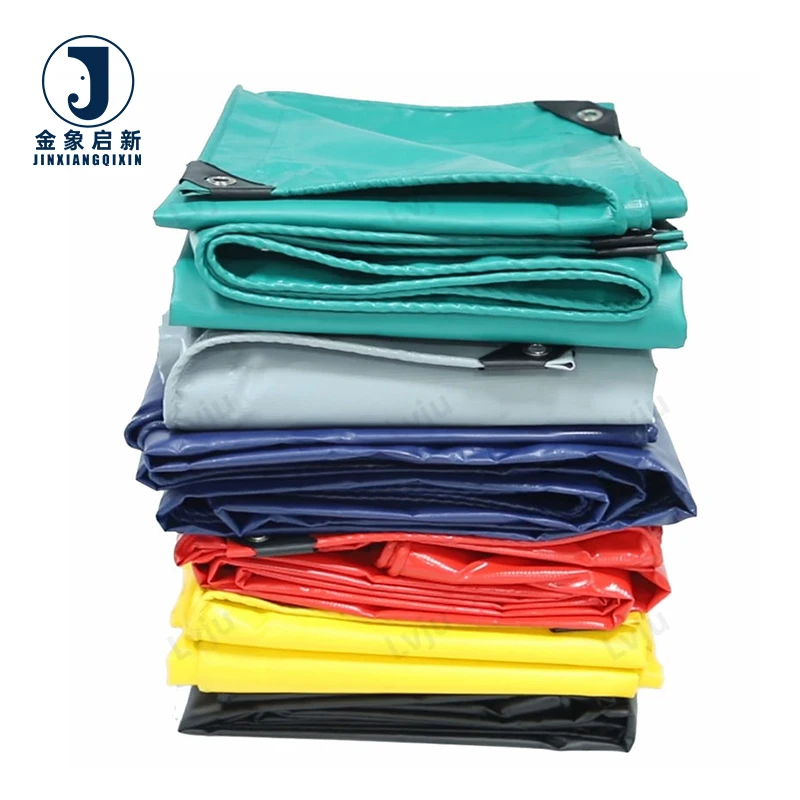
Model-Specific Fitment Focus — Every truck and trailer dimension is measured before cutting, with reinforcement placed exactly where tie-down hardware meets the fabric.
Technical Specifications
| Parameter | Value |
|---|---|
| Product Type | PVC Coated Tarpaulin |
| Material | PVC knife coated fabric |
| Weight Range | 400-500 GSM (medium) / 700-1000 GSM (heavy-duty) / 1100-1500 GSM (super heavy) |
| Thickness Range | 0.35-0.45 mm (medium) / 0.70-1.0 mm (heavy-duty) / 1.2-1.5 mm (super heavy) |
| Base Fabric Denier | 500D (medium) / 1000D (heavy-duty) / 500D-2000D (super heavy) |
| Tensile Strength (Warp/Weft) | 1500-2000 / 1200-1800 N/5cm (medium) ; 2000-2500 / 1800-2200 N/5cm (heavy-duty) ; 2500-3000 / 2200-2800 N/5cm (super heavy) |
| Coating Method | Knife coated |
| Color | Black (primary); other colors available on custom order |
| Key Features | Waterproof, tear resistant, mildew proof, anti-aging, washable; UV treatment available — confirm the grade required for your market |
| Standard Sizes | 8’x10′, 10’x12′, 12’x16′, 16’x20′, 20’x20′, 20’x30′ (custom sizes supported) |
| Finish | Glossy or matte finish available per product line |
| Custom Options | Width, length, eyelets, reinforced hems, pattern printing, branding |
| Certifications | ISO, CE |
Application Suitability
| Application | Exposure & Requirement |
|---|---|
| Long-haul truck side curtains | Constant flexing at load shifts, road abrasion, continuous UV and weather exposure |
| Flatbed trailer load covers | Tie-down strap pressure, wind flap fatigue, cargo edge abrasion at flex points |
| Full-size pickup truck bed covers | All-season outdoor parking, UV exposure, repeated folding and unfolding |
| Farm machinery protection | Dust, chemical spray contact, prolonged sun exposure, mechanical puncture risk |
| Construction site equipment covers | Abrasive aggregate contact, heavy wind loads, mud and moisture accumulation |
Why Generic Sizing Fails on Moving Loads
A PVC Knife Coated Tarpaulin for Truck and Trailer cut to a standard rectangle leaves slack at the cab end and tension gaps at the tailgate — both create wind catch points and load security failures.
The cover must match the trailer model, not the other way around.
Fleet operators routinely replace covers that arrived in the correct GSM but the wrong dimensions. A gap at the rear means rain ingress onto palletised cargo. Excess fabric at the front flaps against the cab at highway speed, wearing through the coating within weeks. [NEED_CITE: aerodynamic flap wear on oversized truck covers at highway speeds] The cost is not just the replacement fabric — it is the load damage claim and the roadside compliance fine.
Sizing to the Trailer, Not to the Tape Measure
A PVC knife coated tarpaulin for truck and trailer applications performs only when it sits tight against the load profile without binding at structural edges. The process starts with the exact trailer model designation — wheel arch clearance, headboard height, side rail profile and tailgate geometry all change the cut pattern. Generic dimensions ignore these variables, producing covers that technically measure correctly but fit poorly on the vehicle.
Reinforcement at the Points That Actually Fail
Tie-down straps concentrate force into a narrow band of fabric. The eyelet row and the hem zone around it absorb that load every time the vehicle brakes, corners or hits a crosswind. Reinforcement in these zones — through doubled fabric layers, welded patches and spaced eyelet placement matched to the trailer rail geometry — prevents the most common failure mode: the eyelet tearing out under dynamic load. [NEED_CITE: dynamic load transfer on tie-down points during highway braking events]
Reading the Spec Sheet for Transport Use
Weight in GSM tells you how much coating sits on the base fabric, but it does not tell you how that coating bonds to the yarn or how the weave handles directional stress. Tensile strength measured warp and weft reveals how the fabric responds to the lengthwise pull of tie-down straps versus the crosswise pull of wind flap. Knife coated construction drives the coating into the weave gaps, producing higher peel strength at welded seams — the point where load flex concentrates stress. Denier selection determines puncture resistance at cargo edges and tear propagation speed once a nick occurs. [NEED_CITE: tensile and tear test methods for coated fabrics per ISO 1421]
The Hidden Cost of Spec Mismatch at the Flex Zone
Welded seams carry the highest stress on a truck cover because they sit at the point where cargo shifts during braking and cornering. When the coating weight is too low for the load profile, the weld peels before the fabric itself shows wear. When the denier is insufficient for the cargo type, a single nick from a pallet corner propagates into a full-length tear. Batch-to-batch colour variation becomes visible when panels from different rolls sit side by side on the same trailer — forcing a full replacement instead of a panel swap. [NEED_CITE: weld seam peel failure under cyclic flex loading in transport covers] These failures show up on the road, not in the warehouse, which makes them expensive to correct.
Why This Source Handles Transport Covers Differently
Deep process control over coating weight and adhesion means the GSM on the quotation matches the GSM on the roll. Three full production lines and 36 sets of equipment support bulk orders with on-time dispatch across multiple weight grades. The 10-person R&D team develops model-specific cut patterns and reinforced hem layouts for each trailer type before production begins. Dedicated QA and QC checks at every production stage catch coating weight deviation and colour drift before the fabric reaches the cutting table. Samples for custom sizing and reinforcement layouts are developed within days, not weeks, so fitment is verified before the bulk run starts.
Documentation & Verification
- Material specification sheet confirming GSM, base fabric denier and coating method for each roll
- UV treatment test report supplied when UV-grade fabric is specified in the order
- Pre-shipment inspection record verifying weight and colour against the approved sample
- Roll packing list with roll count, dimensions and net weight for container loading
- ISO and CE certificates included with every export shipment
- Certificate of origin and customs documentation prepared per destination market requirements
Fabrication, Handling & Storage
- Heat weld parameters should match the knife coated PVC layer thickness — confirm temperature and dwell time with the supplied spec sheet
- Eyelet spacing on the hem row must align with trailer rail tie-down points to distribute load evenly
- Store rolls upright on pallets to prevent flat spots that show as visible creases after unrolling
- Allow cold-temperature rolls to reach ambient temperature before unfolding to avoid coating crack at fold lines
- Clean with mild detergent and soft brush — abrasive cleaners damage the glossy or matte surface finish
- Lay flat on a clean surface for cutting to avoid trapping grit between the fabric layers during fabrication
What to Include in Your Enquiry
To size a PVC knife coated tarpaulin correctly for your fleet or project, provide the trailer model designation, the cargo type and typical route conditions. Specify whether you need finished cut covers with eyelets and hems or roll stock for your own fabrication line. State your target market so that any required UV or fire-retardant grade can be matched to local compliance standards.
Frequently Asked Questions
Q: How is truck cover sizing matched to a specific trailer model rather than a generic cut?
A: The trailer model designation drives the cut pattern, accounting for wheel arch clearance, headboard height and side rail profile. Measurements are taken against the actual vehicle geometry, not a standard rectangle. Reinforcement zones are then placed at the tie-down and flex points specific to that trailer type, ensuring the cover fits tight without binding or leaving gaps.
Q: What GSM and denier grade suits long-haul highway exposure versus construction site use?
A: Long-haul highway covers typically require heavy-duty weight with 1000D base fabric to handle wind flap fatigue and continuous UV exposure. Construction site covers face abrasive aggregate contact and puncture risk, often calling for super heavy grades with higher denier yarn. The selection depends on cargo type, route conditions and tie-down frequency.
Q: Can you supply UV-treated or flame-retardant fabric with a verifiable test report?
A: UV treatment and flame-retardant grades are available — confirm the specific grade required for your market and application. Test reports supporting the stated treatment grade are supplied with the shipment documentation. Request the applicable standard in your enquiry so the correct grade is specified from the start.
Q: How is colour consistency ensured across multiple rolls in one order?
A: Colour matching is verified roll-to-roll and panel-to-panel during pre-shipment inspection against the approved sample. Coating weight and pigment batch are controlled at each production stage to prevent drift. The inspection record documents the verification, so any panel swap in the field matches the surrounding fabric.
Q: What is the lead time for custom widths, printed branding and finished cut sizes?
A: Custom widths, colour matches and printed branding follow typical multi-week lead times depending on order volume and specification complexity. Samples for custom requirements are developed within days for approval before bulk production. Confirming all specifications at the enquiry stage — including trailer dimensions and branding artwork — keeps the timeline on track.