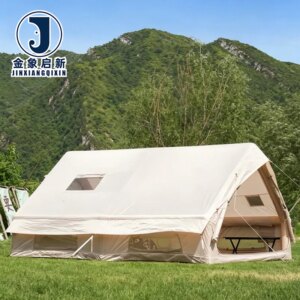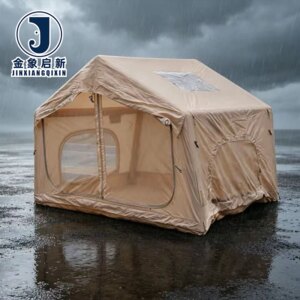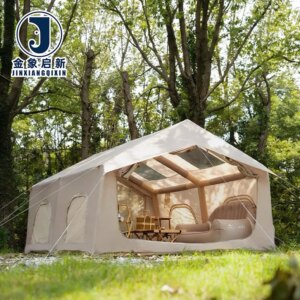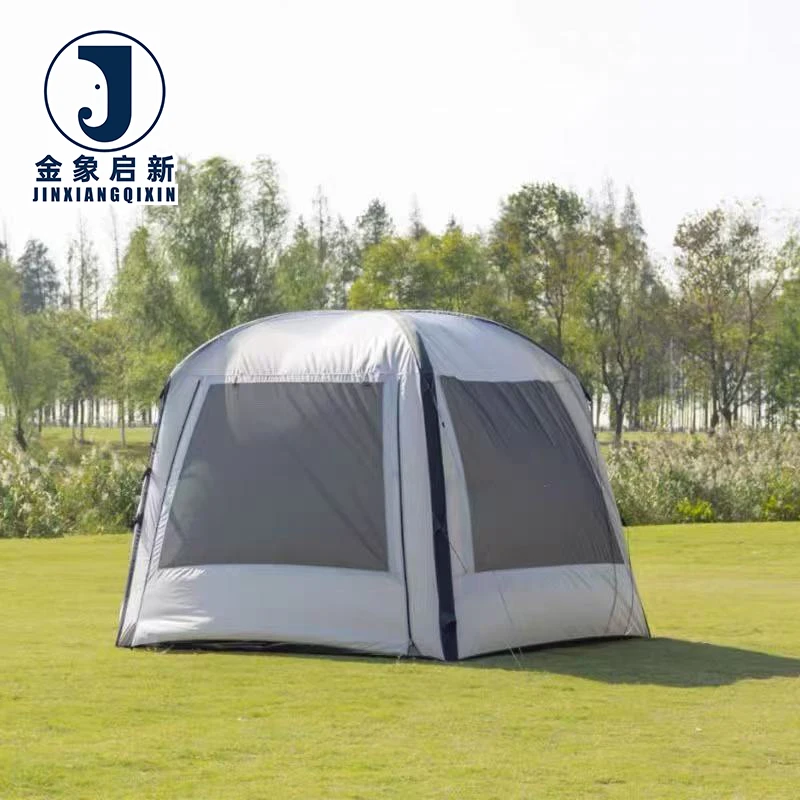
Rapid Deployment — three full production lines support consistent batch output for inflatable tent orders, with 100% pre-shipment inspection verifying inflation integrity and seam performance before dispatch.
Technical Specifications
| Parameter | Value |
|---|---|
| Product Type | Inflatable Tent |
| Core Material | PVC Tarpaulin |
| Product Forms | Automatic Inflatable 3-5 Person Camping Shelter |
| Waterproofing | Fully coated construction, waterproof |
| UV Resistance | UV-resistant (test basis not stated in source — confirm standard for your market) |
| Fire Retardancy | Fire-retardant treatment available (grade not stated in source — confirm grade required for your market) |
| Anti-Static | Anti-static treatment available (standard not stated in source — confirm compliance requirement) |
| Tear Resistance | Tear-resistant PVC construction |
| Customization | OEM & ODM: sample customization, pattern printing, material selection, product design |
| Certifications | ISO 9001, ISO 14001, ISO 45001, CE |
Application Suitability
| Application | Exposure & Requirement |
|---|---|
| Construction site temporary shelters | Daily UV exposure, wind loading, repeated inflation cycles, crew traffic abrasion |
| Mining camp accommodations | Remote deployment, dust infiltration, temperature fluctuation, rapid setup demand |
| Logging site personnel shelters | Forest moisture, falling debris risk, uneven ground contact, seasonal relocation |
| Emergency response base camps | Immediate deployment under time pressure, varied climate conditions, multi-use teardown cycles |
| Industrial event pavilions | Extended outdoor exposure, crowd capacity, branding and signage attachment |
| Outdoor equipment storage facilities | Continuous weather exposure, ventilation requirements, security against unauthorised access |
What Happens When Inflatable Tent Material Fails on a Remote Site
Coating adhesion and seam integrity determine whether the shelter holds pressure or collapses when it matters most.
I have reviewed field returns where inflatable structures lost air pressure within hours of setup because the welded seams separated under flex load. The PVC material itself remained intact — the failure occurred at the heat-welded joints where inflation tubes connect to the main body. On mining camps and logging sites, a collapsed shelter is not a minor inconvenience; it halts operations and forces crews into unprotected conditions [NEED_CITE: common failure modes in inflatable temporary structures per field inspection data]. Batches that pass initial inflation testing can still develop slow leaks after repeated deployment cycles if the coating weight and base fabric adhesion were not controlled during production.
Why Base Fabric Density Matters More Than Coating Weight Alone
When specifying an Automatic Inflatable PVC Tent, buyers often focus on the total weight of the material without examining the base fabric construction. The denier of the yarn and the weave density of the polyester scrim determine how well the fabric resists tearing when punctured by sharp ground contact or debris. A heavier coating adds waterproofing and surface durability, but it cannot compensate for a loosely woven base that allows tears to propagate once initiated. For inflatable structures that flex with wind loading and inflation pressure changes, the base fabric carries the structural load while the coating provides environmental protection.
How Coating Method Affects Weld Strength and Inflation Reliability
The PVC coating process — whether knife-over-roll, laminating, or calendering — directly influences how well heat-welded seams hold under sustained inflation pressure. Knife-coated PVC tarpaulin typically achieves higher peel strength between the coating and the base fabric because the PVC penetrates the weave structure during application [NEED_CITE: coating adhesion mechanisms for PVC tarpaulin per ISO 1421 tensile test methods]. This penetration creates a mechanical bond that resists delamination at the weld line. For automatic inflatable tents, where the air tubes are welded directly to the shelter body, this bond strength determines whether the structure maintains shape through repeated inflation and deflation cycles over its service life.
Reading the Specification Sheet Beyond Total Weight
Three factors interact to define real-world performance: base fabric denier and weave density set the tear and tensile baseline, coating weight determines waterproofing durability and surface abrasion resistance, and the adhesion strength between them governs weld performance and flex fatigue resistance. A material with high GSM but low adhesion will delaminate at the seams during inflation. Glossy or matte surface finish affects how the material responds to field cleaning and whether printed branding maintains legibility after UV exposure. Fire-retardant treatment, where specified for industrial worksite compliance, must be matched to the regulatory grade your target market requires — confirming the applicable standard before production avoids rejected shipments.
The Hidden Cost of Specifying Without Verification
I have seen inflatable tent orders where the material delivered was noticeably lighter than what appeared on the quotation. The coating felt thinner, the fabric flexed more easily, and inflation tubes lost rigidity faster during setup. Without a pre-production sample and a batch-specific inspection report, buyers discover these discrepancies only after the container arrives [NEED_CITE: GSM verification practices for coated fabric procurement]. Colour variation between rolls in the same order creates visible inconsistency when multiple tents are deployed side by side at an event pavilion or mining camp. Welded seams that fail before the fabric does leave buyers replacing entire structures rather than performing simple field repairs.
Why Procurement Teams Source Inflatable Tents Here
Full-process QA/QC means every production stage — from base fabric inspection through coating, welding, and final inflation testing — is checked by dedicated quality staff on site, not outsourced. A 10-technician R&D team handles material thickness adjustment and pattern printing for custom branding, developing samples within days so buyers can verify performance before committing to bulk. Three dedicated production lines provide the capacity to fulfil multi-unit commercial orders within typical lead times without sacrificing inspection rigour. Every batch ships with a quality inspection report covering waterproofing, tear resistance, and UV protection test data retrievable by order number for full traceability.
Documentation & Verification
- Material specification sheet stating PVC tarpaulin type, coating method, and colour reference per batch
- Test report for UV and fire-retardant properties where treatment is specified for the order
- ISO 9001, ISO 14001, ISO 45001, and CE certificate copies for compliance audits
- Pre-shipment inspection record covering inflation pressure checks and seam integrity
- Quality inspection report with waterproofing and tear resistance data per batch
Fabrication, Handling & Storage
- Heat-weld seams at temperatures matched to the PVC tarpaulin coating weight to avoid burn-through or weak bonds
- Store rolled inflatable tent material upright to prevent permanent creasing in the PVC coating layer
- Use compatible PVC adhesive for field repairs on tear-resistant coated fabric at puncture points
- Avoid dragging inflated shelters across abrasive ground to protect the PVC coating surface finish
- Clean with mild detergent only to preserve fire-retardant and anti-static treatment where applied
What to Include in Your Enquiry
Provide the intended application environment — whether construction site, mining camp, or emergency response — along with the deployment climate and expected frequency of setup and teardown. Specify any fire-retardant grade or anti-static standard your site compliance requires so the treatment can be confirmed before production. Indicate whether you need pattern printing or custom branding, the quantity per order, and whether a pre-production sample is required for approval before bulk manufacturing begins.
Frequently Asked Questions
Q: What fire-retardant grade options are available for worksite compliance?
A: Fire-retardant treatment is available for the PVC tarpaulin used in these inflatable tents. The specific grade must be confirmed based on your target market’s regulatory requirements — different regions apply different classification standards. Provide the applicable standard with your enquiry so the correct treatment is applied and documented with a test report before shipment.
Q: Can you customise sizing and add branding for commercial orders?
A: Yes, OEM and ODM services include custom sizing, pattern printing, and material selection handled by a 10-technician R&D team. Pre-production samples are developed within days for client approval before bulk manufacturing begins. Specify your dimensions, colour requirements, and branding artwork when requesting a quotation.
Q: How do you ensure batch consistency across large multi-unit orders?
A: Each production batch undergoes full-process quality inspection with dedicated QA and QC staff checking coating weight, colour consistency, and seam integrity. A batch-specific inspection report accompanies every shipment, and test data is retrievable by order number. This ensures uniform material properties across all units in a commercial order.
Q: What setup time can we expect compared to traditional pole tents?
A: The automatic inflatable design eliminates manual pole assembly, allowing deployment by inflating the structural tubes with a pump. This reduces setup labour significantly on remote sites where time and crew availability are constrained. Exact inflation time depends on the unit size and pump capacity used on site.
Q: What documentation ships with each order for compliance verification?
A: Orders ship with a material specification sheet, quality inspection report, and copies of ISO 9001, ISO 14001, ISO 45001, and CE certificates. Where fire-retardant or UV-resistant treatment is specified, the corresponding test report is included. Material safety data sheets are available upon request for site safety audits.