Process-Controlled Coating — Every roll of this PVC laminated canvas tarpaulin passes dedicated QA checkpoints at each production stage, ensuring the 600gsm weight and coating adhesion you specify on the order are what arrives at your dock.
Technical Specifications
| Parameter | Value |
|---|---|
| Product Type | Truck Cover Tarpaulin |
| Base Fabric | Polyester-cotton industrial textile, 8–12 strands of fine cotton yarn |
| Coating Method | PVC laminated |
| Weight | 600gsm |
| Thickness | 0.5mm / 0.6mm / 0.7mm |
| Roll Width | 2m |
| Roll Length | 100m |
| Color Options | Army Green Camouflage / Custom |
| Eyelets | Rust-proof aluminum, spaced every 1m at corners and hem |
| Hem & Seam Construction | Folded and welded seams sewn with poly ropes |
| Waterproof | Yes |
| Anti-Mildew | Yes |
| UV Resistance | Available with UV treatment — confirm test basis required for your market |
| Fire Retardancy | Available in flame retardant grades — confirm the grade required for your market |
| Standards | CE, ISO |
Application Suitability
| Application | Exposure & Requirement |
|---|---|
| Flatbed and tipper truck top covers | Highway wind load, tie-down abrasion, rain and road spray, daily rigging stress at eyelets |
| Curtain-side trailer fabric | Constant flexing at folds, lateral wind pressure, UV exposure on vertical surfaces |
| Asphalt transport covers | High material temperature contact, repeated folding and unfolding, chemical exposure from bitumen fumes |
| Construction equipment and stockpile covers | Static long-term outdoor exposure, ground moisture, wind uplift on large surface areas |
| Tent and awning fabrication | Tension at frame contact points, seasonal humidity swings, handling during assembly |
Why a 600gsm Canvas Truck Cover Tarpaulin Still Fails at the Seams
The seam, not the fabric body, is where most truck cover failures originate under real-world load flex.
Fleet operators often specify a heavy-duty canvas truck cover tarpaulin by weight alone, assuming 600gsm guarantees durability across the entire assembled cover. In practice, the point where the load flexes most — typically near the tie-down rails and rear corners — concentrates stress into a narrow band of welded or sewn seams. If the seam construction does not match the tensile demands of the base fabric, the join fails long before the canvas itself shows wear [NEED_CITE: tensile and tear test methods for coated fabrics per ISO 1421]. This is not a GSM problem. It is a construction problem. Specifying poly-rope reinforced hems and welded-and-sewn seams together, rather than relying on either method alone, distributes load across a wider zone and prevents the single-point failures that leave cargo exposed mid-transit.
Covering Moving Loads on Flatbeds and Curtain-Side Trailers
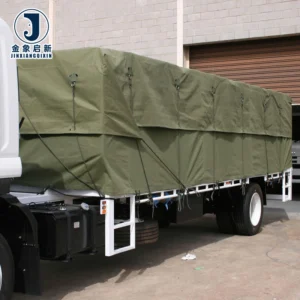
A Heavy Duty Canvas Tarpaulin for Truck Cover on a flatbed or curtain-side trailer endures a combination of forces that stationary covers never see: aerodynamic lift at highway speed, rhythmic vibration from road surface irregularities, and repeated manual tensioning each time the driver secures the load. The polyester-cotton base with 8–12 strand fine cotton yarn construction provides the tear resistance needed when the fabric flexes around uneven cargo profiles. Rust-proof aluminum eyelets at 1-meter intervals along the hem and corners align with standard ratchet strap and bungee tie-down systems, distributing holding force across a wider section of the reinforced edge rather than concentrating it at a single grommet.
Fabrication to Match Your Trailer Model
Generic-sized truck covers force operators into compromises: excess fabric that flaps in the wind, or insufficient overlap that leaves the load’s rear corners exposed to spray. This canvas truck cover tarpaulin is fabricated to the dimensional profile of specific trailer models — flatbed length and width, curtain-side drop depth, tipper body geometry — so the finished cover seats correctly without tension gaps or material bunching. Custom sizing also extends to eyelet placement; if your fleet uses a track-based tie-down system with fixed anchor points, the eyelet spacing can be adjusted to match those positions exactly rather than relying on the standard 1-meter interval [NEED_CITE: fleet tie-down system anchor spacing standards for commercial trailers].
How Weight, Weave and Lamination Interact in the Field
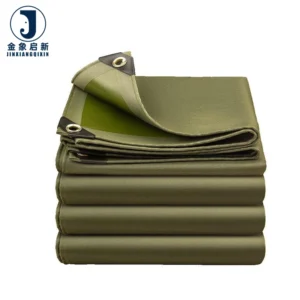
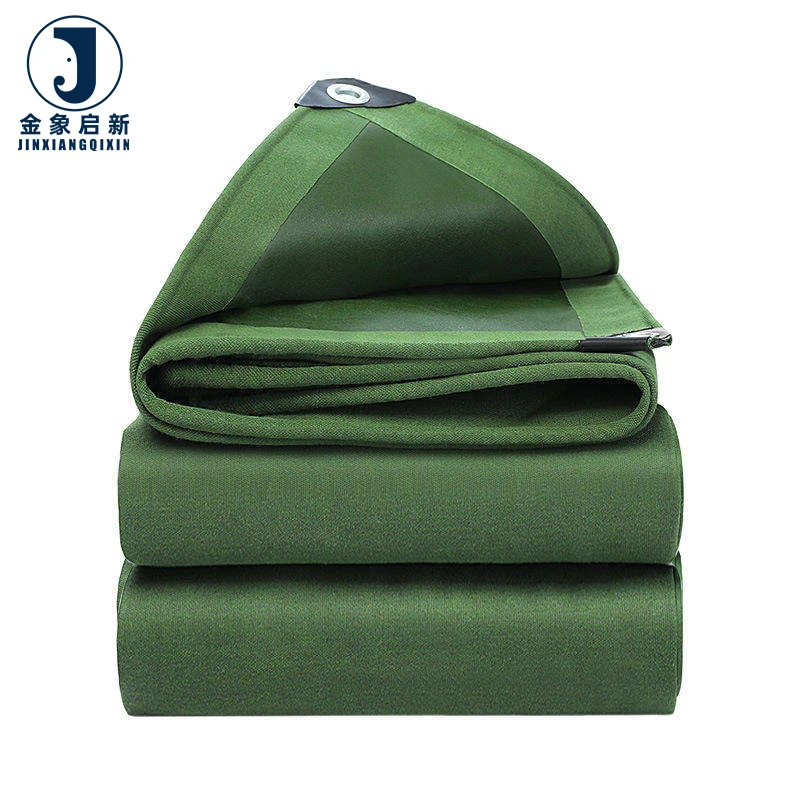
The 600gsm weight of this material reflects the combined mass of the polyester-cotton base fabric and the laminated PVC coating layers — not the coating alone. The 8–12 strand fine cotton yarn weave creates a high-density upper face that contributes the majority of the tensile and tear strength, while the laminated PVC backing adds waterproof integrity and anti-mildew protection. Lamination, as opposed to knife-over-roll coating, bonds the PVC film to the base fabric under heat and pressure, producing a consistent coating thickness across the 2m roll width. This consistency matters when the fabric is heat-welded at the seams: uniform coating weight means predictable welding temperatures and reliable bond strength. The three available thickness options — 0.5mm, 0.6mm and 0.7mm — allow you to match the material to the duty cycle; a curtain-side application that flexes continuously may favour the lighter option for flexibility, while a flatbed top cover exposed to abrasion from heavy machinery loads may benefit from the additional coating mass of the 0.7mm grade.
What Happens When the Specification Is Wrong for the Trailer
Selecting a canvas truck cover tarpaulin without confirming how the finished cover will actually be used on the vehicle leads to predictable, costly failures. A cover specified too thin for a tipper trailer carrying aggregate will abrade through at contact points within the first season. A cover supplied without verifying UV treatment on a test basis will degrade unevenly across sun-exposed and shaded panels, creating visible colour and strength differentials across the same vehicle [NEED_CITE: UV degradation test standards for PVC coated fabrics in transport applications]. A cover fabricated to a generic size rather than the specific trailer model wastes material on excess overlap or, worse, leaves the rear load edge uncovered during rain. These are not manufacturing defects — they are specification errors made before production begins, and they compound across an entire fleet replacement programme.
Why Procurement Teams Source This Canvas Tarpaulin Here
Three full production lines and 36 sets of professional equipment support bulk roll output with consistent on-time delivery for fleet-scale orders. A dedicated 10-person R&D team handles custom sizing, pattern requirements and sample development, producing samples within days rather than weeks for trailer-specific cover dimensions. Every production stage — from base fabric weaving through coating lamination to eyelet insertion — has dedicated QA/QC oversight, with 100% inspection before shipment rather than batch sampling. The 600gsm weight stated on your quotation is verified on the finished roll and documented before dispatch, eliminating the common discrepancy between quoted and delivered GSM. ISO and CE certified processes underpin the entire production workflow, and export documentation for markets across North America, Europe and Asia is handled as standard.
Documentation & Verification
- Material specification sheet confirming base fabric construction, 600gsm weight and PVC lamination method per roll
- Pre-shipment inspection record verifying GSM, colour and dimensional accuracy against the purchase order
- Roll packing list with individual roll identification for traceability across multi-roll fleet orders
- Certificate of origin and customs documentation prepared for your destination market requirements
- UV or flame retardant test reports provided where treatment grade has been confirmed and specified on the order
Fabrication, Handling & Storage
- Heat-weld seams at temperatures matched to the PVC lamination thickness to maintain bond integrity at flex points
- Reinforce all eyelet positions with the poly-rope sewn hem to prevent tearing under ratchet strap tension
- Store 2m × 100m rolls upright on end cores to prevent flat-spot deformation of the laminated surface
- Avoid folding the 600gsm canvas at sharp angles during cold-weather handling to prevent coating cracking
- Clean with mild detergent and soft brush; avoid solvent-based cleaners that attack the PVC lamination bond
- Plan cutting layout across the 2m roll width to minimise off-cuts and seam joints on large trailer covers
What We Need to Quote Your Cover Accurately
To specify this canvas truck cover tarpaulin correctly for your application, share the trailer make and model or the exact cover dimensions required, including drop depth for curtain-side applications. Indicate your tie-down system type so eyelet spacing and hem reinforcement can be matched to your anchor points. If your operating region requires UV or flame retardant certification, state the test standard or grade your market demands so the correct treatment and documentation can be included from the outset.
Frequently Asked Questions
Q: How is the 600gsm weight verified before shipment?
A: Every roll is weighed and measured during the pre-shipment inspection stage. The actual GSM is recorded against the quoted 600gsm value and documented in the inspection report provided with your dispatch. This eliminates the common problem of material arriving lighter than agreed — the weight you see on paper matches the weight on the roll.
Q: Can the tarpaulin be cut to fit my specific trailer model?
A: Yes. Custom sizing is available to match your exact trailer dimensions, including flatbed length and width, curtain-side drop depth and tipper body profiles. Provide the vehicle model or dimensional drawings, and a dimensional confirmation is sent for your approval before production begins.
Q: What UV test basis applies to this canvas tarpaulin?
A: UV resistance treatment is available, but the specific test basis and grade should be confirmed for your market and exposure conditions. Request a UV test report specifying the standard used so your technical team can verify suitability for your regional climate and fleet operating environment.
Q: How are the seams built to handle load flex stress?
A: Seams are folded, welded and then sewn with poly rope reinforcement. This three-stage construction distributes tension across a wider zone at the hem, preventing the single-point failures that occur when load flex concentrates stress at a standard welded join alone.
Q: What eyelet options are available for different tie-down systems?
A: Standard specification includes rust-proof aluminum eyelets at 1-meter intervals along the hem and at corners. If your fleet uses a track-based or fixed-anchor tie-down system, eyelet spacing can be adjusted to match your anchor positions exactly.