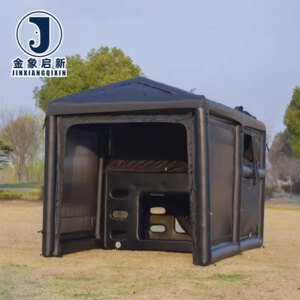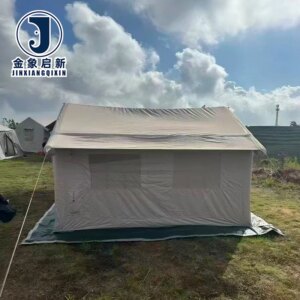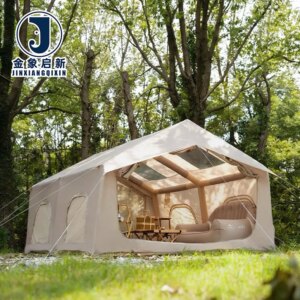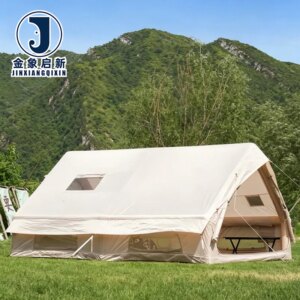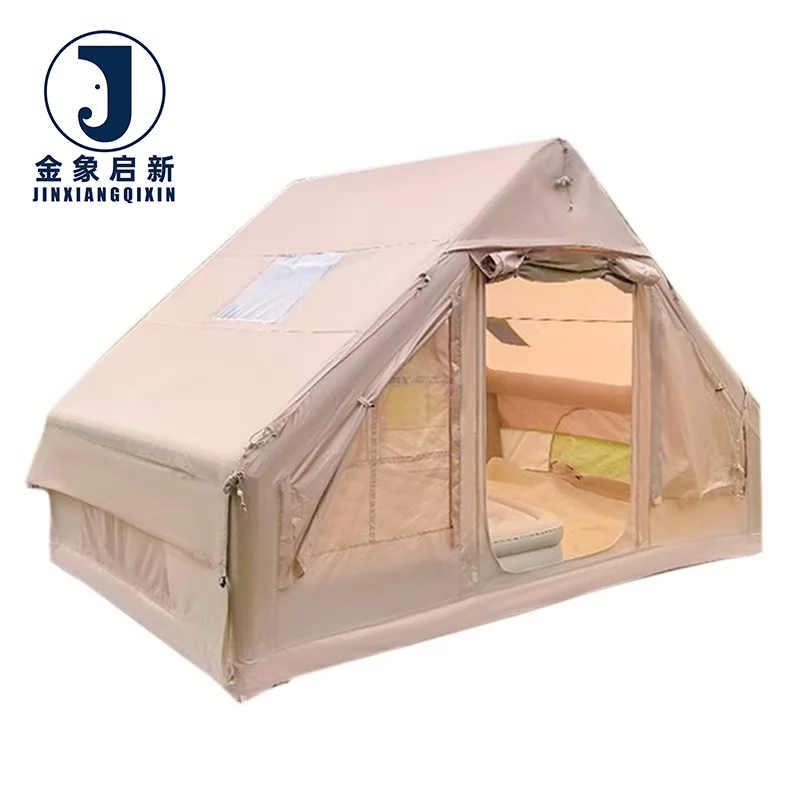
Precision Coating Control — Three dedicated production lines maintain consistent GSM and adhesion across every roll of inflatable tent fabric, verified at each stage before dispatch to fleet staging sites.
Technical Specifications
| Parameter | Value |
|---|---|
| Product Type | Inflatable Tent |
| Core Material | PVC tarpaulin |
| Product Form | Inflatable structure with quick automatic opening |
| Waterproofing | Fully waterproof coated construction |
| UV Resistance | Available in UV-resistant grades — confirm the grade required for your transport yard exposure |
| Tear Resistance | Tear-resistant fabric construction (grade not stated in source) |
| Customization | OEM & ODM with sample customization and pattern printing |
| Production Facility | 9,180 m² with 3 full production lines |
| Processing Equipment | 36 sets of professional processing equipment |
| R&D Support | 10 technicians handling material selection and sample development |
| Certifications | ISO 9001, ISO 14001, ISO 45001, CE |
Application Suitability
| Application | Exposure & Requirement |
|---|---|
| Temporary crew shelters at truck staging yards | Constant UV exposure, repeated inflation and deflation cycles, road dust and spray |
| Rapid-deploy emergency logistics tents | Fast setup under time pressure, variable weather, frequent relocation between sites |
| Mobile equipment covers at outdoor transport hubs | Prolonged sun and rain exposure, abrasion from industrial handling, wind load at anchor points |
| Auxiliary storage alongside loading docks | Moisture ingress risk, forklift and pallet contact, daily temperature fluctuation |
Why Quick Deployment Matters More Than Fabric Weight Alone
Inflatable Tent Fabric for truck and transport application must prioritize rapid structural integrity over raw GSM figures.
Fleet operators lose measurable revenue every minute a staging shelter takes to erect. Conventional frame tents require multiple crew members, mechanical assembly and tensioning sequences that stretch setup into half-hour windows at each stop. Inflatable fabric structures eliminate that labour bottleneck entirely — the membrane inflates and holds shape within minutes, freeing personnel to manage cargo movement instead of pole assembly [NEED_CITE: rapid deployment shelter standards for logistics operations]. The critical variable is not how heavy the PVC tarpaulin is, but how reliably the welded air chambers maintain pressure under sun load and wind shear at the transport yard.
Air Chamber Weld Integrity Under Transport Yard Conditions
The inflation tubes built into inflatable tent fabric carry internal pressure that places continuous stress on every welded seam. At outdoor logistics hubs, midday UV exposure raises membrane surface temperature significantly, softening the PVC coating and testing weld adhesion precisely when structural rigidity matters most. Inflatable Tent Fabric for truck and transport application must deliver seam strength that matches or exceeds the base fabric tear resistance, because a burst chamber renders the entire shelter unusable regardless of how durable the surrounding material remains. Our R&D team evaluates weld parameters against the specific PVC formulation used in each production run rather than applying a single heat-setting across all grades.
Repeated Inflation Cycles and Coating Adhesion
Each inflation and deflation cycle flexes the PVC tarpaulin at fold points and chamber junctions. After dozens of deployments at roadside operations and staging areas, coating delamination can begin at these stress concentrations if the base fabric adhesion was insufficiently controlled during manufacturing. Our 36 sets of processing equipment allow us to adjust coating weight and curing conditions to match the flex demands of inflatable structures, where the fabric must recover its shape repeatedly without developing micro-cracks along the coating interface [NEED_CITE: coating adhesion test methods for inflatable coated fabrics]. This process control directly determines how many deployment cycles the shelter survives before maintenance or replacement becomes necessary.
Reading the Specification Sheet Beyond GSM
Weight per square metre tells you how much PVC coating sits on the base fabric, but it does not tell you how that coating was applied or what base fabric construction lies underneath. A knife-coated PVC tarpaulin achieves higher peel strength between coating and substrate compared to laminated alternatives, which directly influences how well welded seams hold during inflation. Base fabric denier and warp-weft density determine how tear forces distribute across the membrane — a high-density weave arrests tear propagation more effectively than a loose construction of equivalent weight. For inflatable tent structures, these interactions matter more than a standalone GSM figure because the air chamber geometry concentrates stress at curved junctions where coating adhesion and tear resistance must work together [NEED_CITE: tensile and tear test methods for coated fabrics per ISO 1421].
The Cost of Overlooking Batch Consistency in Fleet Orders
When a transport operator orders inflatable shelters for multiple staging locations, receiving rolls with visible colour variation between batches forces an impossible choice — accept mismatched branding across the fleet or delay deployment while replacements ship. Similarly, if GSM on arrival falls below the quoted specification, the air chambers may not reach design pressure, causing the structure to sag under its own weight in warm conditions. Weld failures at inflation stress points compound these issues because a single burst tube takes the entire shelter offline. These outcomes trace back to insufficient in-process quality control during coating and finishing, not to the material specification itself [NEED_CITE: pre-shipment inspection protocols for coated fabric batches].
Why Source Inflatable Tent Fabric From This Facility
Three full production lines dedicated to coated fabric give us the capacity to fulfil bulk fleet orders without compressing lead times on custom widths or colours. The 10-technician R&D team develops inflatable structure samples within days, adjusting PVC formulation and weld parameters to your specific chamber geometry before bulk production begins. Every roll passes through dedicated QA and QC checkpoints where coating weight, adhesion strength and colour consistency are verified against the order specification. Our 9,180 m² facility houses 36 sets of processing equipment configured for PVC tarpaulin coating, allowing us to hold tight tolerances on inflatable-grade material that generic tarpaulin lines cannot maintain. ISO 9001 and CE documentation accompanies each dispatch for compliance verification at your procurement office.
Documentation & Verification
- Material specification sheet stating PVC tarpaulin composition, coating type and treatment grades per batch
- UV and tear-resistance test reports matched to the batch number supplied with your inflatable tent order
- ISO 9001 and CE certificates included with each shipment for commercial tender compliance
- Pre-shipment inspection record confirming GSM and colour consistency across all rolls in the order
- Roll packing list with individual roll identification for traceability at your transport hub
Fabrication, Handling & Storage
- Set heat-sealing temperature to match the specific PVC tarpaulin coating grade used in your inflatable chambers
- Reinforce inflation anchor points with additional PVC patches welded at controlled temperature to prevent peel failure
- Store rolls upright in shaded conditions to prevent flat-spot deformation of the coated surface
- Allow membrane to reach ambient temperature before inflation in cold conditions to avoid coating crack risk
- Clean with pH-neutral detergent only to preserve the UV-resistant surface treatment on the PVC tarpaulin
- Cut pattern pieces accounting for weld allowance at chamber seams to maintain designed inflation geometry
Requesting a Production Quote
To specify Inflatable Tent Fabric for truck and transport application accurately, share your inflation chamber dimensions, expected deployment frequency and the UV exposure conditions at your staging sites. Let us know whether you require rolls for your own fabrication or finished cut-and-welded shelter panels ready for assembly. If your fleet demands specific colour coding or printed branding across multiple units, provide the Pantone references and quantity per variant so we can plan batch-consistent production runs.
Frequently Asked Questions
Q: How is GSM verified on arrival — do you provide roll-level weight data with each shipment?
A: Each roll in your inflatable tent order ships with a weight verification record showing the measured GSM against the quoted specification. Our QA team samples every roll during pre-shipment inspection and logs the data on the dispatch documentation, so you can confirm the PVC tarpaulin coating weight matches what was agreed before the material reaches your transport staging site.
Q: What UV test basis supports the anti-UV claim for outdoor transport-yard exposure?
A: UV resistance grades are available with corresponding test reports that document the exposure protocol and results. Request the specific test basis that matches your regional climate requirements when placing your order, and we will supply the relevant report with your Inflatable Tent Fabric for truck and transport application shipment so your procurement team can verify compliance.
Q: Can custom widths and lengths be produced for specific inflatable shelter frame sizes?
A: Our production lines handle custom widths and cut lengths for inflatable tent structures. Provide your chamber dimensions and required roll lengths during the inquiry stage, and our R&D team will develop a sample cut to your specifications. Once approved, bulk production follows the same PVC tarpaulin coating and quality inspection process as standard grades.
Q: How is batch-to-batch colour consistency controlled when multiple rolls supply one fleet order?
A: We formulate PVC coating batches to a single colour reference for each fleet order and verify shade consistency during in-process QA. Rolls are grouped by production batch on the packing list, and pre-shipment inspection compares colour across all rolls before dispatch, ensuring your inflatable shelters present a uniform appearance across all transport hub locations.
Q: What reinforcement options are available at high-stress inflation anchor points?
A: We can supply inflatable tent fabric with reinforced patches welded at specified anchor locations during fabrication. Share your inflation pressure requirements and tie-down geometry so our R&D team can position PVC tarpaulin reinforcement patches at the chamber junctions where stress concentrates, reducing the risk of peel failure during repeated deployment cycles.