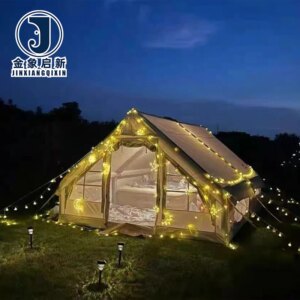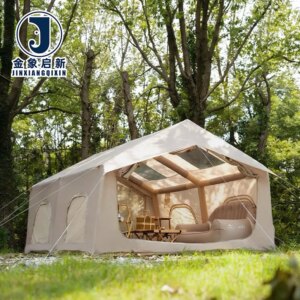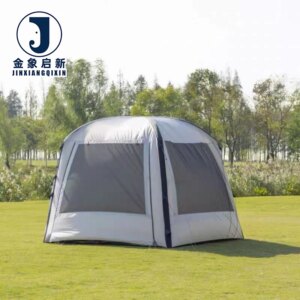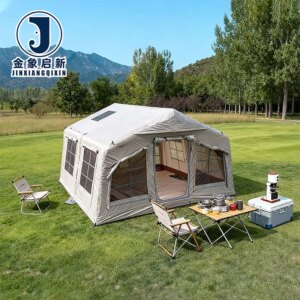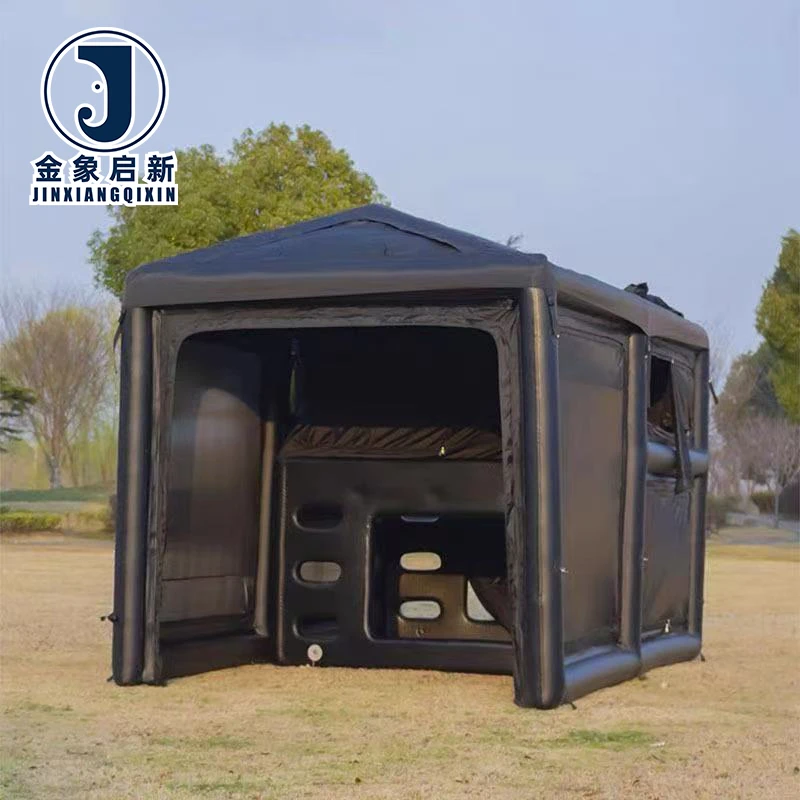
Production Consistency at Scale — 36 sets of professional coating and welding equipment maintain batch-to-batch colour and thickness uniformity across every roll in your inflatable tent production run.
Technical Specifications
| Parameter | Value |
|---|---|
| Product Type | Inflatable Tent Fabric |
| Core Material | PVC Knife-Coated Tarpaulin |
| Hydrostatic Head | ≥ 5000mm |
| UV Treatment | UPF 50+ (test basis not stated — confirm certification required for your market) |
| Flame Retardant Grade | EN 13501-1 Class B |
| Tear Strength | ≥ 300N (test standard not stated — verify against ISO 1421 or equivalent) |
| Anti-Static Surface Resistance | 10⁶–10⁹ Ω |
| Material Thickness Range | 0.4mm–1.2mm (available across the product family — specify the grade for your application) |
| Inflation Pressure Retention | Sustained 24-hour pressure retention tested |
| Key Features | Waterproof, UV-resistant, tear-resistant, fire-retardant, anti-static |
Application Suitability
| Application | Exposure & Requirement |
|---|---|
| Commercial inflatable camping shelters | Repeated inflation cycles, flex stress at welded seams, four-season weather exposure |
| Construction site temporary pressurised enclosures | Fire safety compliance on active sites, dust and debris abrasion, anti-static requirements |
| Outdoor event and expedition-grade equipment | Sustained internal pressure, high UV exposure, transport and packing wear |
| Specialist air-supported membrane structures | Continuous inflation load, wind-induced fabric movement, regulatory fire classification |
Why Inflatable Tent Fabric Demands More Than a Waterproof Claim
Airtight seam integrity at every weld line is what separates shelter fabric from general-purpose tarpaulin.
When inflatable structures lose pressure overnight, the failure almost always traces back to the weld zone rather than the base fabric. Coated fabrics that perform adequately as truck covers or pond liners behave differently under sustained internal inflation pressure, where the seam carries cyclic stress that peaks at every flex point. [NEED_CITE: weld seam failure modes in inflatable membrane structures per EN 13501-1 testing protocols] Buyers sourcing inflatable tent fabric for camping equipment lines discover too late that a material rated for static cover applications cannot hold pressure through repeated inflation and deflation cycles without the coating delaminating at the heat-welded joint.
Heat-Weld Integrity Under Inflation Load
Inflatable tent fabric for camping structures must transfer inflation pressure evenly across the entire panel surface, concentrating mechanical demand at every welded seam. PVC knife-coated construction produces a homogeneous coating layer that melts uniformly under hot-air or high-frequency welding, creating a bond that matches the tear resistance of the base fabric itself. This consistency matters when a commercial shelter remains inflated for days in variable wind conditions, where panel flexing repeatedly loads the weld line.
Roll-to-Roll Consistency Across Production Batches
Equipment manufacturers running continuous production cannot tolerate colour variation or thickness deviation between rolls delivered in the same shipment. Every roll of this inflatable tent fabric for camping applications passes dimensional and visual inspection before dispatch, ensuring that panels cut from different rolls produce a uniform finished product. Batch traceability records allow you to match any field complaint back to the specific production run and coating parameters used. [NEED_CITE: batch consistency standards for coated technical textiles in manufacturing supply chains]
Understanding the Specification Stack
The interplay between base fabric denier, coating weight, and total thickness determines how inflatable tent fabric behaves under sustained pressure. A heavier coating does not automatically mean better inflation retention if the base fabric lacks sufficient tensile strength to resist stretching. PVC knife-coated application builds the coating layer by layer directly onto the woven polyester substrate, achieving higher adhesion strength than laminated alternatives and producing a surface that accepts heat welding without delamination risk. The hydrostatic head rating of ≥ 5000mm ensures waterproof performance well beyond typical rainfall intensity, while EN 13501-1 Class B fire classification satisfies the regulatory requirements of most European and international commercial shelter markets. Anti-static treatment in the 10⁶–10⁹ Ω surface resistance range addresses safety requirements on industrial and construction sites where dust accumulation or electronic equipment proximity demands controlled conductivity. Tear strength of ≥ 300N provides the damage tolerance needed when inflated panels contact sharp ground surfaces or packing hardware during deployment.
The Cost of Overlooking Weld Compatibility
Fabric that performs perfectly in flat-cover applications can fail systematically when fabricated into inflatable structures. Coating formulations optimised for flexibility at low temperatures may soften excessively under hot-air welding, producing uneven seam thickness and pressure leaks that only appear after the structure is fully inflated and loaded. [NEED_CITE: coating formulation compatibility with high-frequency welding processes for inflatable fabrics] Manufacturers who skip pre-production weld testing on their specific equipment settings risk discovering seam failures during prototype inflation trials, delaying product launch and forcing a complete material requalification. Colour inconsistency across rolls in a single order becomes visible only when panels from different rolls are welded side by side on the finished shelter, triggering rejection of an entire production batch.
Why Source This Fabric Through Jinxiang
Nearly 30 years of coated fabric production have built process control over coating weight and adhesion that directly affects how inflatable tent fabric performs at the weld line. Three full production lines and 36 sets of specialised equipment support the volume requirements of commercial equipment manufacturers without sacrificing the batch consistency that inflatable structures demand. A 10-person R&D team develops samples within days, adjusting thickness, colour and surface treatment to match your specific inflation pressure and welding parameters. Dedicated quality control at every production stage, with 100% pre-shipment inspection, catches coating defects and dimensional deviations before they reach your cutting table. Full documentation accompanies every dispatch, from material specification sheets to batch-specific test reports, giving your compliance team the evidence needed for market certification.
Documentation & Verification
- Material specification sheet confirming PVC coating weight, base fabric construction, and thickness grade per roll
- EN 13501-1 Class B fire test report and anti-static surface resistance certificate included with each shipment
- Batch-specific dimensional inspection records verifying width, length and colour consistency before dispatch
- Pre-production sample approval documentation with 5-year batch traceability records
- ISO 9001, ISO 14001, ISO 45001 and CE compliance certificates accompanying all commercial dispatches
Fabrication, Handling & Storage
- Hot-air weld temperature and speed settings must be calibrated to the specific PVC knife-coated thickness grade being joined
- High-frequency welding produces the most consistent seam integrity on inflatable panels under sustained internal pressure
- Store rolls vertically on padded racks to prevent permanent creasing that compromises inflation panel flatness
- Allow cold-stored rolls to reach ambient temperature before unrolling to avoid coating micro-cracking at flex points
- Cut patterns should account for seam allowance width specific to the inflation pressure and panel geometry of your design
- Surface cleaning with mild detergent preserves the UPF 50+ treatment and anti-static coating layer
What We Need to Quote Accurately
Provide the inflation pressure your shelter design operates at, the target market fire classification you must satisfy, and the annual volume in linear metres. Specify whether you require rolls in stock widths or custom slit dimensions, and confirm the colour reference or print artwork for your brand application. Sample rolls for weld testing on your fabrication equipment are available before any bulk commitment is required.
Frequently Asked Questions
Q: What fire safety classification does this inflatable tent fabric hold?
A: The fabric is certified to EN 13501-1 Class B, which satisfies fire safety requirements across most European commercial and construction-site shelter markets. Test documentation is included with every shipment. If your target market requires a different classification such as NFPA 701 or M2, confirm the specific standard with our team before ordering so we can verify compliance or recommend an alternative grade.
Q: How is anti-static performance verified for industrial site use?
A: Surface resistance is measured in the 10⁶–10⁹ Ω range, addressing static discharge requirements on construction sites and industrial environments. Batch-specific test reports accompany each shipment. If your site safety plan specifies a narrower resistance window or a particular test method, provide those parameters during the inquiry stage so we can confirm the material meets your exact compliance requirement.
Q: What thickness options are available and how do they affect inflation performance?
A: Thickness is available from 0.4mm to 1.2mm across the product family, with the appropriate grade depending on your shelter’s operating pressure and panel size. Heavier grades provide greater structural rigidity and puncture resistance but require higher inflation pressure. Our R&D team can recommend the optimal thickness based on your design specifications and provide sample material for prototype inflation testing.
Q: Can you match custom colours and maintain consistency across production runs?
A: Custom colour matching and pattern printing are available through our OEM and ODM service, with samples developed within days for your approval. Roll-to-roll colour consistency is verified at every production stage through dedicated quality control inspection. Batch traceability records ensure that any future reorder can be matched to your original colour reference with documented verification.
Q: Do you provide sample material for weld testing before bulk orders?
A: Pre-production samples are supplied for weld compatibility testing on your specific fabrication equipment, allowing you to optimise hot-air or high-frequency welding parameters before committing to a bulk order. The sample includes the same PVC knife-coated construction and thickness grade as the production material, ensuring your test results translate directly to full-scale manufacturing.