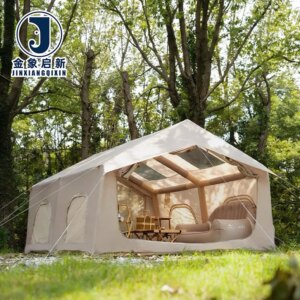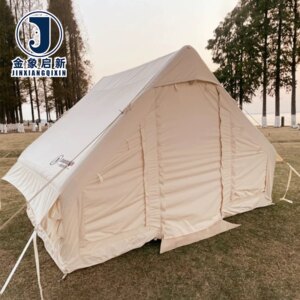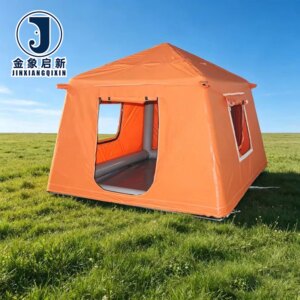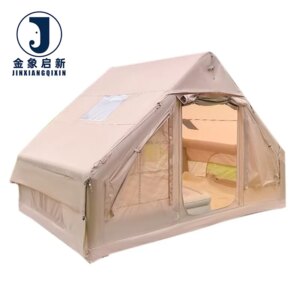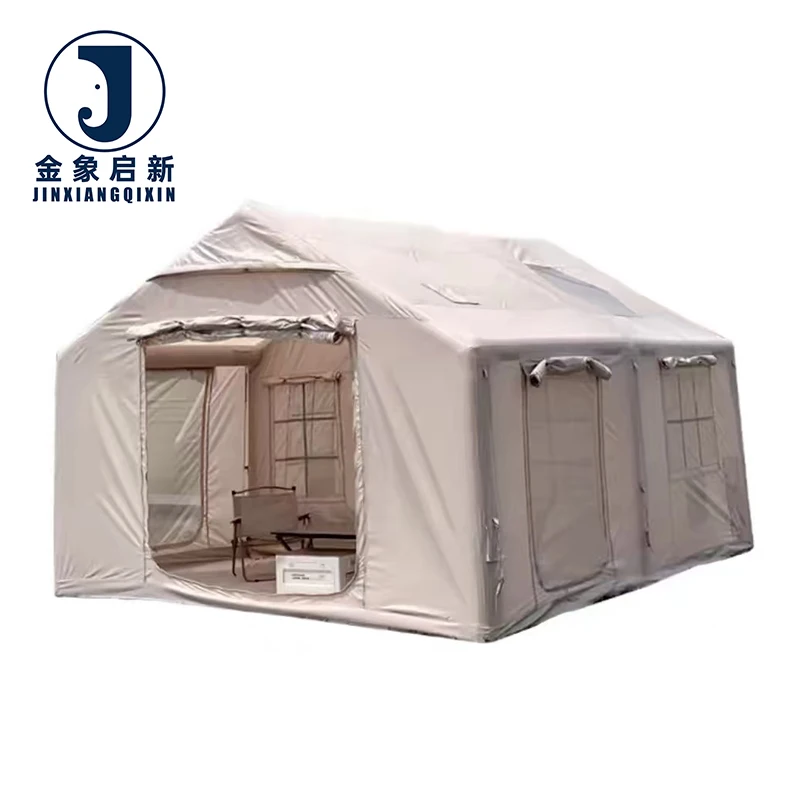
Technical Specifications
| Parameter | Value |
|---|---|
| Product Type | Inflatable Tent Fabric |
| Core Material | PVC tarpaulin |
| Key Performance | UV protection (test basis not stated in source), waterproof, tear-resistant, automatic inflatable |
| Product Forms | 3-5 person capacity, four-season design, single layer construction, extended type |
| Customization Service | OEM & ODM, sample customization, pattern printing |
| Certifications | ISO9001, ISO14001, ISO45001, CE |
Application Suitability
| Application | Exposure & Requirement |
|---|---|
| Roadside emergency shelter for breakdown crews | Constant deployment and folding, high UV exposure, rapid inflation stress |
| Temporary weather cover for exposed cargo | Wind load, rain ingress prevention, abrasion from shifting loads |
| On-site command or rest point for long-haul fleets | Extended outdoor exposure, temperature variations, heavy foot traffic |
Why Generic Covers Fail Where Inflatable Structures Succeed
Generic-sized covers that fail at flex points cost fleet operators downtime — this inflatable tent deploys in minutes to shield cargo and crew at any stop.
When a transport fleet faces an unexpected breakdown or a sudden weather shift, the time spent rigging a traditional tarpaulin with ropes and poles is time lost. I have seen heavy-grade coated rolls fail at the weld line simply because the tension was applied unevenly during a manual setup. An inflatable tent for truck and transport emergency shelter eliminates the mechanical stress of tie-downs by using internal air pressure to maintain its shape. [NEED_CITE: tensile and tear test methods for coated fabrics per ISO 1421]. The automatic inflatable structure ensures that the PVC tarpaulin is stretched to its optimal tension without the risk of human error or over-tightening at the grommets.
Rapid Deployment Architecture for Transport Fleets
The primary advantage of this inflatable tent for truck and transport emergency shelter is the speed of deployment. In a logistics environment, a delay of thirty minutes can disrupt a delivery schedule that affects multiple downstream receivers. The automatic inflatable system allows a single operator to establish a weatherproof workspace or cargo cover in a fraction of the time required for pole-based structures. This efficiency is critical when managing roadside repairs or temporary storage during transit delays.
Structural Integrity Under Inflation Stress
The single-layer construction is engineered to balance transport weight with the necessary tear resistance. When the internal bladder is pressurized, the PVC tarpaulin core must withstand significant outward force, particularly at the seams and corners. Our production process focuses on high-frequency welding to ensure the seams do not fail before the fabric itself. [NEED_CITE: welded seam integrity standards for inflatable PVC structures]. This is vital for fleet operators who need a reliable shelter that will not collapse under wind load or internal pressure fluctuations.
Decoding PVC Tarpaulin Performance in the Field
The effectiveness of this inflatable tent relies on the relationship between the base fabric denier and the coating weight. While the core material is PVC tarpaulin, the tear resistance is dictated by the weave density of the underlying scrim. A higher denier yarn provides the structural skeleton that prevents a small puncture from propagating into a catastrophic rip during inflation. The UV protection treatment is applied to the coating surface to mitigate polymer degradation, though the specific test basis is not stated in the source and should be confirmed for your regional exposure levels. The single-layer design minimizes the overall weight, which is a crucial factor for transport fleets where every kilogram of emergency equipment reduces the available payload capacity.
The Hidden Costs of Incorrect Fabric Selection
Sourcing a shelter based solely on price often leads to premature failure at the inflation stress points. I have seen heavy-grade coated rolls fail at the weld line because the material was too stiff to fold repeatedly without cracking the PVC coating. Conversely, a material that is too light will not hold the air pressure required to maintain the roof pitch, leading to water pooling and eventual collapse. Batch consistency is another major risk; if the PVC formulation varies between rolls, the heat-sealing parameters will not be uniform, resulting in weak seams that leak air. [NEED_CITE: impact of coating adhesion on inflatable bladder performance]. These failures typically occur when the shelter is needed most, during extreme weather or emergency situations.
Why Procure This Inflatable Shelter From Jinan Jinxiang
- Specialized Process Control: Nearly 30 years of experience in coated fabric allows for precise control over the PVC coating weight, ensuring the material remains flexible enough for repeated inflation cycles.
- Customization Capability: A 10-person R&D team handles pattern printing and custom sizing, allowing fleet operators to brand their emergency shelters for high-visibility identification.
- Production Capacity: Three full production lines and 36 sets of professional equipment ensure that bulk orders for large fleets are delivered with consistent quality across every unit.
- Quality Assurance: Dedicated QA/QC staff perform 100% inspection before shipment, verifying that every inflatable bladder holds pressure and every seam is free of leaks.
Documentation & Verification
- Material specification sheet stating PVC base fabric denier and coating weight.
- Batch-level test report available by order number for UV and physical properties.
- Pre-shipment inspection record verifying inflation integrity and seam strength.
- CE and ISO certificates supplied with dispatch documentation for customs clearance.
Fabrication, Handling & Storage
- Use high-frequency welding for seams to ensure airtight integrity in the PVC tarpaulin.
- Store the deflated tent in a cool, dry place to prevent the PVC coating from adhering to itself.
- Avoid dragging the single-layer construction over sharp gravel to prevent surface punctures.
- Clean with mild soap and water; avoid solvents that may degrade the UV protection treatment.
- Inspect the inflation valve mechanism regularly to ensure it remains free of debris and corrosion.
Inquiry Guidance for Fleet Procurement
To provide an accurate recommendation for your fleet’s emergency shelter requirements, please specify the typical operating environments and the expected frequency of deployment. Let us know if you require custom pattern printing for fleet branding or specific dimensions to fit standard pallet sizes. We also need to know your target market’s compliance requirements regarding UV stability and fire safety to ensure the material specification matches your local regulations.
Frequently Asked Questions
Q: How can I verify the PVC material grade and coating weight upon arrival?
A: We provide a material specification sheet with every shipment that details the base fabric denier and the exact coating weight. You can perform a simple weight check by cutting a known area of the fabric and comparing it to the stated GSM. Our pre-shipment inspection records also include these measurements for your specific batch.
Q: What is the basis for the UV protection claim and its impact on service life?
A: The UV protection is integrated into the PVC formulation to resist polymer breakdown under sunlight. However, the specific test basis is not stated in the source document. We recommend requesting a batch-level test report to verify the UV stabilizer concentration and discussing your local solar radiation levels with our R&D team to ensure suitability.
Q: Can the inflatable tent be customized with our company logo or specific colors?
A: Yes, our 10-person R&D team supports OEM and ODM services, including pattern printing and custom sizing. We can match your fleet’s corporate colors and apply durable branding that withstands the folding and unfolding cycles associated with emergency shelter deployment.
Q: How do you ensure the welded seams do not fail during inflation?
A: We use specialized high-frequency welding equipment and conduct 100% inspection of all seams before dispatch. Our QA team tests the inflation integrity of every unit to ensure the seams can withstand the internal pressure required for the four-season design without leaking or separating.