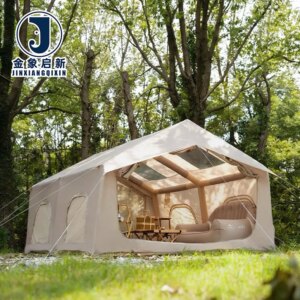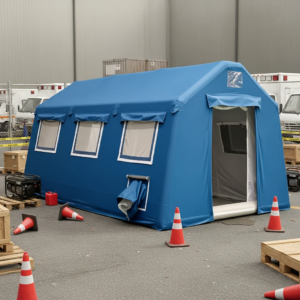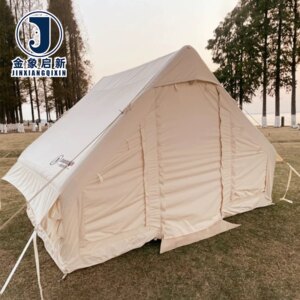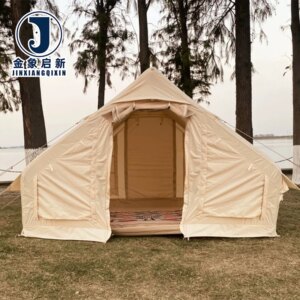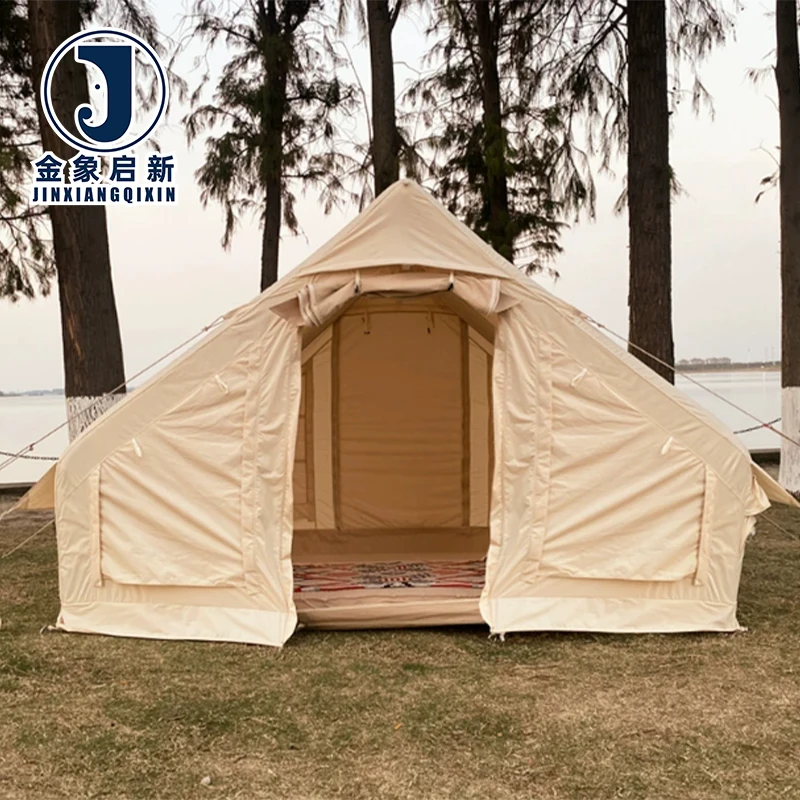
Proven Coating Expertise — Nearly 30 years focused on PVC coated fabric with deep process control over coating weight and adhesion, ensuring consistent material performance across every inflatable tent produced.
Technical Specifications
| Parameter | Value |
|---|---|
| Product Type | Inflatable Tent |
| Core Material | PVC Tarpaulin |
| Key Performance | Waterproof, Windproof, Quick Automatic Opening, 4-Season Design |
| Product Forms | Extended Type, Single Layer Construction |
| Customization Service | OEM & ODM (sample customization, pattern printing) |
| Production Facility Area | 9,180 m² |
| Production Lines | 3 full production lines |
| Processing Equipment | 36 sets |
| R&D Team Scale | 10 technicians |
| Quality Control System | Strict full-process quality inspection with dedicated QA&QC staff |
| Standards | ISO9001, ISO14001, ISO45001, CE |
Application Suitability
| Application | Exposure & Requirement |
|---|---|
| Emergency response command centers | Rapid deployment under severe weather, need for stable pressurized structure and reliable air retention |
| Temporary storage facilities for relief supplies | Continuous waterproof protection, wind load resistance, UV exposure in open staging areas |
| Equipment maintenance shelters in disaster zones | Abrasion from ground contact, chemical and fuel exposure, repeated inflation and deflation cycles |
| Temporary workspace for engineering teams | All-season thermal stability, windproof envelope, quick setup without heavy equipment |
When Generic Tent Dimensions Fail the Fleet on the Road
A truck cover cut to a generic size that does not fit the specific trailer model is a shelter that fails before it deploys.
Fleet operators and transport builders routinely source inflatable shelters based on standard size charts, only to discover at the breakdown site that the footprint does not clear the axle, the entrance does not align with the loading bay, or the height interferes with overhead crane clearance. The cost is not the tent itself — it is the hours lost while crews improvise a workaround in rain or freezing wind [NEED_CITE: field reports on emergency shelter sizing failures in transport logistics]. A PVC Inflatable Tent aftermarket supplier that offers OEM/ODM dimension matching eliminates this gap by developing tent geometry from the actual vehicle or site drawing, not from a catalog default.
How OEM/ODM Matching Works for Transport-Linked Shelters
Every PVC Inflatable Tent for truck and transport operations starts with the deployment scenario. Our 10-technician R&D team reviews the trailer outline, axle clearance, door positions, and ground conditions before proposing a tent footprint. Sample units are produced within days so the buyer can verify fit on an actual vehicle before committing to full-scale production.
Pattern Printing and Branding Without Compromising Fabric Integrity
Transport companies and relief agencies frequently require fleet logos, hazard markings, or agency identifiers printed on the tent exterior. Pattern printing on PVC tarpaulin demands ink adhesion that survives repeated folding and inflation pressure cycles. We validate print bonding during sample approval, confirming that the PVC Inflatable Tent for truck and transport use retains legibility through deployment and repacking [NEED_CITE: adhesion testing methods for printed PVC coated fabrics].
Reading the Specs That Actually Govern Shelter Performance
GSM alone does not define how a PVC Inflatable Tent will behave under wind load or inflation pressure. The base fabric denier and weave density determine tensile and tear resistance, while the coating weight and method govern air retention and weld strength. A single layer extended type construction keeps packed volume manageable for vehicle-mounted kits, yet the coating must maintain peel strength through the heat-welded seams that form the air chambers. Waterproof and windproof ratings depend on both the PVC formulation and the seam construction technique — a spec sheet listing only GSM leaves the buyer guessing at the structural margins [NEED_CITE: relationship between coating weight and seam peel strength in inflatable fabric structures]. The 4-season design designation means the PVC compound retains flexibility at low temperatures without becoming brittle, and resists softening at elevated ambient heat.
What Specification Mismatches Cost in the Field
When an inflatable tent arrives with a lower coating weight than quoted, the air chambers lose pressure faster and the structure sags under its own weight within hours. Welded seams that fail before the fabric does typically trace back to incorrect heat settings for the PVC formulation supplied — a problem that surfaces only after the tent is inflated on site and the load flexes at the seam line [NEED_CITE: welded seam failure modes in PVC inflatable structures]. Colour variation between tents in the same order becomes visible once they are erected side by side at a staging area, undermining the professional appearance that fleet operators and relief agencies require for public-facing operations.
Why Sourcing Here Reduces Transport Shelter Risk
Deep process control over coating weight and adhesion means every roll of PVC tarpaulin used in your inflatable tent is verified against the quoted specification before cutting begins. Three full production lines and 36 sets of professional processing equipment support bulk order capacity with reliable on-time delivery, even when multiple custom dimensions are required in a single shipment. Dedicated QA and QC staff conduct 100 percent inspection, including inflation testing on every unit, before dispatch — catching air retention defects at the factory rather than at the breakdown site. Sample development within days lets buyers validate dimensions, print placement, and material feel before authorizing production. ISO9001, ISO14001, ISO45001, and CE certification documentation accompanies each shipment, supporting cross-border procurement compliance for international fleet operators and relief agencies.
Documentation & Verification
- Material specification sheet stating PVC base fabric, coating type, and colour reference per batch
- Test reports for waterproof and windproof performance verification where applicable
- ISO9001, ISO14001, ISO45001, and CE certificates supporting cross-border compliance
- Pre-shipment inspection record including inflation test results for structural stability
- Roll packing list with unit dimensions and print confirmation matching the approved sample
- Certificate of origin and customs documentation for international dispatch
Fabrication, Handling & Storage
- Heat-weld all air chamber seams using temperature profiles matched to the PVC tarpaulin coating weight to prevent delamination
- Fold the single layer extended type tent along factory-scored lines to avoid creasing the PVC coating at random stress points
- Store packed inflatable tents flat and avoid stacking heavy loads on top to prevent permanent coating impressions
- Deploy the quick automatic opening system only after clearing ground debris that could puncture the PVC tarpaulin base
- Clean exterior surfaces with mild detergent compatible with PVC coatings to preserve waterproof performance and printed branding
- Inspect welded seams after each inflation cycle and apply PVC-compatible repair patches to any visible lifting
What to Include in Your Inquiry
Provide the trailer model drawing or site footprint dimensions so our R&D team can propose a matched tent geometry. Specify any pattern printing, colour, or branding requirements along with the target deployment climate so we can confirm the appropriate PVC formulation. Indicate the order volume and whether you need completed units or fabric rolls for in-house fabrication, and request a sample for fit and material validation before full production authorization.
Frequently Asked Questions
Q: How are custom dimensions matched to specific trailer or vehicle models?
A: Our R&D team reviews your trailer outline, axle clearance, and door positions to develop a tent footprint. A sample unit is produced within days so you can verify fit on the actual vehicle. Once approved, full-scale production follows the validated dimensions with dedicated QA inspection before dispatch.
Q: What welding and seam integrity tests are performed on inflatable structures?
A: Every welded seam on the PVC tarpaulin air chambers undergoes peel strength verification and inflation pressure testing. Units are inflated at the factory to confirm structural stability and air retention over a sustained period. Any seam showing lift or pressure loss is reworked before the tent passes pre-shipment inspection.
Q: How is batch-to-batch colour consistency controlled across multiple tent orders?
A: Each production run references the approved colour sample and is verified under standardized lighting before packing. Coating formulation is held constant across the batch, and pre-shipment inspection includes a side-by-side colour comparison. Units that fall outside the agreed tolerance are rejected before dispatch.
Q: What OEM/ODM options are available for pattern printing and branding on inflatable tents?
A: We offer custom pattern printing including fleet logos, hazard markings, and agency identifiers on the PVC tarpaulin exterior. Print adhesion is validated during sample approval to confirm durability through repeated folding and inflation. Colour matching and placement proofs are provided before production begins.
Q: How is the tent packed and loaded for container transport to prevent fabric damage?
A: Each PVC Inflatable Tent is folded along factory-scored lines and packed flat to avoid random creasing. Units are stacked within weight limits that protect the PVC coating from permanent impressions. Container loading plans account for roll count and weight distribution to prevent shifting during transit.