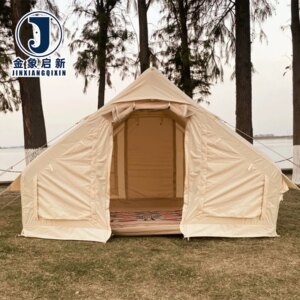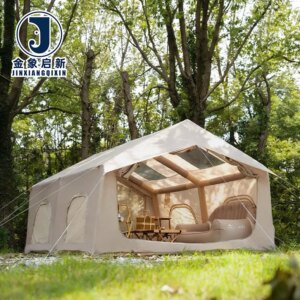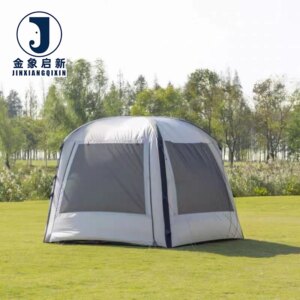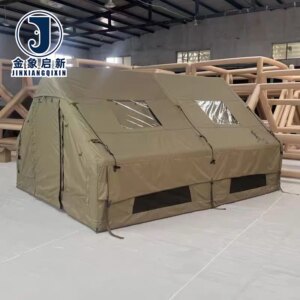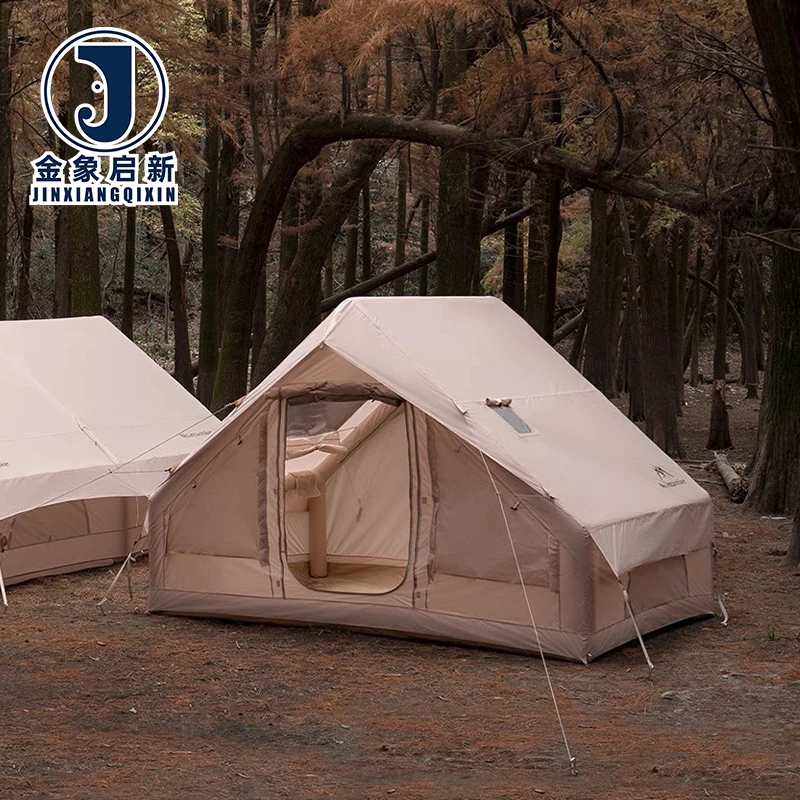
Batch Consistency on Every Roll — Three full production lines and 36 sets of professional equipment ensure that every meter of PVC inflatable tent fabric meets the same thickness, coating adhesion, and tensile baseline from first roll to last.
Technical Specifications
| Parameter | Value |
|---|---|
| Product Type | Inflatable Tent |
| Core Material | PVC tarpaulin (PVC knife-coated fabric) |
| Coating Method | Knife coated |
| Coating Material | PVC |
| Product Form | Inflatable structure with automatic opening mechanism |
| Capacity | 4-6 person |
| Construction | Single layer |
| Waterproof | Yes (test basis not stated in source) |
| UV-resistant | Yes (test basis not stated in source) |
| Tear-resistant | Yes (test standard not stated in source) |
| Flame Retardant | Available in flame retardant grades — confirm the grade required for your market |
| Anti-Static | Not confirmed — specify if required for your application |
| Printing Option | Pattern printing available |
| Customization | OEM & ODM, sample customization, size adjustments, color customization |
| Standards | ISO9001, ISO14001, ISO45001, CE |
Application Suitability
| Application | Exposure & Requirement |
|---|---|
| Temporary site offices for construction projects | Prolonged sun exposure, wind load, dust ingress, repeated relocation across sites |
| Mobile exhibition spaces | High foot traffic, frequent inflation-deflation cycles, visual branding consistency |
| Equipment storage shelters for outdoor events | Rain and ground moisture, UV degradation over multi-day deployments, rapid setup demands |
| Industrial camping accommodations for remote deployments | Extreme temperature swings, abrasive terrain, crew safety compliance in isolated locations |
Why Welded Seams Fail Before the Fabric Does on Inflatable Tents
Calibrated tension testing and 24-hour pressure retention checks catch seam weakness before the PVC inflatable tent leaves the factory.
Inflatable structures concentrate stress at the junctions where air beams meet the base panel. When the coated fabric flexes under internal pressure and external wind load simultaneously, the welded seam carries more force per linear centimeter than the body fabric does. A PVC inflatable tent for truck and transport applications that passes visual inspection can still lose pressure overnight if the heat-seal temperature was set too high for the coating weight, degrading the PVC layer at the bond line [NEED_CITE: tensile and tear test methods for coated fabrics per ISO 1421]. Buyers who specify only the base fabric GSM without verifying seam peel strength often discover the gap during the first field deployment.
Knife-Coated PVC and What It Means for Inflatable Structures
The knife-coated process applies PVC paste directly onto the base fabric under controlled blade tension, producing a uniform coating thickness across the full width. For a PVC inflatable tent manufacturer custom-building units for commercial deployment, this consistency matters because uneven coating creates thin spots that become leak paths under cyclic pressure. The single-layer construction relies entirely on coating integrity rather than a bonded laminate interface, which simplifies field repair when punctures occur on remote sites.
Pressure Retention and the Inflation-Deflation Fatigue Cycle
Every inflatable camping tent undergoes repeated pressurization as crews pack and redeploy it between locations. The automatic opening mechanism depends on the air beam holding its shape without creep deformation. Knife-coated PVC tarpaulin resists this deformation because the coating penetrates the base fabric weave, locking yarns in position rather than sitting on the surface where it can delaminate under flex fatigue [NEED_CITE: DIN 4102 fire classification for building materials]. This penetration also gives the welded seams a larger bonding cross-section, which directly improves peel strength at the joints most likely to fail.
Reading the Specification Sheet Beyond the GSM Number
GSM alone tells a buyer how much material is present, not how that material is distributed between base fabric and coating. A high GSM driven by thick coating with a light base fabric will resist puncture but tear easily once a nick starts, because the yarn density carrying the tear load is low. Conversely, a tighter weave with moderate coating weight delivers better tear propagation resistance, which is the property that keeps a small field puncture from becoming a full beam failure. The knife-coated method supports both profiles, so the correct specification depends on whether the inflatable tent will face sharp ground debris or sustained wind-driven flexing. Surface finish — whether glossy or matte — affects how dirt and UV exposure interact with the coating over successive deployments, and pattern printing can be applied without compromising the underlying coating adhesion when done at the correct curing stage.
The Hidden Cost of Overlooking Seam Peel Strength
When procurement focuses on fabric weight and color match but skips seam verification, the inflatable tent can pass pre-shipment visual checks and still deflate within the first night on site. Welds that are too hot embrittle the PVC at the bond line, while welds that are too cool leave a weak boundary layer that separates under the first full-pressure cycle. Either failure mode shows up as a slow leak that crews trace back to the factory, triggering replacement logistics that cost more than the original order margin [NEED_CITE: peel strength testing of welded PVC seams per ISO 2411]. Batch-to-batch inconsistency in seam quality is especially damaging for rental companies deploying multiple units at a single event, where one leaking tent undermines client confidence across the entire fleet.
What Process Control Looks Like at Scale
Dedicated QA and QC staff monitor coating weight and seam temperature at every production stage rather than sampling only finished units. Thirty-six sets of professional processing equipment allow parallel production runs without forcing machines beyond their optimal speed range, which is where thickness variation typically enters the process. A 10-person R&D team handles material selection and sample development, so buyers can request a sample built to their target specification before committing to volume. One hundred percent pre-shipment inspection covers pressure retention, seam peel, and visual coating consistency across every unit in the order. ISO9001, ISO14001, and ISO45001 certifications provide the management system framework, while CE marking supports market entry where regulatory compliance is mandatory.
Documentation & Verification
- Material specification sheet stating coating method, base fabric type, and available flame retardant grades
- UV and flame retardant test reports provided where the specified grade has been confirmed
- 24-hour pressure retention record logged for every inflatable tent before packaging
- Pre-shipment inspection report covering seam peel strength and coating consistency
- ISO9001, ISO14001, ISO45001, and CE certificates included with each dispatch
- Roll packing list and certificate of origin for customs clearance support
Fabrication, Handling & Storage
- Heat-seal temperature must match the knife-coated PVC formulation to avoid embrittlement at beam joints
- Store rolled units upright on pallets to prevent permanent crease marks in the single-layer construction
- Clean with pH-neutral detergent only to preserve the coating surface and any applied pattern printing
- Inspect welded seams before each redeployment to catch early delamination at high-flex junctions
- Allow the fabric to reach ambient temperature before inflation when deploying in cold conditions
Requesting a Specification Match
Provide the intended deployment environment, expected inflation-deflation frequency, and any fire safety classification required by local regulation. Confirm whether the PVC inflatable tent needs custom sizing, specific color references, or pattern printing for branding. Indicate target order volume and whether sample approval is needed before production begins, so the R&D team can prepare a unit built to your exact material and construction requirements.
Frequently Asked Questions
Q: How is welded seam integrity verified on inflatable tents before shipment?
A: Every unit undergoes 24-hour pressure retention testing and seam peel inspection using calibrated equipment. QA staff check heat-seal temperature logs against the specific PVC coating formulation to confirm the bond cross-section meets the required peel strength threshold before the inflatable tent is cleared for packaging.
Q: What UV-resistant test basis supports the stated outdoor performance?
A: UV resistance is confirmed through testing, with the specific standard depending on the grade selected. Buyers targeting markets with defined UV exposure requirements should specify the test method needed, and the corresponding report is supplied with the documentation package upon request.
Q: What OEM and ODM customization options are available for size, color, and pattern printing?
A: Size adjustments, color customization, and pattern printing are all supported through sample development. The R&D team builds a prototype to your specification, allowing performance and visual verification before bulk production of the PVC inflatable tent begins on the main production lines.
Q: How is batch-to-batch consistency maintained across high-volume inflatable tent orders?
A: Three full production lines and 36 sets of professional equipment allow orders to run within each machine’s optimal capacity range. Dedicated QA monitoring at the coating and welding stages, combined with 100 percent pre-shipment inspection, keeps thickness and seam quality uniform across every unit.
Q: What supporting documentation ships with each order?
A: Each dispatch includes a material specification sheet, pre-shipment inspection record, pressure retention log, ISO and CE certificates, packing list, and certificate of origin. Flame retardant test reports are added when the specified grade has been confirmed during the inquiry stage.