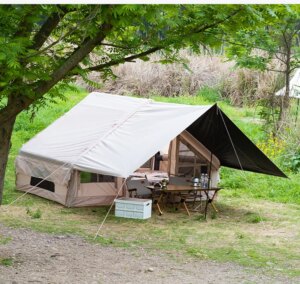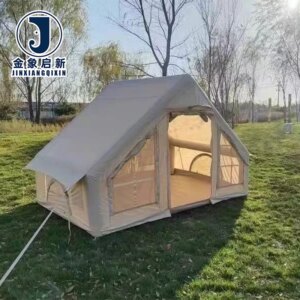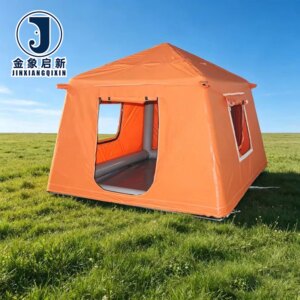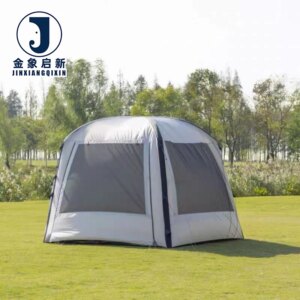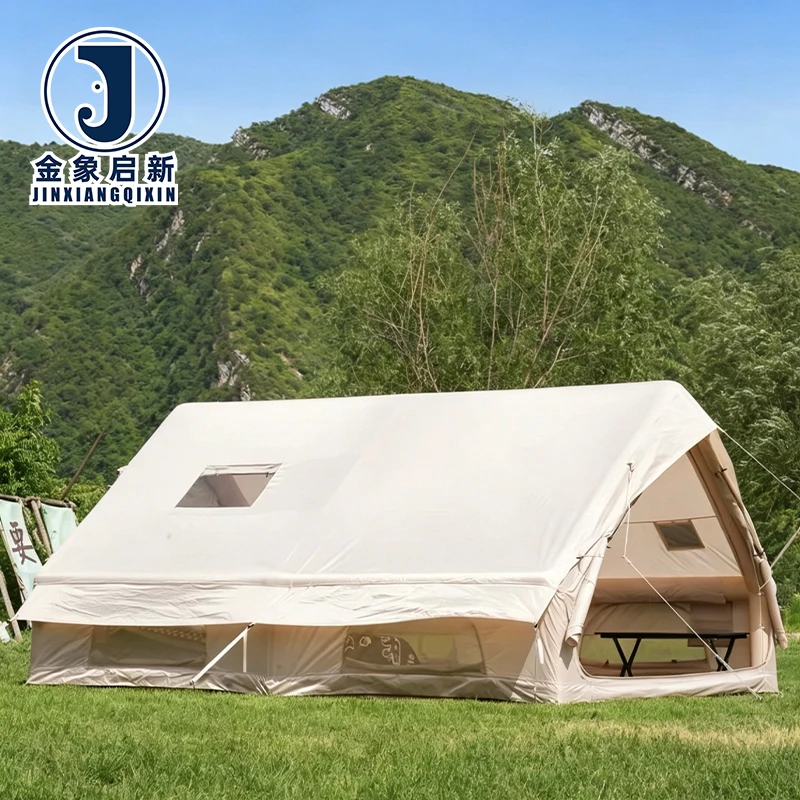
Batch-Consistent PVC Coated Fabric — Every roll of inflatable tent material is produced on dedicated lines with full-process QA, ensuring hydrostatic and tear performance holds from first sample to final shipment.
Technical Specifications
| Parameter | Value |
|---|---|
| Product Type | PVC Inflatable Camping Tent |
| Core Material | PVC knife-coated tarpaulin |
| Capacity | 2–3 Person |
| Structure | Single Layer Air Tent |
| Waterproof Rating | Hydrostatic head exceeding industry standards (exact value — confirm with test report) |
| UV Resistance | UV-resistant formulation (test basis — confirm with QUV report) |
| Flame Retardant Grade | Not stated — confirm the grade required for your market |
| Airtightness Test Pressure | 20 kPa |
| UV Aging Simulation | 2,000 hours |
| Tear Strength Test Standard | ASTM D751 |
| Key Features | Waterproof, UV-resistant, tear-resistant, quick automatic opening |
| Customization | OEM & ODM — size, pattern printing, color matching, hardware modifications |
| Sample Lead Time | 7–10 days |
| Mass Production Lead Time | 15–20 days for orders under 500 units |
| Certifications | ISO 9001, ISO 14001, ISO 45001, CE |
Application Suitability
| Application | Exposure & Requirement |
|---|---|
| Commercial outdoor gear product lines | Repeated inflation cycles, transport abrasion, four-season UV and rain exposure |
| Construction site temporary housing | Constant weathering, dust ingress, puncture risk from tools and equipment |
| Expedition base camp shelters | High-wind loading, extreme temperature swings, rapid deployment needs |
| Industrial event temporary structures | Frequent setup and teardown, crowd traffic wear, visual branding requirements |
| Equipment rental fleets | High-frequency use cycles, operator handling damage, multi-season storage |
Why Hydrostatic Head Ratings Mislead Inflatable Tent Buyers
A PVC inflatable tent manufacturer quoting a waterproof number without the test method gives you a figure you cannot verify in the field. The coating adhesion and seam weld integrity matter more than the hydrostatic column value printed on a spec sheet. Buyers who chase the highest stated rating often discover that the welded seams — not the fabric face — are where water enters first, especially after a season of inflation and deflation cycles [NEED_CITE: hydrostatic test methods for coated fabrics per ISO 811].
Knife-Coated Fabric Core and What It Means for Air-Holding Structures
PVC knife-coated fabric forces the coating compound into the weave of the base yarn under blade pressure, producing a bond that resists delamination when the air beam flexes during inflation. For a PVC inflatable tent, this adhesion quality determines whether the air tube holds its shape across hundreds of setup cycles without the coating peeling away from the base fabric at the fold lines.
Welded Seam Integrity Under Inflation Pressure
Inflatable tents rely on airtight seams that must withstand internal pressures of 20 kPa without separation. The knife-coated PVC surface provides a thermally weldable layer that fuses under high-frequency welding, creating a bond that is tested to match or exceed the parent fabric strength. This is critical because a seam failure in an air beam brings down the entire structure instantly, unlike a pole tent where one failed seam may only sag locally [NEED_CITE: seam strength testing for welded PVC structures per ISO 1421].
Reading the Specs That Actually Govern Tent Longevity
The 2,000-hour UV aging simulation indicates how the formulation resists degradation under accelerated weathering, but real service life depends on installation orientation, latitude, and seasonal UV index. The ASTM D751 tear strength test standard tells you the method used — compare the actual force values across competing PVC inflatable tent options rather than accepting a generic "high tear resistance" claim. The single-layer air tent structure means every gram of coating weight contributes directly to both waterproofing and structural rigidity, making the coating-to-base-fabric ratio a more meaningful spec than total GSM alone. Base fabric denier and weave density govern how a puncture propagates: a higher-denier yarn in a ripstop weave limits tear spread from a single field puncture.
The Hidden Cost of Specifying on Price Per Kilogram
When procurement decisions hinge on cost per unit weight, suppliers cut coating thickness to hit the target price — the fabric arrives at the agreed GSM but the coating layer is too thin to withstand high-frequency welding. The seams separate under inflation pressure within weeks. Alternatively, the base fabric yarn count is reduced to compensate for heavier coating, and the material becomes brittle at fold lines after a single season of UV exposure. These failures do not show up in incoming inspection; they appear only after the inflatable tent reaches the end user [NEED_CITE: coating adhesion failure modes in PVC tarpaulins].
What This Supply Chain Delivers to Your Product Line
Three full production lines with 36 sets of professional equipment allow concurrent sample development and bulk runs, so your pre-production approval does not delay the main order queue. A 10-person R&D team handles material selection, pattern printing, and custom sizing in-house, returning samples within 7–10 days. Dedicated QA/QC stages include raw material testing, coating adhesion checks, airtightness verification at 20 kPa, seam integrity inspection, hardware durability cycles, UV aging simulation, and dimensional accuracy measurement — all before shipment.
Documentation & Verification
- Material specification sheet confirming PVC coating type, base fabric denier, and treatment grades
- Batch-specific test reports covering hydrostatic pressure, tear strength per ASTM D751, and UV aging results
- Pre-shipment inspection record with airtightness and seam integrity sign-off per unit
- Certificate of origin and customs documentation for international inflatable tent shipments
- ISO 9001, ISO 14001, ISO 45001, and CE certificates supporting import compliance
Fabrication, Handling & Storage
- Set high-frequency welder dwell time to match the PVC knife-coated layer thickness for full seam fusion
- Reinforce air beam junction points with additional PVC patches before welding to distribute inflation load
- Store rolls vertically on padded racks to prevent flat-spot creasing in the coated surface
- Allow cold-stored rolls to reach ambient temperature before unrolling to avoid coating micro-cracking
- Use mild pH-neutral cleaners on the PVC surface; solvents will attack the plasticizer in the coating
- Repair field punctures with compatible PVC adhesive patches matched to the knife-coated formulation
Specifying Your Inflatable Tent Order
Provide your target inflation pressure, expected deployment frequency, and the climate zones your end users operate in so we can match the coating weight and UV formulation accordingly. Confirm any fire classification your destination market requires, as flame retardant grades vary by region and application. Share your color references and pattern artwork early — we develop pre-production samples within 7–10 days so your engineering team can validate material, weld quality, and hardware before bulk commitment.
Frequently Asked Questions
Q: What test basis supports the UV-resistant claim and what outdoor lifespan can I expect?
A: The UV-resistant formulation is validated through a 2,000-hour accelerated aging simulation. Actual field life depends on installation latitude, seasonal UV index, and whether the tent is stored covered between uses. We supply the UV aging test report with each batch so your team can assess suitability for your specific market conditions.
Q: What size customization range is available and what is the minimum order?
A: OEM and ODM customization covers dimensional adjustments, capacity scaling beyond the standard 2–3 person format, and structural modifications. Sample units are produced within 7–10 days for your approval. Mass production runs of up to 500 units carry a 15–20 day lead time. Confirm your required sizes and annual volume for specific minimum order guidance.
Q: How is color consistency controlled across production batches?
A: Each batch is matched against your approved color reference using controlled formulation records. The 7-point inspection protocol includes visual and instrumental color verification before dispatch. We ship batch-specific quality certificates so your receiving team can trace the color data for every roll or finished unit in the shipment.
Q: What is the process for custom pattern printing and sample approval?
A: Submit your artwork and Pantone references at inquiry stage. Our R&D team prepares a printed sample showing color accuracy, registration, and coating compatibility within the standard 7–10 day sample window. Once your team approves the sample, the print specification is locked for the production run to ensure repeatable results across subsequent orders.
Q: How are welded seams tested for airtightness in the finished inflatable tent?
A: Every air beam is pressurized to 20 kPa during the airtightness stage of our 7-point inspection protocol. Seam integrity is visually and physically verified at junction points and along the full weld length. Units that fail to hold pressure are rejected before packing, and the inspection record accompanies each shipment.