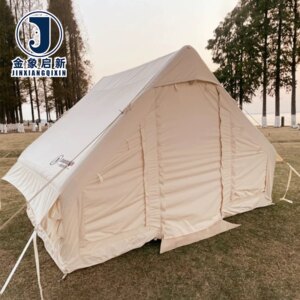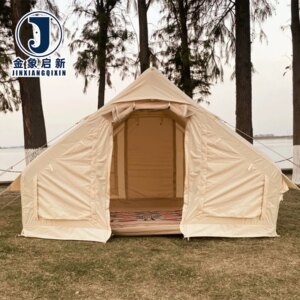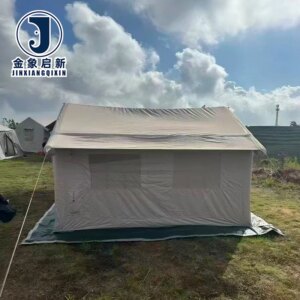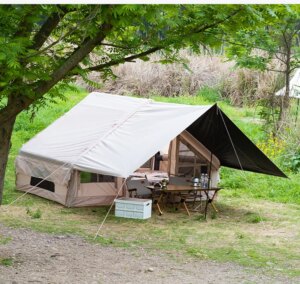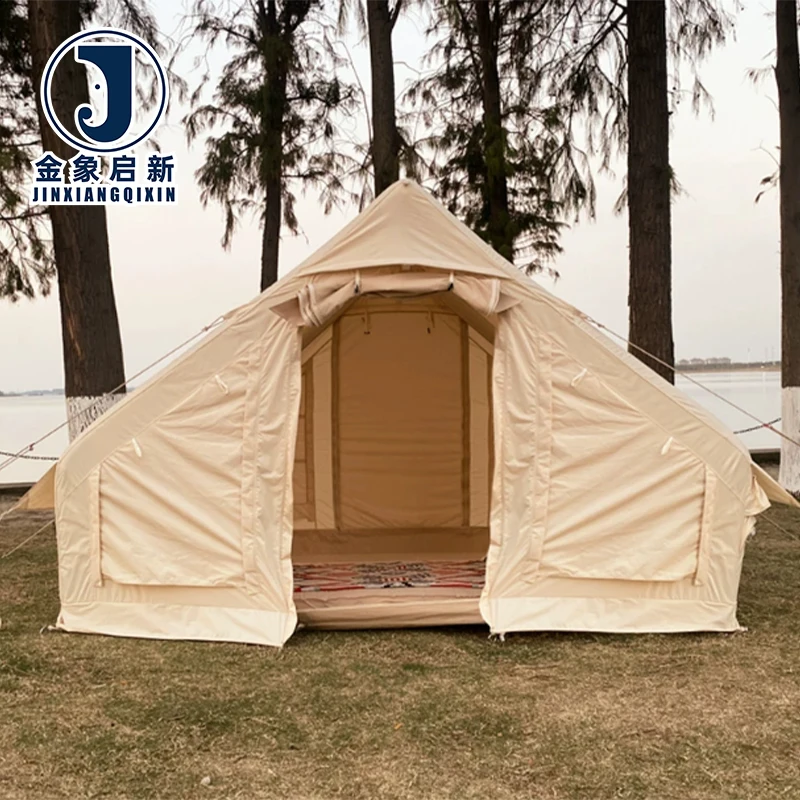
Seam-First Construction — Welded joints on inflatable structures are tested through repeated inflation cycles before shipment, ensuring the seams outlast the fabric in field conditions.
Technical Specifications
| Parameter | Value |
|---|---|
| Product Type | Inflatable Tent |
| Core Material | PVC Waterproof Fabric |
| Product Form | Inflatable structure, single layer construction |
| Waterproof Performance | Waterproof (rating not stated in source) |
| UV Treatment | UV-Resistant (test basis not stated in source) |
| Tear Resistance | 120N (standard not stated in source) |
| Deployment Mechanism | Quick automatic opening |
| Customization | OEM & ODM, sample customization, pattern printing |
| Certifications | ISO 9001, ISO 14001, ISO 45001, CE |
| Quality Inspection | 7-point inspection from raw material to final packaging |
| Batch Traceability | Full ERP-based traceability system |
Application Suitability
| Application | Exposure & Requirement |
|---|---|
| Commercial outdoor equipment manufacturing | Repeated inflation and deflation cycles, long-term UV exposure, end-user safety compliance |
| Event shelter and temporary structure systems | Rapid deployment demands, wind loading on inflated surfaces, frequent relocation and repacking |
| Transport fleet roadside emergency response | Roadside dust and debris exposure, variable weather, limited setup crew |
| Outdoor gear rental fleets | High-frequency use cycles, varied operator skill levels, cleaning between rentals |
| Industrial temporary accommodation solutions | Extended continuous inflation, temperature fluctuation, occupant safety standards |
When "Waterproof" and "UV-Resistant" Mean Nothing Without Proof
Requesting test data before you commit is the only way to separate coated-fabric manufacturers from trading desks.
Inflatable tents sit in full sun for extended periods, and the PVC surface takes constant UV load during every deployment. A fabric that degrades under ultraviolet exposure loses coating adhesion, becomes brittle, and eventually cracks at the stress points where air tubes bend during inflation. We supply PVC inflatable tent fabric with UV-resistant treatment; however, the specific test basis and expected service duration must be confirmed against your market’s exposure conditions. The same applies to waterproof claims — a coated fabric can pass a hydrostatic test at the mill yet fail at welded seams once fabricated into an airtight tube. [NEED_CITE: standard test methods for coated fabric waterproofness and UV degradation assessment]
How Inflated Tube Geometry Dictates Fabric Stress Distribution
When a PVC inflatable tent structure pressurises, the internal air load acts perpendicular to every surface of the tube. On straight sections, this creates hoop stress that the weft yarns must resist. At bends, junctions, and tapering points, the stress pattern becomes biaxial and concentrates where two welded panels meet. For manufacturers sourcing inflatable tent structures for commercial outdoor product lines, understanding this geometry means specifying a base fabric with balanced tensile properties in both directions rather than optimising for a single warp-dominated figure. The quick automatic opening mechanism further demands that the fabric unfolds uniformly without localised creasing that could trap air and delay deployment.
Coating Adhesion and the Inflatable Seam Integrity Question
Every inflatable tent relies on welded seams to hold air pressure, and those seams are only as strong as the bond between the PVC coating and the polyester base fabric. During welding, heat must penetrate through the coating layer to fuse two surfaces together without scorching the face or leaving the inner ply partially unbonded. Coating adhesion control at the manufacturing stage determines whether a seam holds through thousands of inflation cycles or delaminates after one season of rental use. This is where process-controlled coating weight and dedicated QA at each production stage matter — not as marketing claims, but as verifiable inspection records. [NEED_CITE: peel strength and seam integrity test protocols for welded PVC coated fabrics]
What Tear Resistance, Single Layer Construction, and Quick Deployment Mean Together
The 120N tear resistance figure (standard not stated in source) indicates the force required to propagate a tear through the PVC-coated fabric once a cut or puncture exists. In a single layer inflatable construction, every part of the structure is one ply thick — there is no second layer to arrest a running tear. This makes initial tear resistance critical, particularly at ground-contact zones and tube junctions where abrasion accumulates. For event shelter operators deploying inflatable tent systems repeatedly across sites, this single-layer design trades multi-ply redundancy for reduced packed weight and faster automatic opening. The trade-off is acceptable when the coating formulation maintains tear resistance through repeated folding, packing, and transport cycles without the plasticiser migration that stiffens stored PVC over time.
The Cost of Specifying on Marketing Language Instead of Test Data
Buyers who accept "UV-resistant" without a test report often discover coating failure only after months of outdoor use, when the surface chalks, cracks, and loses waterproof integrity across entire air tube panels. The same pattern applies to tear resistance: a figure quoted without a test standard is unverifiable, leaving no basis for a warranty claim when the fabric splits at a welded junction during inflation. Batch inconsistency in coating weight can mean one roll welds cleanly at standard temperature while the next requires re-calibration of heat settings — slowing production and increasing reject rates. For PVC inflatable tent manufacturers, the rework cost of a single failed seam in a pressurised structure is substantially higher than the savings from choosing an unverified fabric source. [NEED_CITE: field failure analysis of coated fabric inflatable structures and common delamination causes]
Why Sourcing This Inflatable Tent Fabric Here Reduces Your Compliance Risk
Our three full production lines and 36 sets of processing equipment handle PVC coated fabric from incoming yarn through to coated roll and finished inflatable structure, giving us direct control at every stage. The 10-technician R&D team develops pre-production samples for custom inflatable tent designs, allowing you to validate tube geometry, valve placement, and seam layout before mass production begins. Each batch passes through seven inspection points — from raw material incoming checks through to final packaging — with full ERP traceability linking every roll back to its coating run. ISO 9001, ISO 14001, ISO 45001, and CE certifications are held at facility level, supporting your regulatory documentation requirements across markets. OEM and ODM capability extends to pattern printing and custom sizing, so your inflatable tent product line can carry distinct branding without needing a separate print contractor.
Documentation & Verification
- Material specification sheet confirming PVC coating weight and base fabric construction per roll
- UV resistance and waterproof test reports issued per batch — confirm the grade required for your market
- Pre-shipment inspection record covering all seven quality checkpoints with photographic evidence
- ISO 9001, ISO 14001, ISO 45001, and CE certificate copies included with dispatch documentation
- ERP batch traceability record linking each roll to its production run and raw material lot
- Certificate of origin and customs documentation prepared for cross-border shipment
Fabrication, Handling & Storage
- Weld temperature must match the specific PVC coating formulation to avoid delamination at inflatable tube seams
- Single layer construction requires careful ground-contact protection to prevent puncture at abrasion-prone zones
- Store rolls on core tubes horizontally to prevent permanent creasing that affects automatic opening performance
- Use PVC-compatible cleaners only — solvent-based products can degrade the coating surface and compromise waterproof integrity
- Field repairs on inflated structures require hot-air welding compatible with the original coating weight and composition
- Allow fabric to reach ambient temperature before unfolding in cold conditions to prevent coating micro-cracking
What We Need to Move Your Inflatable Tent Project Forward
Provide your target deployment environment and the regulatory framework your end market requires — this determines which UV and fire performance grades apply. Specify whether you need rolls of PVC inflatable tent fabric for your own fabrication line or fully assembled inflatable structures with valve and seam finishing. Confirm your target dimensions, colour references, and any pattern printing requirements so we can develop a pre-production sample. Indicate your annual volume and preferred batch sizes to align production scheduling with your delivery windows.
Frequently Asked Questions
Q: How is UV resistance verified and what service life can be expected?
A: Our PVC inflatable tent fabric is supplied with UV-resistant treatment; however, the specific test basis and expected outdoor service duration depend on your application’s exposure intensity and regional climate. We recommend requesting the test report for your batch and discussing expected service conditions with our R&D team before finalising your specification.
Q: What OEM and ODM customization options are available?
A: We support full OEM and ODM development including custom inflatable tent sizing, tube geometry, pattern printing, and branding. A pre-production sample is developed for your design evaluation and adjustment before mass production begins, ensuring the final product matches your commercial outdoor equipment line requirements.
Q: How are welded seams tested for repeated inflation cycles?
A: Each production batch undergoes seam integrity checks as part of our seven-point inspection process. Welded joints on inflatable structures are evaluated for coating adhesion and peel strength to ensure they withstand repeated inflation and deflation cycles without delamination at the stress points where tube geometry concentrates load.
Q: What certifications and documents ship with each order?
A: Every shipment includes material specification sheets, batch test reports for applicable performance claims, ISO 9001, ISO 14001, ISO 45001, and CE certificate copies, pre-shipment inspection records, ERP traceability documentation, and full customs support papers including certificate of origin.
Q: What is the sample development process for custom designs?
A: Submit your inflatable tent design requirements including dimensions, valve placement, and graphic specifications. Our 10-person R&D team develops a pre-production sample for your evaluation. Once approved, the confirmed sample serves as the production benchmark, with batch quality measured against it during the seven-point inspection sequence.