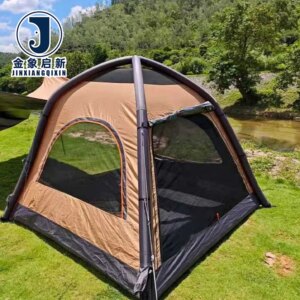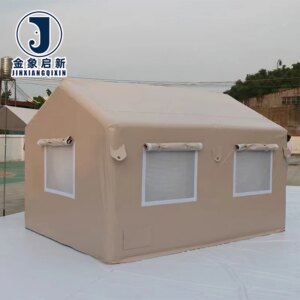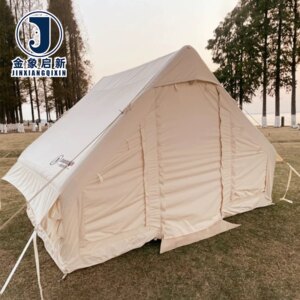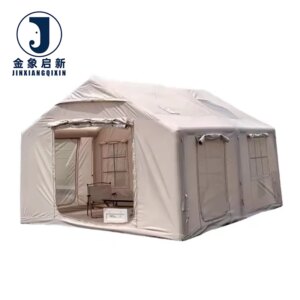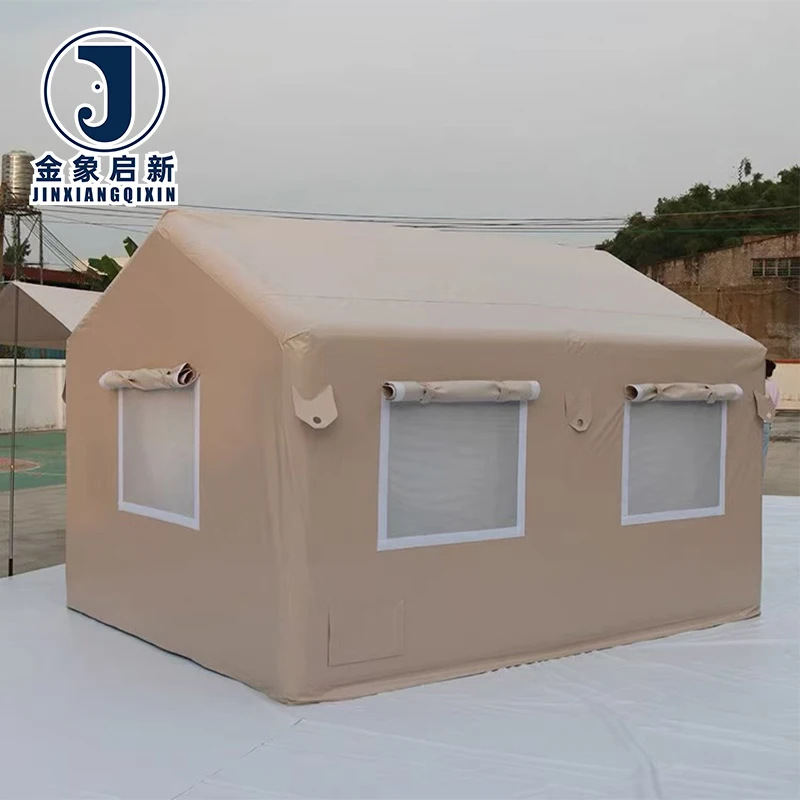
Deep Process Control Over Coated Fabric — Nearly 30 years of focused production on PVC coated textiles ensures every roll of inflatable structure fabric meets exacting weight and adhesion tolerances, validated through 100% pre-shipment inspection before dispatch to fleet operators and site contractors.
Technical Specifications
| Parameter | Value |
|---|---|
| Product Type | Inflatable Tent |
| Capacity | 6-8 Person |
| Opening Mechanism | Quick Automatic Opening |
| Design Classification | Four-Season |
| Construction | Single Layer |
| Configuration | Extended |
| Core Material | PVC |
| Customization | OEM & ODM Supported |
| Standards | ISO 9001, ISO 14001, ISO 45001, CE |
Application Suitability
| Application | Exposure & Requirement |
|---|---|
| Roadside incident command post | Wind-driven rain, vehicle proximity abrasion, rapid deployment under time pressure |
| Remote transport depot staging shelter | Sustained sun exposure, dust ingress, repeated inflation-deflation cycles |
| Disaster-relief coordination hub | Uneven ground contact, multi-day continuous occupation, equipment staging load |
| Fleet breakdown triage point | Low-light operations, emergency vehicle wash, chemical splash risk |
Why Rapid Deployment Matters More Than Tent Pole Count for Emergency Response
A PVC Inflatable Tent for truck and transport operations eliminates the assembly bottleneck that costs critical minutes at every incident scene.
Fleet operators and site contractors have lost response windows because traditional pole-and-sleeve tents required three people and fifteen minutes of fumbling in rain or darkness. Inflatable structures collapse that timeline to a single inflation cycle, which matters when a transport staging yard needs a weather-sealed command point before the next vehicle arrives. The operational cost of delayed deployment compounds across every shift [NEED_CITE: emergency response time benchmarks for temporary structures].
How Automatic Inflation Changes the Deployment Equation on Site
When a fleet manager pulls a PVC Inflatable Tent for truck and transport staging from the back of a service vehicle, the expectation is that one technician can have it operational before the incident assessment is complete. Quick automatic opening removes the variable of crew availability — the structure does not depend on finding personnel who know the pole sequence or who can read assembly diagrams in poor light. This matters at highway breakdown scenes where the response team is already occupied with traffic management and vehicle assessment.
What Four-Season Single-Layer PVC Construction Actually Delivers
The single-layer PVC build trades internal insulation for transport-friendly weight, which aligns with how fleet operators carry emergency equipment. A four-season rating in this context means the coated fabric maintains flexibility in cold-weather deployments and resists softening during high-temperature staging operations [NEED_CITE: PVC coated fabric temperature performance range]. The extended configuration provides enough interior clearance for standing-height equipment staging and operational map boards without requiring a multi-pole frame that adds pack weight.
Reading the Capacity and Configuration Specs for Procurement Decisions
The 6-8 person capacity designation assumes seated operational positions with minimal personal equipment. For procurement planning, consider whether the tent will serve as a standing command post with map tables and radio equipment, which reduces effective occupancy. The extended type designation indicates additional length beyond standard footprints, providing the linear space needed for stretcher staging or equipment benches. Single-layer PVC construction means thermal management depends entirely on ventilation planning — buyers specifying tents for cold-climate fleet operations should confirm whether internal heater compatibility is required and whether the PVC grade tolerates localized heat exposure from ducted warming systems.
The Hidden Cost When Inflatable Structure Fabric Fails at the Weld Line
A recurring failure pattern in inflatable emergency shelters involves seam separation at the tube-to-canopy junction, precisely where inflation pressure and structural flex concentrate stress. When the welded seam delaminates before the PVC fabric itself shows wear, the root cause is typically heat-seal temperature or dwell time that did not match the specific coating formulation. Batch inconsistency in coating weight across the fabric surface compounds this problem, creating zones where the weld takes hold unevenly. Buyers who specify inflatable structures for repeated deployment cycles should request pre-shipment weld peel-strength verification rather than relying on visual seam inspection alone [NEED_CITE: welded seam peel strength testing for PVC coated fabrics].
What Consistent Production Infrastructure Means for Your Inflatable Tent Order
Three full production lines and 36 sets of professional processing equipment allow this manufacturer to run dedicated inflatable structure fabric batches without competing for line time against standard tarpaulin orders, protecting your lead time. A 10-technician R&D team handles OEM and ODM customization directly, meaning custom sizing, print placement, and inflation port configurations move from inquiry to sample without external design intermediaries. Every production stage includes dedicated QA/QC checkpoints with 100% inspection before shipment — this is particularly important for inflatable structures where a single undetected coating defect can cause catastrophic deflation under field use. ISO 9001, ISO 14001, ISO 45001, and CE certification across production gives cross-border procurement teams the compliance documentation their purchasing departments require.
Documentation & Verification
- Material specification sheet stating PVC grade, base fabric construction, and coating weight per roll
- Pre-shipment inspection record confirming inflation tube weld integrity and canopy seam strength
- ISO 9001, ISO 14001, ISO 45001, and CE certificates for procurement compliance files
- Sample approval documentation confirming custom dimensions and print registration before production release
- Batch colour consistency verification across multiple tent units within the same order
Fabrication, Handling & Storage
- Verify heat-seal temperature settings against the specific PVC coating grade before welding inflation tube joints
- Store rolled tent units on pallets to prevent compression creasing in the single-layer PVC membrane
- Avoid dragging packed units across abrasive surfaces that can score the PVC coating before deployment
- Use mild detergent and soft brush cleaning — aggressive solvents can degrade the PVC surface coating
- Inspect inflation valves and tube connection points after each deployment cycle for particulate ingress
What to Include in Your Inquiry
Specify the deployment environment — highway shoulder, remote depot, or disaster zone — because ground conditions and wind exposure shape the anchoring and inflation requirements. Confirm whether your market requires fire-retardant certification and which standard applies, as regulatory requirements vary by jurisdiction for temporary structures at industrial sites. Indicate the expected annual volume and whether OEM branding or custom colour matching is needed, as these parameters determine production scheduling and sample approval timelines.
Frequently Asked Questions
Q: What is the minimum order quantity for custom-sized PVC Inflatable Tents across a fleet?
A: Minimum quantities depend on the degree of customization — standard 6-8 person configurations typically carry lower minimums than fully custom dimensions or print specifications. Request a quotation with your target unit count and custom requirements so the production team can confirm line scheduling and material batch allocation for your order.
Q: How is batch colour consistency maintained across multiple inflatable tent units?
A: The production facility runs dedicated coating batches per order with in-process colour verification at each stage. A pre-shipment inspection compares units side by side before packing, which catches variation before it reaches the installation site where differences become visible in a multi-tent deployment.
Q: Are welded seams at inflation points tested for repeated deployment cycles?
A: Every unit undergoes 100% pre-shipment inspection that includes weld integrity checks at tube-to-canopy junctions. If your application involves high-frequency inflation and deflation cycles, request sample units for your own field-cycle testing before committing to the full production run.
Q: What fire-retardant certification is available for on-site regulatory compliance?
A: PVC inflatable tent fabric is available in flame retardant grades — confirm the specific grade required for your market and site regulations. Documentation including material specification sheets and applicable test reports are supplied to support your compliance submission.
Q: How are inflatable tents packed and protected for container shipment?
A: Each unit is individually packed to prevent compression damage to the PVC coating and inflation tube assemblies during transit. A detailed roll packing list accompanies every shipment, and container loading is planned by unit count and weight to maximize space while protecting product integrity.