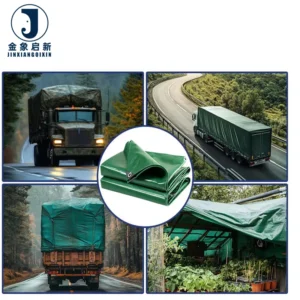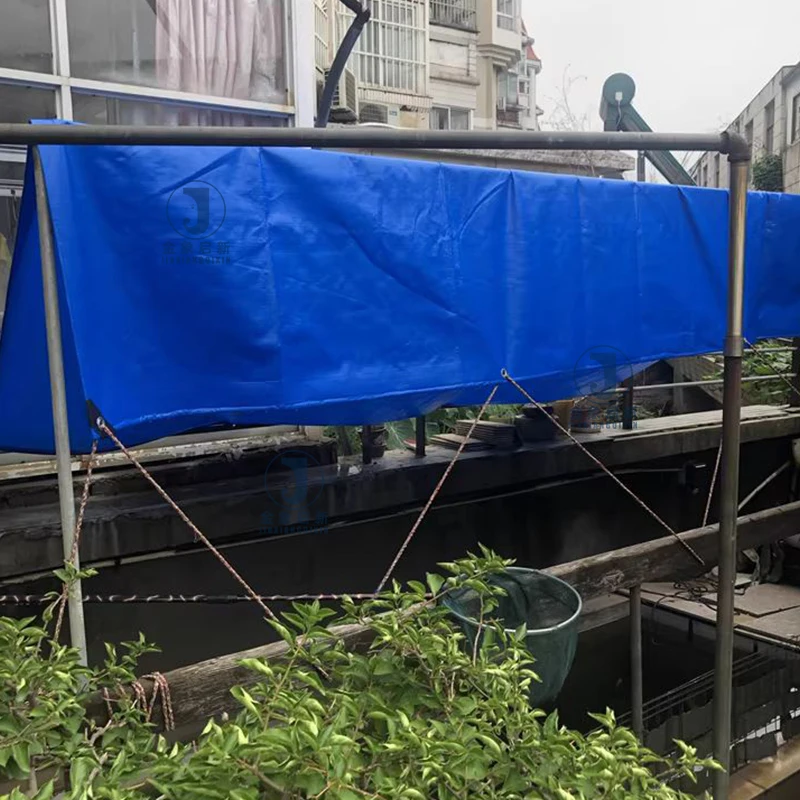
Production Line Depth — three full coating lines and 36 sets of specialist equipment handle bulk roll output with stable GSM control across every batch of PE tarpaulin for truck and transport fleets.
Technical Specifications
| Parameter | Value |
|---|---|
| Product Type | PVC Truck Cover / PE Tarpaulin Roll |
| Coating Material | HDPE weaving with LDPE lamination on both sides |
| Weight Range | 50 g/m² to 220 g/m² (confirm required grade at inquiry) |
| Total Thickness | 0.18 – 0.35 mm (varies by grade) |
| Knitting Density | 8×8 (lightweight), 10×10 (medium), 12×12 (heavy-duty) |
| Tensile Strength | Meridian 300–1200 N/5cm, Latitude 250–1000 N/5cm (test basis not stated) |
| Edge Reinforcement | All four edges heat-sealed with PP rope in hem |
| Eyelets | Galvanized steel, spaced every 3 ft or 1 m interval |
| Corner Protection | Reinforced plastic corners |
| Surface Finish | Matte (glossy available on request) |
| UV Treatment | Available — confirm grade required for your market |
| Anti-Mildew | Mildew-proof and anti-aging formulation (test basis not stated) |
| Waterproof | Fully waterproof LDPE laminated construction |
| Color Options | Blue, Blue/Orange, Green, Grey, Black, Clear, Grey/Green, Orange, or custom |
| Roll Width | 6 ft, 8 ft, 10 ft, 12 ft or 2 m, 4 m, 6 m |
| Roll Length | 100 yards, 100 meters, or custom per order |
| Printing | Custom brand printing available |
Application Suitability
| Application | Exposure & Requirement |
|---|---|
| Truck and trailer load covering | Highway-speed wind load, rain and road spray, tie-down abrasion at flex points, UV exposure on long-haul routes |
| Side curtain fabric for equipment builders | Daily roll-up and unroll flex cycles, lateral tension from curtain runners, colour match across full vehicle side |
| Flatbed and tipper cover | Point load from irregular cargo shapes, friction contact at load edges, weather sealing for open-deck transport |
| Fleet vehicle branding | Corporate livery colour consistency across multiple vehicles, logo print adhesion on PE surface |
Why a Generic-Size PE Tarpaulin for Truck and Transport Costs You More Than the Cover Itself
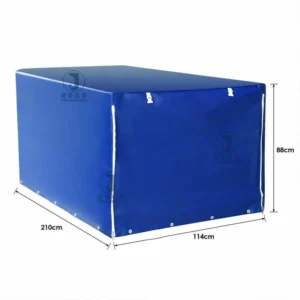
A cover cut to a generic dimension that does not match your specific trailer model creates loose fabric, flapping stress and premature seam failure at every flex point.
When a transport operator orders a truck cover in a standard size rather than specifying the exact trailer body dimensions, the result is predictable. Excess fabric gathers at corners, catches wind at highway speed, and abrades against the load and tie-down hardware. The seams at the highest-stress flex points — typically where the cover bends over the load edge or meets the eyelet line — fail within weeks rather than seasons. The operator then faces a second purchase, downtime while the vehicle runs uncovered, and load security risk on every trip in between [NEED_CITE: common failure modes in truck tarpaulin covers under road conditions].
Fit-to-Model Sizing Eliminates the Cost of Rework
Specifying the exact make, model and body dimensions of each truck and trailer in your fleet allows the cover to be cut and hemmed to match. Eyelet placement aligns with the vehicle’s tie-down rails, and the hem line sits flush against the body without gaps that admit water or create wind lift. This approach removes the on-site trimming and re-drilling that fleet maintenance teams routinely perform when generic covers arrive.
Tie-Down Hardware Designed for Road-Grade Stress
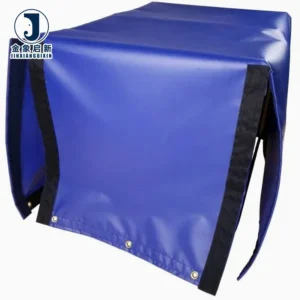
The PP rope reinforced hem and galvanized eyelets at regular intervals handle the cyclic loading of strap tie-downs during transit. Reinforced plastic corners prevent the most common tear initiation point — the corner eyelet pulling through under lateral strap tension. For side curtain applications, the eyelet spacing can be matched to the curtain runner track system used by the equipment builder [NEED_CITE: tie-down load distribution on truck tarpaulin eyelets per transport standards].
Reading the Grade Behind the GSM Number
GSM alone does not determine how a PE tarpaulin for truck and transport will perform on the road. A 150 g/m² fabric woven at 8×8 density with thicker individual yarns will behave differently under tie-down tension than a 150 g/m² fabric woven at 12×12 with finer yarns. The knitting density and base yarn denier together define the tear propagation resistance — the property that matters most when a sharp load edge or a failed eyelet concentrates stress into a small area. Always request the knitting density alongside the GSM on the specification sheet, and verify both on arrival.
What Happens When Batch Consistency Slips
Colour variation between rolls in the same order becomes visible the moment two panels are installed side by side on a fleet vehicle. For operators running branded liveries across multiple trucks, a shade difference on one vehicle undermines the entire fleet presentation. This inconsistency typically traces back to pigment batching at the coating stage, and it is preventable when the production run is managed as a single batch with colour reference checks between rolls [NEED_CITE: colour consistency standards for coated fabrics in fleet applications].
Why Procurement Teams Choose This Source
Deep process control over LDPE coating weight and adhesion means the GSM stated on the quotation is the GSM that arrives on the roll, verified during pre-shipment inspection rather than left to chance. Three full production lines support the volume requirements of fleet orders covering dozens of vehicles, with delivery scheduled to match vehicle build or maintenance timelines. The R&D team develops cut-to-model samples within days, allowing operators to confirm fit and eyelet alignment before committing to full production. Dedicated quality checks at every stage — from base fabric weaving through lamination, printing, hemming and packing — catch defects before they reach the dispatch area.
Documentation & Verification
- Material specification sheet stating confirmed GSM, knitting density and coating type for each roll
- Colour reference document matching the agreed fleet livery shade across the full order
- Pre-shipment inspection record covering eyelet spacing, hem integrity and surface quality
- Roll packing list with individual roll weight and dimensions for container loading verification
- Certificate of origin and customs documentation for cross-border shipment clearance
Fabrication, Handling & Storage
- Heat-seal hems at temperatures matched to the LDPE lamination grade to avoid delamination at the PP rope line
- Space galvanized eyelets to align with the vehicle tie-down rail pattern, avoiding unsupported spans
- Store rolls horizontally on pallets to prevent flat-spot deformation on the 0.18–0.35 mm thickness range
- Unroll and allow the PE tarpaulin to relax before tensioning, particularly in cold transport conditions
- Use mild detergent only — solvent cleaners degrade the LDPE surface and compromise print adhesion
- Cut panels from the same roll batch for side-by-side installation to maintain colour consistency
What to Include in Your Inquiry
Provide the truck or trailer make, model and exact body dimensions so the cover can be cut to fit without on-site modification. Specify the tie-down system type and eyelet spacing required for your load securement setup. Confirm the colour reference or Pantone match for fleet livery, and indicate whether custom logo printing is needed. State your target market so that any UV or anti-aging treatment can be matched to the exposure conditions and regulatory expectations of the operating region.
Frequently Asked Questions
Q: How do I verify the GSM of the PE tarpaulin on arrival?
A: Cut a measured sample from each roll, weigh it on a calibrated scale, and calculate grams per square metre. Compare the result against the material specification sheet supplied with the shipment. Any deviation beyond the agreed tolerance should be flagged before the covers are cut or installed on vehicles.
Q: What eyelet spacing works for heavy-duty truck tie-down applications?
A: Standard spacing is every 3 ft or 1 m, but high-wind routes and irregular loads may require closer intervals. The galvanized eyelets and PP rope hem distribute strap tension across the reinforced edge. Confirm the spacing with your tie-down hardware layout before production to avoid field drilling.
Q: Can the cover be cut to fit a specific trailer model?
A: Yes. Provide the trailer make, model, body length, width and height, along with side curtain track type if applicable. Samples are developed within days to confirm fit, eyelet alignment and hem placement before the full production run is released.
Q: How is batch colour consistency managed across multiple rolls?
A: All rolls for a single fleet order are produced from the same pigment batch with colour reference checks between consecutive rolls. The pre-shipment inspection record documents shade consistency. Request a physical colour swatch for approval before production if exact livery matching is critical.
Q: What UV treatment options are available for long-haul road exposure?
A: UV stabiliser can be compounded into the LDPE lamination to extend service life under direct sunlight. The specific grade and test basis depend on the exposure conditions of your operating region — confirm the UV treatment level required for your market when placing the inquiry.