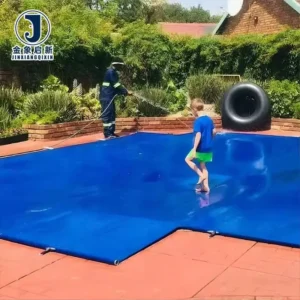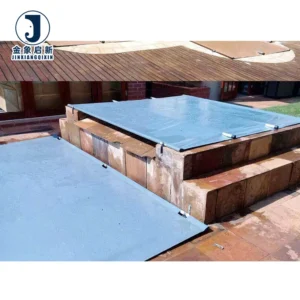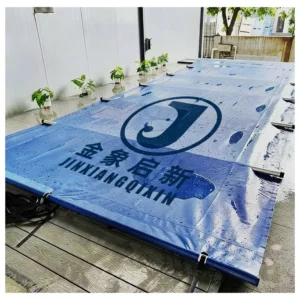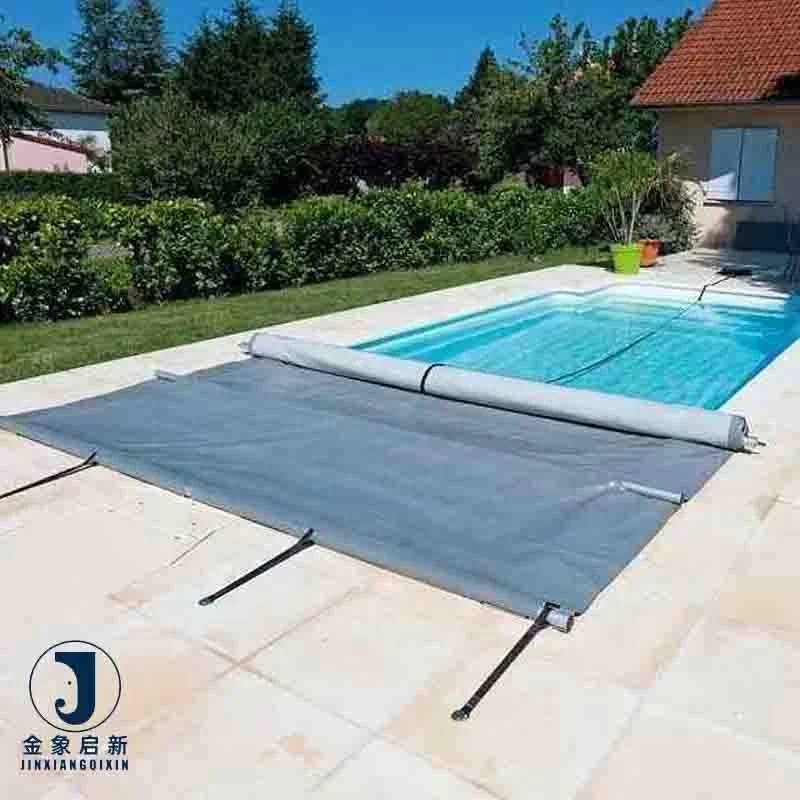
Batch Consistency Across Rolls — verified through dedicated QA at every production stage, ensuring colour and coating uniformity for multi-cover fleet and pool installations.
Technical Specifications
| Parameter | Value |
|---|---|
| Product Type | PVC Tarpaulin Pool Cover |
| Base Fabric | High-strength polyester mesh fabric |
| Coating Technology | Laminated technology & Hot-melt coating technology |
| Weight (GSM) | 350gsm / 420gsm / 500gsm / 550gsm / 600gsm / 750gsm (available as options) |
| Total Thickness | 0.32mm / 0.35mm / 0.4mm / 0.45mm / 0.5mm / 0.65mm |
| Roll Width | 2m / 2.1m |
| Roll Length | 75m (2m width) / 50m (2.1m width) |
| Color Options | Blue, Red, Yellow, Light blue, Grey (customized colours available) |
| Key Features | Waterproof, cold crack resistance, anti-mildew, anti-static treatment, blackout |
| UV Treatment | Anti-UV (test basis not stated — request report for your market) |
| Flame Retardant | Flame retardant grades available (grade not stated — confirm requirement) |
| Service Life | Suited to extended outdoor exposure under normal conditions |
Application Suitability
| Application | Exposure & Requirement |
|---|---|
| Swimming pool safety covers | Constant UV exposure, ratchet tensioner stress at anchor points, chemical splash from pool treatment, debris load during winter |
| Truck side curtains and awnings | Continuous flexing at mounting rails, road abrasion, wind flap fatigue, UV degradation from daily transit exposure |
| Cargo ship deck covers | Marine salt spray, heavy weather, constant movement and load shift during ocean transit |
| Transport fleet trailer wraps | Aerodynamic drag stress, tie-down strap abrasion at flex points, temperature swings across regional routes |
Why PVC Pool Cover Tarpaulin Welds Fail Before the Fabric Does
The coating adhesion method determines whether the seam holds or peels under tension.
Buyers specifying transport covers or pool safety covers often focus on fabric weight while overlooking how the PVC bonds to the polyester base. Hot-melt coating technology delivers deeper penetration into the mesh structure compared to simple lamination, which directly affects how well high-frequency welds perform at the exact points where ratchet tensioners and tie-down straps concentrate stress. A cover that tears along a welded edge — rather than through the body fabric — traces back to insufficient coating adhesion at the interface. [NEED_CITE: tensile and tear test methods for coated fabrics per ISO 1421]
Tensioning Hardware Demands More From the Fabric Edge
Pool safety covers using aluminium bar anchors or ratchet tensioner systems place concentrated load on the perimeter hem and any welded attachment points. The PVC pool cover tarpaulin must resist peel propagation precisely where hardware interfaces with the fabric. Hot-melt coated grades offer stronger interlayer bonding, reducing the risk that a tensioned edge delaminates before the base polyester reaches its tensile limit. This matters most for commercial pools where covers are deployed and retracted seasonally with mechanical winch systems.
Road Exposure and Flex Fatigue on Transport Covers
Truck awnings and side curtains fabricated from PVC pool cover tarpaulin endure continuous micro-flexing at mounting rails and buckle points. Each journey cycle introduces abrasion where the fabric contacts metal hardware, combined with UV loading from unsheltered parking. Cold crack resistance becomes relevant when vehicles operate across climate zones — a cover that stiffens and fractures at a fold line in winter conditions has failed at the coating formulation level, not from normal wear. [NEED_CITE: cold crack test methodology for PVC coated textiles]
Reading the Specification Sheet Beyond Weight Alone
GSM tells you how much material is present per square metre, but it does not describe how that mass is distributed between base fabric and coating layers. A heavier PVC pool cover tarpaulin with a thin coating over a dense mesh may weld poorly because insufficient PVC is available at the surface to form a strong thermal bond. Conversely, a lighter grade with a generous hot-melt coating layer can produce welds that exceed the fabric’s own tear strength. The balance between polyester denier, mesh density, and coating weight determines real-world performance more than any single number. Thickness values from 0.32mm to 0.65mm across the available range reflect different ratios of these components — confirming which grade matches your span and wind-load conditions prevents underspecification.
The Cost of Underspecifying for Your Route or Climate
Covers that crack along fold lines after one winter, or whose welded hems peel away from the fabric body under tie-down tension, trace back to grade selection rather than manufacturing defect. Specifying a PVC pool cover tarpaulin without confirming cold crack resistance for northern routes, or without verifying that the flame retardant grade meets the transport regulations of the destination market, leads to rejected loads and replacement orders. Colour variation between rolls in a fleet installation becomes visible once covers are hung side by side — a problem that compounds when the original batch is no longer available for matching replacements. [NEED_CITE: batch colour consistency verification for coated fabric rolls]
Why Fabricators and Fleet Operators Source This Material Here
Three full production lines and 36 sets of professional equipment support bulk roll output with consistent coating weight across long production runs — critical when multiple rolls must match within a single fleet or pool project order.
A 10-person R&D team handles sample development for custom widths, colour matching, and application-specific treatments, delivering samples within days rather than weeks for approval before bulk commitment.
Dedicated QA/QC at every production stage with 100% inspection before shipment means GSM, colour, and coating adhesion are verified per roll — not sampled from the first metre of a batch.
Coating process control built over nearly 30 years of focused PVC fabric production translates to reliable weld performance at the fabrication stage, reducing seam failure callbacks for finished cover manufacturers.
ISO and CE certified production supports documentation requirements for export markets where compliance paperwork accompanies each shipment through customs.
Documentation & Verification
- Material specification sheet confirming GSM, base fabric denier, and coating weight per roll
- Pre-shipment inspection record verifying weight tolerance and colour consistency across batch
- UV test report available for anti-UV grades — request before confirming bulk order
- Flame retardant test report for applicable grades matching destination market regulations
- Roll packing list with batch traceability for multi-roll fleet or project orders
- Certificate of origin and customs documentation for cross-border shipment
Fabrication, Handling & Storage
- Hot-melt coated grades respond well to high-frequency welding — confirm temperature settings for the specific GSM selected
- Reinforce eyelet and tie-down zones with additional PVC patches to distribute concentrated load at perimeter edges
- Store rolls upright on pallets to prevent flat-spot creasing that transfers to finished covers
- Allow cold-stored rolls to reach ambient temperature before unrolling to avoid coating micro-cracking
- Clean with mild detergent only — aggressive solvents degrade the plasticiser in the PVC coating layer
- Plan cut patterns across 2m or 2.1m widths to minimise offcut waste on rectangular pool or trailer covers
Preparing Your Enquiry
Specify the cover application, expected environmental exposure including temperature range and UV intensity, and whether the end use requires flame retardant or anti-static compliance for your market. Indicate whether you need rolls at standard 2m or 2.1m widths or require custom slit widths, and whether finished panels with hemming and eyelets are needed or if your own workshop handles fabrication. Sample approval before bulk production ensures colour and hand-feel meet your project standard.
Frequently Asked Questions
Q: How do I verify that the delivered GSM matches what was quoted for my pool cover order?
A: Request the pre-shipment inspection record that documents actual measured weight per roll against the stated specification. Our QA process includes 100% inspection before dispatch, so each roll’s GSM is verified — not estimated from a batch average. You may also request a sample cut from your production batch for independent lab weighing.
Q: What welding parameters work best for attaching ratchet tensioner points on pool safety covers?
A: Hot-melt coated grades provide strong interlayer adhesion for high-frequency welding at hardware attachment zones. We recommend requesting a fabrication sample with your specified GSM to dial in weld temperature and dwell time before full production, ensuring the welded seam matches or exceeds the base fabric tear strength.
Q: Can colour be matched across multiple rolls for a large fleet transport cover installation?
A: Production within a single batch maintains colour consistency across all rolls. For repeat orders, retain your original colour reference and request a comparison swatch from the new production run before shipment. This prevents visible shade variation when covers are installed side by side on adjacent trailers.
Q: Are custom widths and lengths available for specific trailer model fitments?
A: Custom slit widths and cut-to-length panels are available subject to minimum order quantities. Provide the exact cover dimensions, required hem and eyelet details, and any reinforcement specifications at enquiry stage so the R&D team can develop a sample for your approval before bulk production begins.
Q: Does the PVC pool cover tarpaulin perform reliably in both hot and cold climate zones?
A: Cold crack resistance is built into the coating formulation to handle temperature variation across transport routes. Confirm the specific temperature range your covers will encounter so we can recommend the appropriate grade and, if needed, supply test data relevant to your operating climate before you commit to a bulk order.