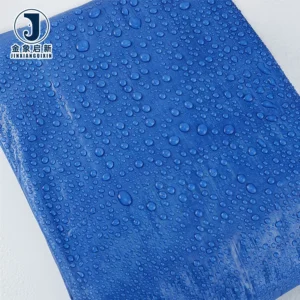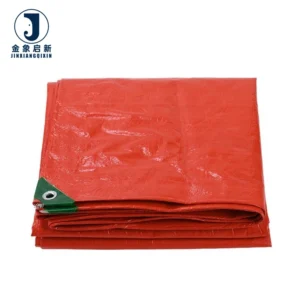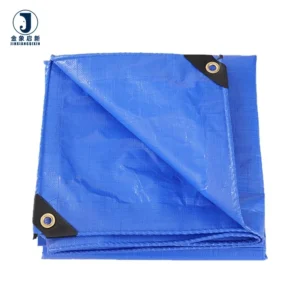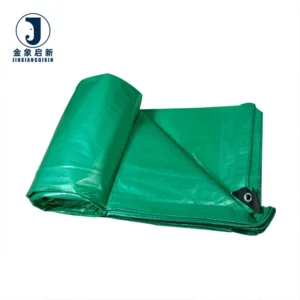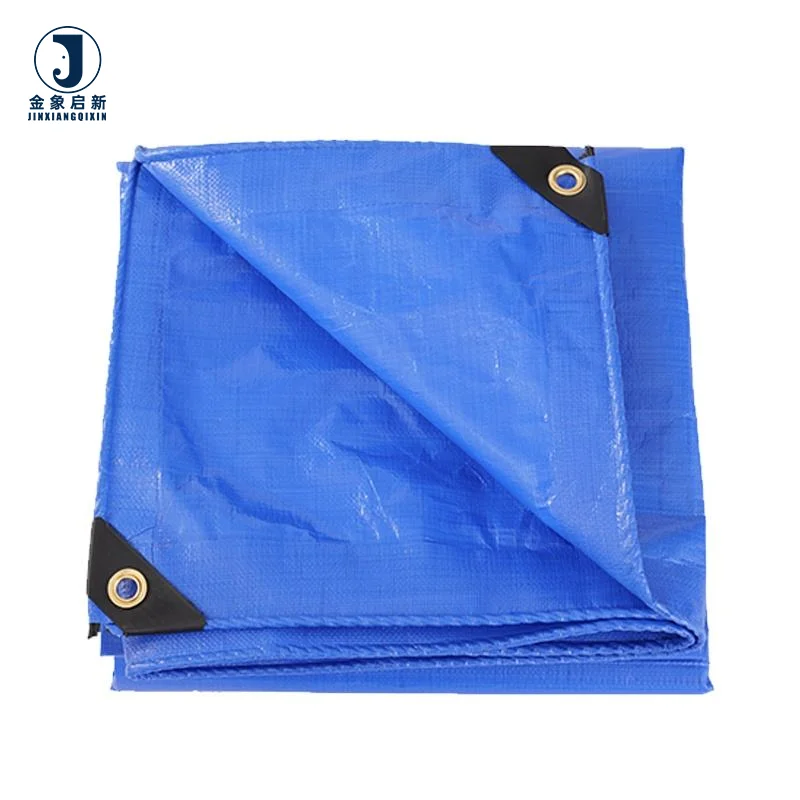
Process-Controlled Fabric Output — HDPE woven base with dual-side LDPE lamination, verified across three weight tiers for transport and construction cover applications.
Technical Specifications
| Parameter | Value |
|---|---|
| Product Type | PE Tarpaulin |
| Coating Material | HDPE weaving with LDPE lamination on both sides |
| Weight (GSM) | 50 g/m² – 220 g/m² (lightweight 80–110 g/m², medium 120–150 g/m², heavy-duty 160–240 g/m²) |
| Total Thickness | 0.18 mm – 0.35 mm (8 mil – 16 mil) |
| Mesh Count | 8×8 / 10×10 / 12×12 |
| Tensile Strength | Meridian 300–1200 N/5cm / Latitude 250–1000 N/5cm (varies by grade) |
| Roll Width Options | 6 ft, 8 ft, 10 ft, 12 ft / 2 m, 4 m, 6 m |
| Roll Length Options | 100 yards, 100 meters, or custom |
| Edge Finish | All four edges reinforced with PP rope in hem |
| Eyelets | Galvanized, spaced every 3 ft or 1 m |
| Corners | Reinforced plastic corners |
| Color Options | Blue, Blue/Orange, Green, Grey, Black, Clear, Grey/Green, Orange, or custom |
| Key Features | Waterproof, washable, tear resistant, mildew proof, anti-aging, UV treatment available (test basis not stated) |
| Certification | ISO, CE |
Application Suitability
| Application | Exposure & Requirement |
|---|---|
| Truck and trailer load cover | Constant road vibration, flex stress at tie-down points, wind uplift, weather exposure |
| Construction site material cover | UV exposure, abrasion from scaffolding and rebar, rain and dust ingress |
| Transport equipment side curtain | Repeated folding and unfolding, friction against load edges, highway-speed airflow |
| Agricultural and warehouse cover | Prolonged sun exposure, moisture, mildew risk in humid storage conditions |
Why Specifying Only GSM Leads to Cover Failure on the Road
A truck cover that tears at the eyelet is rarely a weight problem — it is a reinforcement and fabric balance problem.
When fleet operators specify PE Tarpaulin for truck and transport, the first number on the quotation is almost always the GSM. Yet field failures show that covers fail at stress concentration points: eyelet pull-out, hem separation, and flex cracks near the corners. A heavy-grade sheet with poorly spaced eyelets and no PP rope hem will fail faster than a medium-grade sheet with correct reinforcement layout. [NEED_CITE: relationship between eyelet spacing and tensile load distribution in flexible covers] The specification must address the complete system — base fabric density, lamination adhesion, edge treatment, and hardware placement — not just the weight per square metre.
Fitting the Tarpaulin to the Trailer, Not the Other Way Around
A generic-size cover leaves excess fabric flapping at highway speed, which accelerates abrasion at every contact point and increases wind drag on the load. This PE Tarpaulin aftermarket supplier provides finished cut sizes across a broad range, with custom sizing available for specific truck and trailer models. Providing exact trailer dimensions and tie-down point locations before production ensures the galvanized eyelets align with the fleet’s existing rope and ratchet hardware.
Reinforcement Where the Load Moves Most
Road vibration concentrates stress at the corners and along the hem line, especially on flatbed and curtain-side trailers. All four edges of this PE tarpaulin are reinforced with PP rope sewn into the hem, distributing tie-down tension across a wider fabric area rather than pulling on a single yarn group. Reinforced plastic corners add a second layer at the points most likely to contact sharp load edges. [NEED_CITE: common failure modes of truck tarpaulin at corner reinforcement points]
Reading the Specification Sheet Beyond the Weight Number
Mesh count and tensile strength together define how the fabric behaves under load. An 8×8 weave at lightweight GSM suits short-distance agricultural covering where cost matters more than longevity. A 12×12 weave at heavy-duty GSM delivers substantially higher meridian and latitude tensile values, which directly resist the stretching forces that cause eyelet deformation on long-haul routes. The LDPE lamination on both sides seals the HDPE woven base against water ingress, while the lamination thickness — reflected in the total thickness range from 0.18 mm to 0.35 mm — determines how well the coating resists cracking at fold points during repeated cover and uncover cycles. Selecting the correct combination of mesh count, GSM, and thickness prevents both over-specification for light-duty use and under-specification for heavy transport duty.
The Cost of Getting the Specification Wrong
A batch of covers that measures lighter than the quoted GSM will show accelerated wear at abrasion points, often within the first few trips. Colour variation between rolls in the same fleet order becomes visible once covers are deployed side by side on adjacent trailers, forcing selective replacement and breaking fleet uniformity. UV treatment claimed without a supporting test report means the buyer has no basis to predict service life under prolonged sun exposure. [NEED_CITE: UV degradation testing methods for polyethylene woven fabrics] Welded seams that fail before the base fabric indicate incorrect heat settings during fabrication, not a material defect — and the repair cost falls on the operator, not the supplier.
Why Source This PE Tarpaulin Here
Three full production lines and 36 sets of professional equipment support bulk roll output with consistent delivery scheduling across weight grades and widths. A 10-person R&D team handles custom sizing, pattern layout, and sample development, producing samples within days for fleet-specific trailer dimensions. Dedicated QA/QC at every production stage includes 100% pre-shipment inspection, with measured GSM recorded per roll before container loading. ISO and CE certified processes provide a documented quality baseline for fleet procurement audits. Custom colour, width, and branding are handled within defined lead times and minimums, avoiding the delays typical of spot-market sourcing.
Documentation & Verification
- Measured GSM per roll documented on pre-shipment inspection record
- UV and anti-aging test report provided where treatment is specified
- ISO and CE certificates included with every shipment
- Roll packing list with colour reference and batch number per item
- Certificate of origin and customs documentation prepared for destination market
Fabrication, Handling & Storage
- Heat-seal at moderate temperature to avoid melting the LDPE lamination on both sides
- Space galvanized eyelets at 1 m intervals to match standard tie-down hardware patterns
- Store rolls upright on pallets to prevent permanent creasing across the 6 m maximum width
- Avoid dragging finished tarps over sharp aggregate to protect the LDPE surface coat
- Clean with mild detergent; solvents may degrade the LDPE lamination adhesion
- Allow cold-stored rolls to reach ambient temperature before unrolling to prevent cracking
Requesting the Right Quotation
To receive an accurate specification and lead time, provide the exact trailer model dimensions or the required roll width and length, the intended GSM grade, and the eyelet spacing your fleet hardware requires. If UV treatment is needed for long-haul or outdoor-stored loads, state the destination climate so the correct treatment level can be confirmed with a test report. For custom colour or printed branding, share the Pantone reference and estimated annual volume.
Frequently Asked Questions
Q: How is GSM verified before shipment and what documentation comes with it?
A: Every roll is weighed and measured during pre-shipment inspection. The recorded GSM is listed on the inspection report that accompanies the shipment, so the buyer can compare the delivered weight against the quoted specification before the container is sealed.
Q: Can the tarpaulin be cut to my exact trailer model dimensions?
A: Yes. Provide the trailer floor dimensions, side height, and tie-down point locations. A sample is produced for fitment approval before bulk production begins, ensuring the galvanized eyelets align with your existing rope and ratchet system.
Q: What UV treatment test basis supports the claim for extended outdoor exposure?
A: UV treatment is available and must be specified at the inquiry stage. A test report confirming the treatment level is provided with the shipment documentation, so the buyer has a verifiable basis for the cover’s expected performance under sun exposure.
Q: How are eyelet pull-out and hem strength validated at high-stress points?
A: The PP rope hem distributes tie-down load across the fabric width, and reinforced plastic corners add a second layer at stress points. Pre-shipment inspection includes visual and manual checks on eyelet seating and hem adhesion before the batch is cleared for dispatch.
Q: How do you control colour consistency across multiple rolls in one fleet order?
A: All rolls in a single order are produced from the same LDPE compound batch. A roll-to-roll colour comparison is performed during pre-shipment inspection, and any panel that falls outside the agreed colour reference is excluded before container loading.