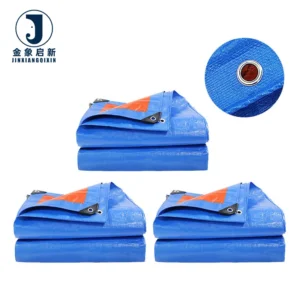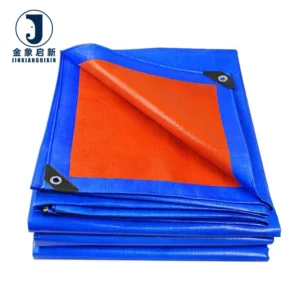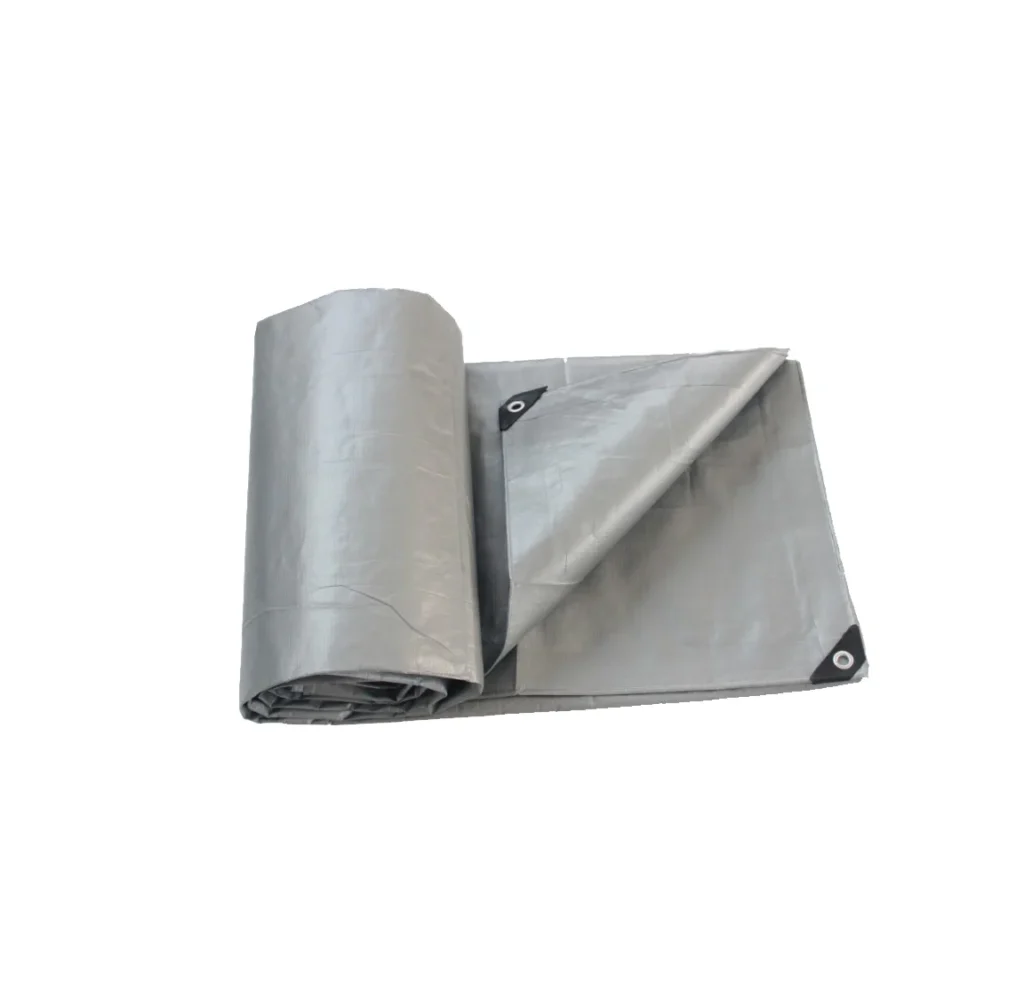
Deep Coating Adhesion Control — our lamination lines bond LDPE to the HDPE woven base under calibrated heat and pressure, reducing delamination risk at hem and eyelet stress points where tie-down loads concentrate on truck and trailer covers.
Technical Specifications
| Parameter | Value |
|---|---|
| Product Type | PE Tarpaulin Roll / Finished PE Tarpaulin |
| Base Fabric | HDPE woven |
| Coating Material | LDPE lamination, both sides |
| Weight Range | 50 g/m² to 220 g/m² (confirm specific grade) |
| Thickness | 0.2–0.4 mm / 8–16 mil / Custom |
| Mesh Count | 6×6 up to 14×16 weave (GSM dependent) |
| Roll Width Options | 6 ft, 8 ft, 10 ft, 12 ft, 2 m, 4 m, 6 m |
| Roll Length Options | 100 yards, 100 meters, or custom |
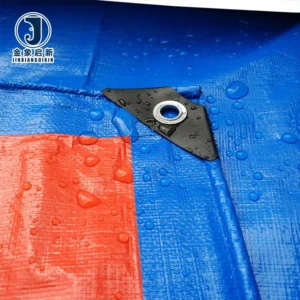
| Waterproof | Yes |
| UV Treatment | Available — test basis not stated in source |
| Mildew & Anti-aging | Yes |
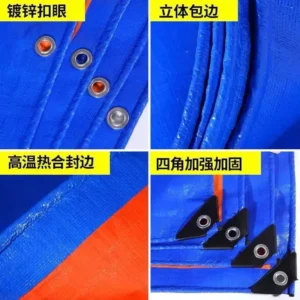
| Finished Hem | PP rope reinforced on all four edges |
| Eyelets | Galvanized, spaced every 3 ft or 1 m |
| Corner Reinforcement | Reinforced plastic patches at corners |
| Color Options | Blue, Blue/Orange, Green, Grey, Black, Clear, Grey/Green, Orange, or custom |
| Certifications | ISO, CE |
Application Suitability
| Application | Exposure & Requirement |
|---|---|
| Flatbed truck load covering | Road vibration, wind uplift at speed, repeated tie-down strap cycles, rain and spray |
| Trailer side curtain fabric | Constant flexing at hinge points, abrasion against load edges, UV from prolonged outdoor parking |
| Container top sheeting | Stacking compression, salt-laden atmosphere in port transit, thermal cycling across climates |
| Pallet wrap for LTL freight | Forklift contact abrasion, short-term weather exposure on loading docks, strap tension at edges |
| Equipment transport covers | Irregular load shapes creating flex zones, tie-down point stress, dust and debris ingress |
Why Generic-Sized Truck Covers Fail Where Custom-Cut PE Tarpaulin Succeeds
A cover that does not match the trailer dimensions creates slack zones — and slack is where wind, water, and abrasion do their worst.
Fleet operators regularly receive PE tarpaulin for truck and transport covering cut to nominal sizes that leave either excess fabric flapping in the slipstream or insufficient overlap at the tailgate. Excess material catches wind at highway speed, generating a parachute effect that accelerates eyelet pull-out and hem tearing. Insufficient overlap exposes the load edge to rain ingress and road debris. The problem compounds when different trailer models in the same fleet receive identical "standard" covers. A flatbed with side rails requires a different drape profile than a curtain-sider or a step-deck [NEED_CITE: truck trailer dimension variability across fleet configurations]. Custom cut-to-size finished PE tarpaulins eliminate this mismatch by matching the cover pattern to the specific trailer geometry, including allowance for strap routing and tailgate clearance.
Matching Weave Density to Road Exposure Conditions
The HDPE woven base fabric is available in mesh counts from 6×6 to 14×16, each corresponding to a GSM band. Lower-density weaves at 50–80 g/m² serve short-haul or light-duty pallet protection where weight savings matter and exposure duration is brief. Higher-density weaves at 120–220 g/m² provide the tensile reserve needed for long-haul flatbed runs where the cover endures sustained wind load, strap tension across sharp load edges, and continuous UV exposure. Selecting the correct weave-to-GSM match ensures the PE tarpaulin for truck and transport covering performs without premature failure at the hem line or eyelet ring.
Edge Reinforcement That Absorbs Tie-Down Cycles
Every finished sheet in this range carries PP rope threaded through a folded hem on all four edges, with galvanized eyelets set at 3-foot or 1-meter intervals. The rope distributes strap tension across the hem width rather than concentrating it at individual eyelet holes. Reinforced plastic corner patches add a secondary load path at the four points where tie-down straps apply the highest peel force. This combination addresses the failure mode where eyelets tear through the laminate after repeated tightening and release cycles on the road [NEED_CITE: eyelet pull-out as primary failure mode in transport tarpaulins].
Reading the Mesh Count and GSM Relationship
Mesh count alone does not determine strength, and GSM alone does not determine durability. A 10×10 weave at 100 g/m² uses finer HDPE tape yarns woven more tightly, producing a smoother surface with good tear propagation resistance but moderate puncture resistance. An 8×8 weave at the same 100 g/m² uses thicker tape yarns in a more open construction, yielding higher puncture resistance but a rougher surface. The LDPE lamination on both sides fills the weave interstices and provides the waterproof barrier regardless of mesh selection. Understanding this relationship lets fleet specifiers choose the construction that matches their dominant failure mode — whether that is abrasion from load contact or puncture from shifting cargo edges.
The Cost of Overlooking Batch Consistency Across Rolls
When multiple rolls or finished sheets from the same order show visible colour variation once installed side by side on adjacent trailers, the entire fleet presentation suffers and the buyer faces a credibility problem with their own customers. This issue typically traces to inconsistent masterbatch dosing during the LDPE lamination stage or temperature variation across the coating head. For fleet operators running dozens of vehicles in corporate livery colours, specifying a single production batch for the full order and requesting a pre-shipment roll-by-roll colour check prevents costly re-sorting or partial returns [NEED_CITE: colour consistency control in LDPE lamination production runs].
Why Procurement Teams Source This PE Tarpaulin Range Here
Our facility runs three dedicated production lines with 36 sets of professional equipment, giving the capacity to fulfil full-container orders on typical multi-week lead times without splitting production across external workshops. A 10-person R&D team handles pattern development, custom sizing and sample fabrication, producing approval samples within days rather than weeks. QA inspectors check coating weight, hem stitching, eyelet spacing and corner patch placement at each stage, with 100% pre-shipment inspection before any roll or bale leaves the warehouse. The coating process controls — lamination temperature, nip pressure and line speed — are calibrated per GSM grade to maintain adhesion consistency across the production run. Custom widths, colours and printed branding are accommodated without prohibitive minimums that block mid-size fleet orders.
Documentation & Verification
- Material specification sheet listing confirmed GSM, HDPE base weave count and LDPE lamination weight per roll
- Pre-shipment inspection record showing eyelet spacing, hem rope insertion and corner patch placement verification
- Roll packing list matched to container loading plan for bale or roll shipment configuration
- Colour reference swatch retained from production batch for post-delivery comparison
- Certificate of origin and customs documentation prepared for destination market requirements
Fabrication, Handling & Storage
- Heat-seal finished sheets at moderate temperature settings suited to LDPE lamination to avoid melt-through on lighter GSM grades
- Route tie-down straps through galvanized eyelets only — never over unreinforced field areas where puncture risk is high
- Store rolls on hard paper tubes horizontally to prevent flat-spot creasing that weakens the LDPE coating layer
- Unfold finished tarps at ambient temperature; cold-stiffened LDPE can crack if forced open in freezing conditions
- Clean with mild detergent and soft brush — aggressive solvents degrade the LDPE lamination surface
- Allow 5–8% drape allowance when specifying custom cut sizes to accommodate load height variation and strap tension
What to Include in Your Enquiry
Provide the specific trailer model or flatbed dimensions so we can recommend finished sheet sizes with correct overlap and strap routing clearance. Indicate the GSM range or weave density you have used previously and any failure modes observed, such as hem tearing or eyelet pull-out, so we can align the construction to your operating conditions. If colour consistency across the fleet is critical, specify the Pantone or RAL reference and confirm whether the full order must ship as a single production batch.
Frequently Asked Questions
Q: How is GSM consistency ensured from roll to roll across a single order?
A: Each roll is weighed and measured during the pre-shipment inspection to verify it falls within the stated GSM tolerance. The production line is calibrated for the specific mesh count and lamination weight before the run begins, and in-process QA checks at the coating head catch drift before it accumulates. We retain a reference swatch from each batch for your verification on arrival.
Q: Can finished PE tarpaulin sizes be specified per trailer model rather than generic dimensions?
A: Yes. Provide the trailer make, model and body dimensions including side rail height and tailgate configuration. We cut and finish each sheet to match, with hem rope, eyelet spacing and corner reinforcement positioned to align with your strap routing pattern, eliminating the slack zones that generic sizes create.
Q: What reinforcement is standard at eyelets and hem lines where flex stress concentrates?
A: All four edges carry a PP rope inserted into a folded hem, spreading strap tension across the full hem width. Galvanized eyelets are set every 3 feet or 1 meter, and reinforced plastic corner patches are applied at all four corners where tie-down force peaks. This construction resists pull-through under repeated tightening cycles.
Q: How is colour variation between rolls controlled within one shipment?
A: Colour consistency depends on masterbatch dosing accuracy and lamination temperature stability during production. For fleet orders where side-by-side colour match matters, we schedule the full quantity as a single production run and conduct a visual check against the retained reference swatch before packing. Request batch consolidation at the enquiry stage.
Q: What evidence supports the UV treatment claim for prolonged outdoor road exposure?
A: UV treatment is available as an option during the LDPE lamination stage, but the specific test basis and exposure rating should be confirmed for your market and operating conditions. Request the applicable test report at the quotation stage so you can verify that the treatment level matches the expected service environment for your fleet.