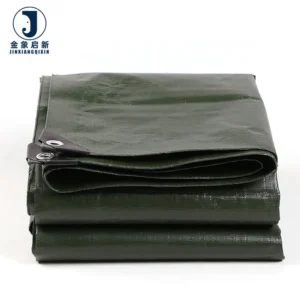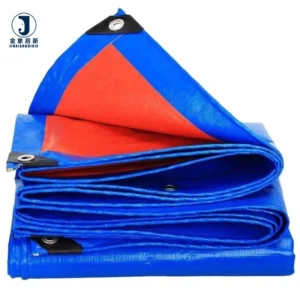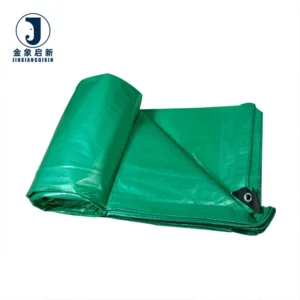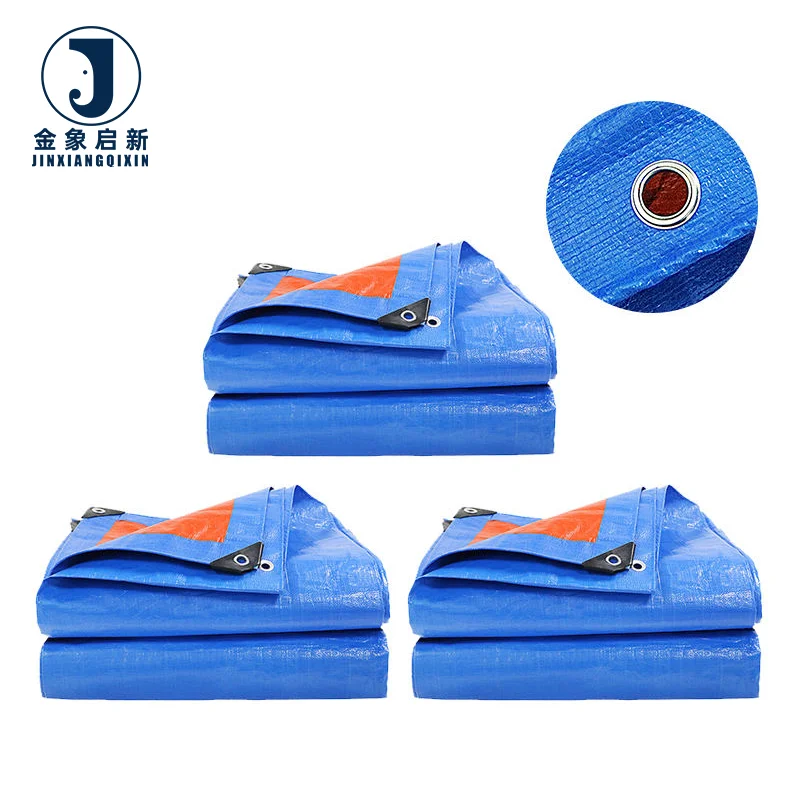
Truck load coverage — PE tarpaulin cut and finished to exact trailer model dimensions, securing fleet loads against road and weather exposure.
Technical Specifications
| Parameter | Value |
|---|---|
| Product Type | PE Tarpaulin |
| Coating Material | HDPE weaving with LDPE lamination on both sides |
| Weight Range | 50 g/m² to 220 g/m² (confirm the specific grade required for your fleet) |
| Total Thickness | 0.18–0.22 mm (lightweight) / 0.22–0.28 mm (medium) / 0.30–0.35 mm (heavy-duty) |
| Mesh Count | 8×8 / 10×10 / 12×12 |
| Tensile Strength (N/5cm) | Meridian 300–500 / Latitude 250–450 (lightweight) |
| Roll Width | 6ft, 8ft, 10ft, 12ft, 2m, 4m, 6m |
| Roll Length | 100 yards, 100 meters, or custom |
| Finished Tarpaulin Sizes | 2×2m to 8×10m (multiple standard and custom dimensions) |
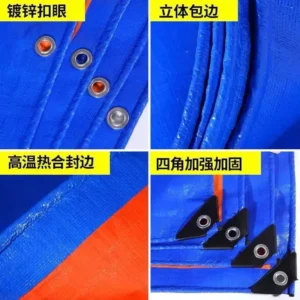
| Eyelet & Hem | PP rope reinforced hem on all four edges; galvanized eyelets every 3ft or 1m; reinforced plastic corners |
| Color | Blue, Blue/Orange, Green, Grey, Black, Clear, Grey/Green, Orange, or custom |
| UV Treatment | Available (confirm test basis required for your operating region) |
| Key Features | Waterproof, anti-mildew, tear resistant |
Application Suitability
| Application | Exposure & Requirement |
|---|---|
| Truck and trailer flatbed loads | Constant road abrasion, wind flap, UV exposure, tie-down tension at flex points |
| Side curtain fabric for transport equipment | Repetitive folding and unfolding, lateral wind pressure, weather sealing |
| Regional and long-haul tie-down covers | Load shift restraint, high-speed airflow stress, secure eyelet anchoring |
| Construction material transport | Dust containment, moisture protection, site handling and re-deployment |
Why Generic-Sized Covers Fail on Specific Trailer Models
PE tarpaulin for truck and trailer cover applications must match the exact vehicle dimensions to prevent load exposure and fabric damage.
Fleet operators frequently receive truck covers cut to a generic size that does not fit the specific trailer model [NEED_CITE: common causes of tarpaulin failure on commercial fleets]. The result is excess fabric flapping at speed, which accelerates edge tearing and eyelet pull-out. Insufficient coverage leaves load edges exposed to rain and road spray. Covers that are too tight place excessive tension on hems during transit, causing premature seam failure. Dimensional accuracy during cutting and finishing directly determines service life and load protection.
Dimensional Fitment for Fleet Vehicles
Every trailer model has distinct deck dimensions, side profile geometry, and tie-down anchor points. A PE tarpaulin for truck and trailer cover use must be cut to those exact measurements with allowance for edge reinforcement and eyelet placement. Fleet operators specifying covers by roll stock can provide vehicle drawings for pattern confirmation before cutting begins. This approach eliminates on-site trimming and ensures consistent coverage across an entire fleet of identical trailers.
Load Restraint and Edge Integrity
The points where a truck cover flexes most — typically at load edges and tie-down anchors — experience the highest abrasion and stress [NEED_CITE: tensile and tear test methods for coated fabrics per ISO 1421]. The PP rope reinforced hem on all four edges distributes tie-down load across the full perimeter rather than concentrating force at individual eyelets. Galvanized eyelets set at 3ft or 1m intervals provide sufficient anchor points for ratchet straps without creating excessive puncture concentration in the fabric.
Weight Grade Selection for Transport Duty
The three available weight tiers correspond to distinct transport conditions. Lightweight grades suit short-haul, enclosed-route coverage where the cover sees minimal abrasion. Medium grades balance weight and durability for regional routes with mixed weather exposure. Heavy-duty grades provide the mesh density and lamination thickness needed for long-haul routes where wind flap and road debris impact are constant. Selecting the correct grade prevents over-specifying cost or under-specifying durability.
How Mesh Count and Lamination Determine Field Performance
Mesh count directly influences how the HDPE woven base resists tearing under load. An 8×8 mesh provides adequate performance for light covers, while 12×12 mesh creates a tighter weave that limits tear propagation when the fabric is punctured or nicked during handling. The LDPE lamination on both sides seals the weave, providing waterproof integrity that prevents moisture ingress at the thread intersections. Together, mesh density and lamination thickness define the balance between flexibility and puncture resistance. Heavier lamination adds stiffness, which can be advantageous for flatbed covers but restrictive for side curtain applications requiring frequent folding.
The Cost of Incorrect Specification at the Tie-Down Point
When eyelet spacing is too wide for the tie-down pattern on a specific trailer, straps cannot be anchored at proper intervals, leaving sections of the PE tarpaulin unsupported and prone to wind flap damage [NEED_CITE: load restraint standards for commercial road transport]. When hem reinforcement is omitted or under-specified, the concentrated force from a single ratchet strap can tear through the unreinforced edge within weeks of deployment. Colour inconsistency between rolls delivered for the same fleet order becomes visible once covers are installed on adjacent trailers, reflecting poorly on fleet presentation and indicating potential batch-to-batch variation in material quality.
Sourcing Reliability for Transport Fabric
Three full production lines and 36 sets of professional equipment provide the capacity needed to fulfil fleet orders on schedule without compromising process control. A dedicated 10-person R&D team handles vehicle-specific pattern development and sample confirmation before bulk production begins. Every production stage includes QA checkpoints, with 100% pre-shipment inspection verifying dimensions, eyelet spacing, hem integrity, and colour match before container loading. Samples are developed within days for custom sizing and finish requirements, allowing fleet operators to confirm fitment before committing to the full order volume.
Documentation & Verification
- Material specification sheet stating confirmed GSM and base fabric mesh count
- UV treatment test report where applicable for outdoor transport exposure
- Pre-shipment inspection record confirming dimensions and eyelet placement per order
- Roll packing list with batch reference for fleet traceability
- Certificate of origin and customs documentation for export shipment
Fabrication, Handling & Storage
- Heat-seal parameters must match the LDPE lamination thickness to prevent delamination at weld lines.
- Galvanized eyelets require correct die pressure during setting to avoid cracking the reinforced plastic corners.
- Roll stock should be stored upright on pallets to prevent permanent crease marks in the HDPE weave.
- Cold-weather deployment requires gradual unfolding to prevent lamination cracking at low temperatures.
- Cut panels should be cleaned with mild detergent; solvent-based cleaners can degrade the LDPE surface.
Specification and Sizing for Your Fleet
Confirm the trailer model dimensions, required weight grade, and preferred colour for your fleet covers. Specify whether you need finished panels with eyelets and reinforced hems, or roll stock for in-house fabrication. If UV treatment is required for your operating region, indicate the test standard your market requires. Providing annual volume estimates helps determine production scheduling and batch consistency planning.
Frequently Asked Questions
Q: How is GSM verified on PE tarpaulin to match the quoted specification on arrival?
A: Every roll undergoes weight verification against the stated GSM during pre-shipment inspection. The actual measured weight is recorded and included with dispatch documentation, so the material received matches the specification confirmed at order placement without reliance on supplier declaration alone.
Q: What eyelet spacing and hem reinforcement options are available for truck cover applications?
A: Standard configuration includes PP rope reinforced hems on all four edges with galvanized eyelets every 3ft or 1m interval and reinforced plastic corners. Custom spacing can be produced to match specific trailer tie-down anchor patterns, ensuring straps align with reinforced points.
Q: Can truck covers be cut to specific trailer model dimensions, and what is the lead time?
A: Covers are cut to exact trailer dimensions based on vehicle drawings you provide. A sample is developed for fitment confirmation before bulk production proceeds. Lead time depends on order volume and customisation level, confirmed at the quotation stage with your specific requirements.
Q: What UV treatment test evidence is provided for PE tarpaulin used in long-term outdoor exposure?
A: UV treatment is available and the applicable test report is supplied with shipment documentation where requested. Specify the test standard required for your operating region at the inquiry stage so the correct treatment grade and supporting documentation are prepared for your delivery.