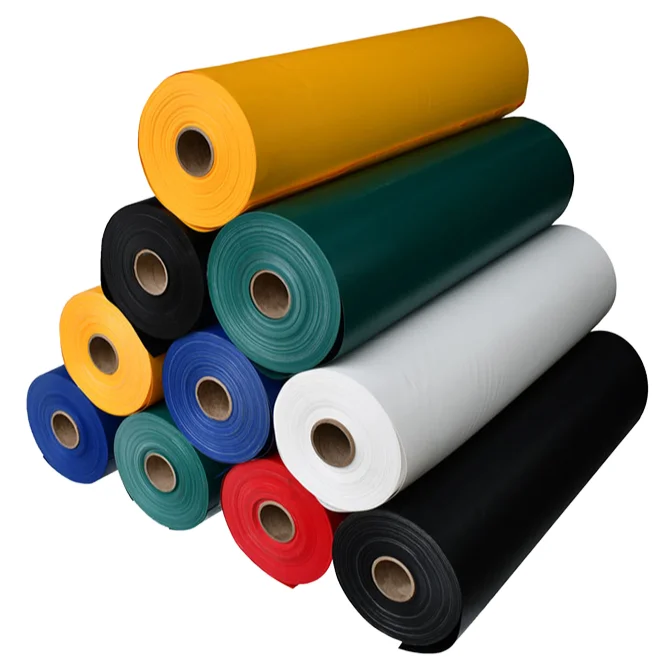
Coating Control Precision — Every roll of PVC coated tarpaulin fabric is produced with strict adhesion and weight monitoring across three full coating lines, ensuring consistent performance from the first metre to the last.
Technical Specifications
| Parameter | Value |
|---|---|
| Product Type | PVC Coated Tarpaulin Fabric |
| Material | PVC + High-strength polyester mesh fabric |
| Coating Method | Laminated technology & Hot-melt Coating technology |
| Weight (GSM) | 350gsm / 420gsm / 500gsm / 550gsm / 600gsm / 750gsm |
| Total Thickness | 0.32mm / 0.35mm / 0.4mm / 0.45mm / 0.5mm / 0.65mm |
| Roll Size | 2m width × 75m length / 2.1m width × 50m length |
| Color Options | Blue, Red, Yellow, Light blue, Grey (Customized) |
| Anti-Static Treatment | Available — confirm the grade required for your application |
| UV Treatment | Sunproof — test basis available on request |
| Flame Retardant | Available — confirm the grade required for your market |
| Key Features | Cold crack resistance, anti-mildew, waterproof, best color fastness, outstanding tearing strength for welding |
| Service Life | 3–7 years under normal circumstances |
Application Suitability
| Application | Exposure & Requirement |
|---|---|
| Truck awning | Constant flexing at mounting points, road debris abrasion, prolonged sun and rain exposure requiring high adhesion at welded seams |
| Tent cover | Wind load stress on panel seams, UV degradation over seasonal use, need for consistent colour across multiple panels |
| Cargo ship cover | Salt spray, heavy moisture, mechanical wear from lashing straps; demands waterproof integrity and mildew resistance |
| Fish tank / pool liner | Continuous water immersion, chemical contact from treatment agents, puncture risk from substrate contact |
Why the Wrong GSM Selection Costs More Than the Fabric Itself
Matching the gsm to the mechanical load and environment prevents premature failure at the seam and flex point.
Buyers often specify a mid-range PVC coated tarpaulin fabric grade based on budget, only to discover that the installed cover fails first at the weld line where the load flexes most. A lighter weight may pass the quotation check but lacks the base fabric density needed to hold a heat-welded seam under repeated tension. [NEED_CITE: tensile and tear test methods for coated fabrics per ISO 1421]
Fleet operators replacing side-curtain fabric on curtain-sider trailers face this pattern repeatedly: the fabric body remains intact while the seam delaminates, forcing a full panel replacement well before the expected service interval. Specifying a grade with documented tearing strength for welding, rather than relying on gsm alone, shifts the decision from price-per-kilo to cost-per-service-year.
Hot-Melt Coating and Seam Integrity Under Repeated Flex Load
The hot-melt coating technology used in this PVC coated tarpaulin fabric range creates a direct bond between the PVC layer and the high-strength polyester mesh base. This adhesion method is critical for fabricated products like truck awnings and tent panels, where heat-welded seams must withstand continuous flexing without peeling apart from the base fabric.
When the coating is properly fused to the yarn structure, the welded seam becomes a continuation of the fabric rather than a weak boundary. For transport and tent applications, this means the stress at tie-down points and panel edges transfers across the full material thickness instead of concentrating at a single interface.
Roll-to-Roll Colour Consistency Across Fleet Orders
Batch colour variation between rolls is a common source of rejection when multiple truck awnings or tent covers are fabricated for the same fleet or project. Even slight shade differences become visible once panels are installed side by side in natural light.
This PVC coated tarpaulin fabric is produced with colour fastness controls aimed at maintaining consistency within a single production run. [NEED_CITE: color fastness testing standards for coated technical textiles] When ordering multiple rolls for a fleet covering project, confirming the batch alignment before dispatch avoids costly rework and client complaints after installation.
Reading the Specification Sheet Beyond the Weight Number
The relationship between gsm, base fabric denier, and coating thickness determines how the material behaves in real use. A 600gsm fabric with a dense polyester mesh and thinner coating may outperform a 600gsm fabric with a loose weave and thick coating when it comes to tear propagation resistance.
The laminated and hot-melt coating technologies offered across this range serve different fabrication requirements. Hot-melt coating typically delivers stronger PVC-to-yarn adhesion, which directly influences how well a heat-welded seam holds under load. Laminated construction offers a different balance of flexibility and coating weight, suited to applications where drape and folding behaviour matter more than weld strength.
Roll width options of 2m and 2.1m affect fabrication yield significantly. A wider roll reduces the number of lateral seams needed for large-format covers such as cargo ship tarps or tent roof panels, lowering both labour cost and potential leak points. The available thickness range from 0.32mm to 0.65mm correlates with the gsm grades, giving fabricators a clear basis for selecting the right combination of stiffness, weight, and handling characteristics.
The Hidden Cost of Specifying by Price Per Kilo
Choosing a PVC coated tarpaulin fabric grade purely on unit cost often leads to early seam failure, particularly at stress points where the cover is tied down or flexed during transport. The cover may look intact from a distance, but close inspection reveals delamination at the weld line. [NEED_CITE: common failure modes in PVC coated fabric covers for transport applications]
Batch colour inconsistency is another consequence of sourcing without roll-level verification. When rolls from different production batches are fabricated into covers for the same fleet, shade variation forces partial replacement or full rejection — a cost that far outweighs any initial savings on the material.
Flame retardant or anti-static requirements specified without a documented grade create compliance risk at the project inspection stage. A cover that cannot produce a valid test certificate against the site specification will not pass acceptance, regardless of how the material performs in other areas.
Sourcing Advantages Built Into the Production Line
Deep process control over coating weight and adhesion across three full production lines ensures that each roll meets the stated specification, not just the nominal grade. This control directly supports fleet operators who need every cover to perform identically.
A 10-person R&D team handles material selection and sample development for custom width, colour, and GSM requirements, providing roll stock that matches project specifications without forcing buyers into a standard catalogue option.
Dedicated QA/QC at every production stage, with 100% inspection before shipment, catches coating defects, colour drift, and weight deviation before the roll leaves the facility. This reduces the risk of receiving material that requires rework or rejection upon arrival.
Sample development within days allows buyers to test weld parameters, colour match, and fabrication behaviour before committing to a full container order — a practical step that prevents costly surprises at the production scale.
Documentation & Verification
- Material specification sheet confirming GSM, base fabric construction, coating method, and colour reference for each roll ordered
- Weight verification per roll against the stated GSM before dispatch, not just quotation-level confirmation
- UV and flame retardant test reports matched to the specific production batch where applicable
- ISO and CE certificates included in the shipment documentation package
- Pre-shipment inspection record detailing roll-by-roll quality checks
- Roll packing list and certificate of origin provided for customs clearance support
Fabrication, Handling & Storage
- Heat-weld seams at temperatures suited to the hot-melt or laminated coating type to maximise adhesion at flex points
- Reinforce eyelet zones with additional PVC patches on heavier GSM grades to distribute tie-down load evenly
- Store rolls upright on end cores to prevent flat-spot creasing that weakens the coating at the fold line
- Allow cold-stored rolls to reach ambient temperature before unrolling to avoid cracking in cold-crack resistant grades
- Clean surfaces with mild detergent only; abrasive solvents may degrade the PVC coating and affect colour fastness
- Plan cutting layout on 2.1m width rolls to minimise lateral seams on large-format truck awnings and tent roof panels
What We Need From You to Quote Accurately
To provide the correct PVC coated tarpaulin fabric grade, we need your application type and the primary mechanical and environmental loads the cover will face. Specify the target market so we can align any fire safety or anti-static requirements with the applicable regional standard.
Provide the roll width, GSM preference or range, and estimated annual volume to allow accurate lead time and batch planning. If you require finished covers cut to specific dimensions rather than roll stock, include the panel sizes and any eyelet or hem reinforcement details. Request a sample roll or swatch if colour matching or weld parameter testing is needed before bulk commitment.
Frequently Asked Questions
Q: Can you match a specific Pantone or RAL colour across multiple rolls?
A: Yes, custom colours are available within this PVC coated tarpaulin fabric range. We develop a lab dip for your approval before production and run all rolls for a single order within the same batch to maintain colour consistency. A colour reference sample is included with the shipment for your verification on receipt.
Q: What test reports accompany UV-resistant and flame-retardant grades?
A: Where UV or flame retardant treatment is specified, we provide test reports from the production batch. The applicable test standard is documented on the report. Confirm the grade and certification required by your market or project specification at the inquiry stage so we match the correct treatment.
Q: What is the minimum order for a custom width or GSM?
A: Minimum order quantities vary depending on whether the specification is a stock grade or a custom production run. Standard roll widths and GSM grades carry lower minimums, while custom widths or non-standard colours require a dedicated production slot. Share your required specification and volume for a confirmed minimum and lead time.
Q: How are welded seams tested before shipment?
A: During production, welded seam samples are taken at regular intervals and tested for peel and tear strength. Results are recorded in the pre-shipment inspection documentation. If your application demands a specific weld performance threshold, share the requirement at the inquiry stage so it is included in the production quality plan.
Q: Do you supply finished truck covers cut to specific dimensions, or fabric only?
A: Both options are available. We supply PVC coated tarpaulin fabric by the roll for fabricators who cut and weld in-house, and we also produce finished covers cut to your specified panel sizes with eyelets and reinforced hems as required. Indicate your preference and dimensions at the inquiry stage for accurate quotation.