Process-Controlled Coating — Nearly 30 years focused on PVC coated fabric, maintaining tight tolerances on coating weight and adhesion across every roll produced for transport and fleet applications.
Technical Specifications
| Parameter | Value |
|---|---|
| Product Type | PVC Coated Tarpaulin |
| Weight Range | 500gsm–1000gsm (confirm the grade for your application) |
| Base Fabric Denier Options | 500D×840D / 500D×1000D / 1000D×1000D / 1000D×1300D / 1300D×1300D / 1000D×2000D |
| Mesh Count Options | 30×19 / 20×20 / 30×15 |
| Coating Material | PVC |
| Coating Method | High frequency hot melt / Hot air / Sewing |
| Total Thickness Options | 0.29mm / 0.32mm / 0.38mm / 0.44mm / 0.46mm / 0.55mm / 0.65mm |
| Roll Width | 2m / 2.1m |
| Tensile Strength (Warp) | Up to 3900 N (test basis not stated in source) |
| Tensile Strength (Weft) | Up to 3500 N (test basis not stated in source) |
| Flame Retardant | Available in flame retardant grades — confirm the grade required for your market |
| UV Treatment | Anti-UV treatment available — confirm test standard for your destination market |
| Anti-Mildew | Anti-mildew treated |
| Waterproof Rating | Fully waterproof coated construction |
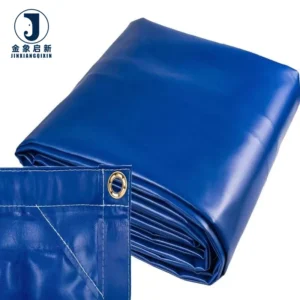
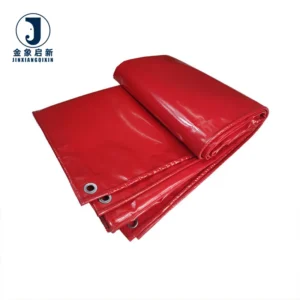
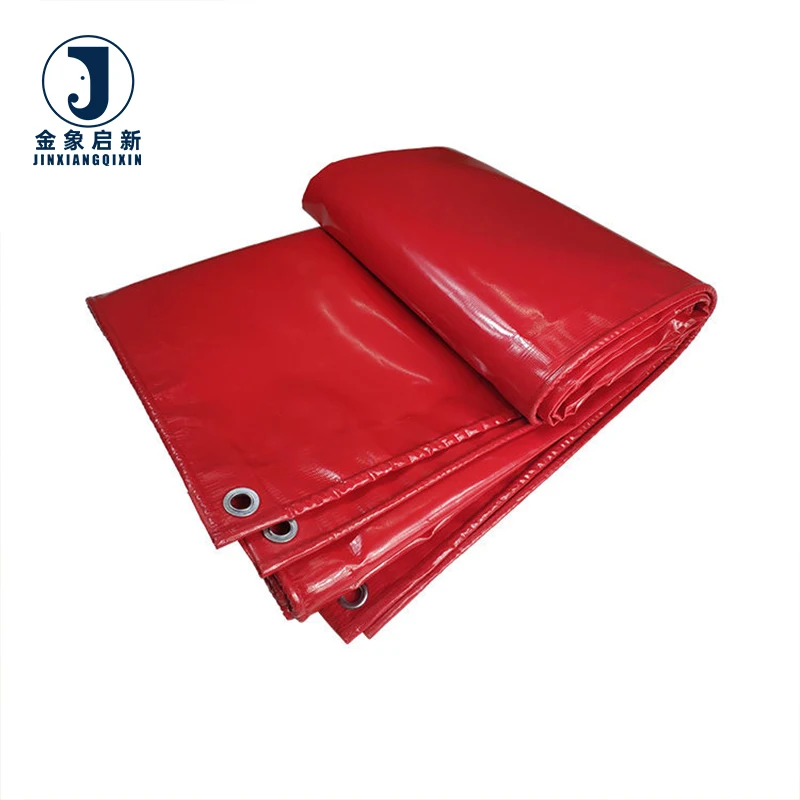
| Eyelet Options | 3cm enlarged aluminum alloy buttonhole with reinforced corners on all sides |
| Hem Construction | 5mm thick rope without splicing; high temperature heat sealed seamless edge wrapping |
| Printing | Printable, customized |
| Certification | ISO and CE |
| Density | 1.15–2.00 g/cm³ |
| Brittle Temperature | ≤ -50 to -60°C |
| Softening Temperature | ≥ 80°C |
| Melting Point | 212°C |
Application Suitability
| Application | Exposure & Requirement |
|---|---|
| Truck and trailer top roof covers | Constant UV exposure, wind uplift load, rain ingress at highway speed, repeated tension cycles at tie-down points |
| Side curtain fabric for curtain-siders | Continuous flexing at fold lines, road debris abrasion, lateral wind pressure, daily roll-up and deployment |
| Pallet and equipment covers on flatbeds | Abrasion from load shifting, UV and rain exposure during multi-day transit, forklift handling stress |
| Transport equipment OEM fitment | Model-specific cut dimensions, consistent colour across production batches, welding compatibility with curtain track systems |
Why Generic-Size Truck Covers Leave Your Cargo Exposed
Custom-cut PVC coated tarpaulin for truck and transport eliminates the gaps, loose folds and premature edge failures that generic covers create on specific trailer models.
Fleet operators who buy off-the-shelf truck covers often find that the fabric bunches at the rear or pulls away from the front bulkhead, leaving cargo vulnerable to rain ingress and road spray. A generic cover cannot account for the exact roof curvature, side rail spacing or rear door configuration of your trailer. When the PVC coated tarpaulin for truck and transport is cut to match your vehicle dimensions, the tension distributes evenly across every eyelet, and the heat-sealed hems sit flat against the bodywork instead of flapping in the slipstream [NEED_CITE: DIN 53354 tensile and tear test methods for coated fabrics].
Cut to Your Trailer, Not a Catalogue Size
Every PVC coated tarpaulin for truck and transport we produce starts with your vehicle’s exact dimensions — roof length, side height, rear overhang and curtain track profile. Our 10-person R&D team develops a sample cut within days, so you can verify the fit on a live trailer before committing to the production run. The base fabric denier is selected to match the stress profile of your specific trailer type, from lighter 500D×840D for urban delivery vehicles up to 1000D×2000D for long-haul curtain-siders that face sustained highway wind loads.
Heat-Sealed Hems That Outlast the Fabric at Flex Points
The most common failure point on a truck cover is not the fabric itself but the welded seam where the load flexes most — typically along the bottom hem and around eyelet rows. Our high temperature heat sealed seamless edge wrapping achieves high adhesion between the PVC coating layers, eliminating the glue cracking and loose edges that appear after repeated tension cycles on the road. The 5mm thick rope hem, inserted without splicing, distributes tie-down tension evenly across the full perimeter so that no single eyelet carries a disproportionate share of the highway wind load.
Reading the Specifications Beyond GSM
Weight alone tells you how much PVC sits on the base fabric, but it does not tell you how the fabric will behave when a forklift pushes a pallet against it or when wind gusts hit a curtain-sider at speed. The base fabric denier and mesh count work together with the coating to determine tear propagation resistance — a 1000D×1000D weave at 30×19 mesh count resists tear spread differently than a 500D×840D at 20×20, even if both carry the same coating weight. Total thickness, ranging from 0.29mm to 0.65mm across the available grades, influences how the material folds into curtain tracks and how it handles abrasion against load edges. The brittle temperature of ≤ -50 to -60°C and softening temperature of ≥ 80°C define the operating envelope for cold-chain routes and hot-climate transit [NEED_CITE: low-temperature flex testing for PVC coated fabrics in transport].
When the Wrong Specification Reaches Your Fleet
Specifying a PVC coated tarpaulin for truck and transport without verifying the base fabric denier against the actual load stress leads to covers that tear at the first tie-down point under highway vibration. A batch where colour drifts between rolls becomes visible the moment two panels hang side by side on the same trailer, forcing a fleet operator to reject an entire shipment. When the heat-seal temperature or dwell time is set for a different coating formulation, the weld line fails before the fabric does — typically at the bottom hem where the curtain meets the trailer bed. These failures rarely show up during a static warehouse inspection; they appear after the first loaded trip [NEED_CITE: weld seam peel strength testing per ISO 1421 for coated fabrics].
Why Transport Buyers Source From This Line
Three full production lines and 36 sets of professional equipment support bulk capacity with reliable on-time delivery for fleet-scale orders, so your replacement cycle stays on schedule. Dedicated QA/QC runs at every production stage with 100% inspection before shipment — cut dimensions are verified against your trailer model drawing, not a generic template. The 10-person R&D team handles material selection, custom sizing and sample development, producing fitment samples within days rather than weeks. Deep process control over coating weight and adhesion means the GSM stated on your quotation is the GSM that arrives at your dock.
Documentation & Verification
- Material specification sheet stating exact GSM, base fabric denier and coating weight for each roll
- Pre-shipment inspection record confirming cut dimensions match your specific trailer model drawing
- Test report for UV and flame-retardant grades where applicable to support treatment claims at destination
- Roll packing list with net and gross weights for container loading verification
- Certificate of origin and customs documentation for cross-border clearance
- ISO and CE certificates covering the production facility and coated fabric output
Fabrication, Handling & Storage
- High frequency hot melt welding suits the PVC coating on this material; verify dwell time against the specific thickness grade selected
- 3cm enlarged aluminum alloy buttonholes distribute tie-down load across the reinforced corner patches, reducing pull-through risk
- 5mm rope hem without splicing maintains even tension — avoid cutting into the rope channel during on-site repairs
- Store rolls upright on a flat surface to prevent permanent creasing in the PVC coating layer
- Clean with mild detergent only; solvent-based cleaners can soften the PVC coating and reduce surface adhesion at repair patches
- When unrolling in cold conditions below 0°C, allow the material to acclimatise before folding to avoid coating micro-cracks near the brittle temperature boundary
What We Need to Quote Your Transport Cover
To provide an accurate specification and sample, share your trailer make and model with roof length, side height and curtain track type. Let us know the operating climate — cold-chain, tropical or temperate — so we can recommend the appropriate base fabric denier and treatment package. Advise whether you need finished covers with eyelets and hem reinforcement or roll stock for your own fabrication line. If colour matching or printed fleet branding is required, provide your Pantone or RAL reference so we can develop a sample for approval before production.
Frequently Asked Questions
Q: How do you ensure the truck cover is cut to fit my specific trailer model rather than a generic size?
A: We request your trailer’s technical drawing or physical dimensions including roof curvature, side rail spacing and rear door configuration. Our R&D team produces a sample cut for you to test-fit on the actual vehicle before production begins, and every finished cover is measured against your drawing during pre-shipment inspection.
Q: How is GSM verified on arrival to prevent the material arriving lighter than agreed?
A: Each roll is weighed and measured during our 100% pre-shipment inspection, and the results are recorded on the material specification sheet that travels with your shipment. You can cross-check the stated GSM against the roll weight and dimensions on arrival to confirm the coating weight matches your purchase order.
Q: What eyelet spacing and hem reinforcement options are available for heavy-duty road transport use?
A: Standard fitment includes 3cm enlarged aluminum alloy buttonholes with reinforced corner patches on all sides. Eyelet spacing is set according to your tie-down system requirements, and the 5mm rope hem without splicing ensures even tension distribution. Custom spacing and additional reinforcement patches at high-stress points are available on request.
Q: How do welded seams perform at the flex points where the load moves most during transit?
A: Our high temperature heat sealed seamless edge wrapping achieves high adhesion between coating layers, specifically addressing the flex-point failures that occur at bottom hems and eyelet rows. The weld bond is tested during production to confirm it holds under repeated flex cycles rather than cracking or delaminating after a few trips.
Q: What UV and flame-retardant test documentation is provided with shipment?
A: Where UV or flame-retardant treatment is specified, we provide the corresponding test report with your shipment documentation. Confirm the specific grade and test standard required by your destination market at inquiry stage so we can match the treatment formulation and supply the correct certification package.