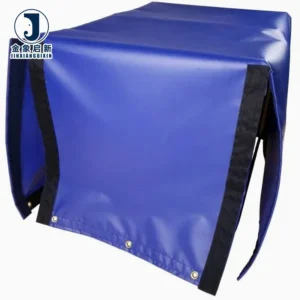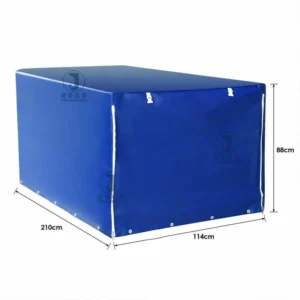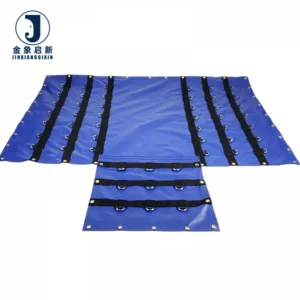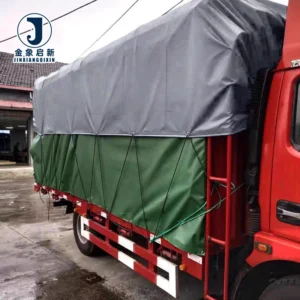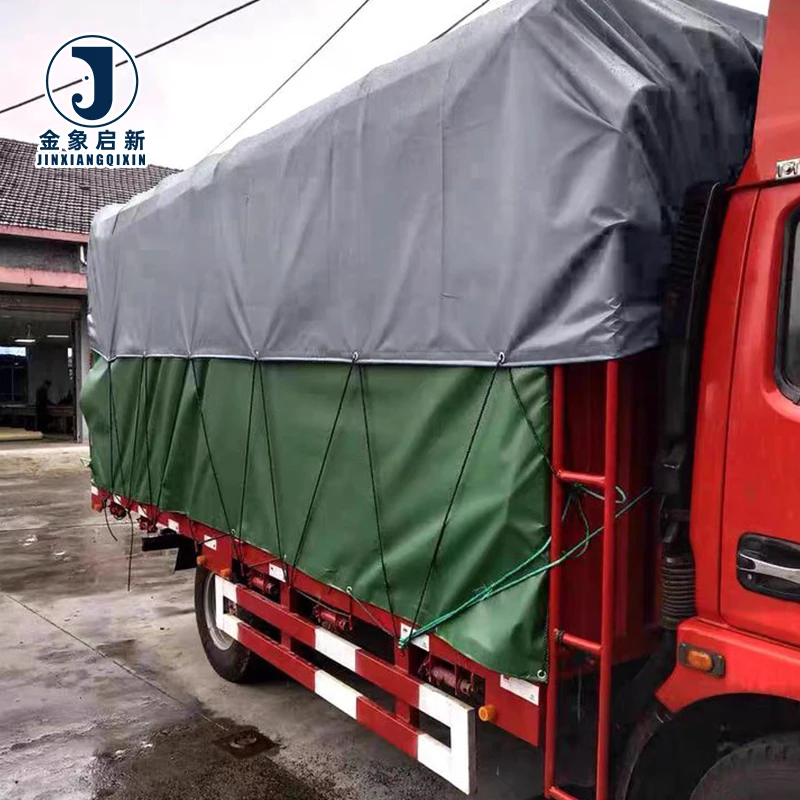
Precision-Cut Fit — every PVC truck cover is dimensioned to your exact trailer model, eliminating the cargo exposure that generic sizing leaves behind on long-haul routes.
Technical Specifications
| Parameter | Value |
|---|---|
| Product Type | PVC Coated Tarpaulin |
| Base Fabric Denier | 1000D |
| Coating Material | PVC |
| Weight | 950 GSM (source value — verify against manufacturer catalog) |
| Total Thickness | 0.70–1.0 mm (range covers product family — confirm the grade for this item) |
| Tensile Strength (Warp / Weft) | 2000–2500 / 1800–2200 N/5cm (test standard not stated in source) |
| Coating Technology | Lamination and hot-melt coating |
| Flame Retardant | Available in flame retardant grades — confirm the grade required for your market |
| Anti-Static | Available with anti-static treatment — confirm surface resistance or standard required |
| UV Treatment | Available with UV treatment — confirm test basis required for your operating region |
| Key Features | Waterproof, cold resistant, mold proof |
| Welding Tear Strength | Excellent |
| Color Fastness | High |
| Custom Options | Custom size, color, printing, treatment options |
| Standards | ISO, CE (specific certification numbers not provided) |
Application Suitability
| Application | Exposure & Requirement |
|---|---|
| Flatbed trailer cover | Constant road vibration, load flex at tie-down points, rain and crosswind abrasion |
| Side curtain fabric for curtain-siders | Repeated rolling and flexing, friction against cargo edges, highway UV exposure |
| Heavy-haul equipment wrap | Oversized load geometry, wind flap stress, puncture risk from protruding machinery |
| Fleet livery cover | Multi-unit colour consistency, printed branding adhesion, daily deployment wear |
Why a 1000D Base Fabric Decides Whether Your PVC Truck Cover Survives the First Year
The coating protects against weather, but the base fabric carries every mechanical load the road throws at it.
A PVC truck cover for fleet operations sees stress concentrations at tie-down zones, corner folds, and wherever the load shifts under braking. I have seen covers where the coating remained intact but the base fabric tore along the warp line because the denier was too low for the flexing cycle. The 1000D polyester yarn in this fabric provides the structural backbone that keeps the material holding together at those stress points, long after lighter denier fabrics would have started to unravel [NEED_CITE: tensile and tear test methods for coated fabrics per ISO 1421].
Cut-to-Model Sizing That Eliminates the Generic Cover Problem
A PVC truck cover for fleet use that arrives in a generic rectangle forces your drivers to fold, tuck, and strap excess material — creating wind catch points and leaving corners of the load exposed. Each cover is cut to the exact dimensions of your trailer model, whether that is a standard 13.6 m curtain-sider or a specialised low-loader. This means eyelet spacing aligns with your tie-down rail, and the fabric sits flat without bunching at the rear doors.
Hot-Melt Coating Adhesion Under Road Vibration
The hot-melt lamination coating process bonds the PVC layer to the 1000D base fabric at a molecular level, producing adhesion strength that resists delamination under the constant vibration of highway travel. Where cheaper coating methods can separate at the weld line after repeated flexing, this construction keeps the coating and base fabric acting as a single unit [NEED_CITE: coating adhesion test methods for PVC tarpaulin]. That matters most at the seams, where the cover flexes every time the load shifts under cornering or braking.
How 950 GSM and 1000D Work Together on the Road
The 950 GSM weight of this PVC truck cover places it firmly in the heavy-duty range, but weight alone does not determine how the fabric behaves under load. The 1000D base fabric denier means each yarn in the weave carries a higher individual load before breaking, which directly translates to tear resistance when a corner catches on a cargo edge. The PVC coating at this weight provides the thickness needed to resist abrasion from road grit and tie-down strap friction, while the hot-melt lamination ensures the coating does not separate from the base fabric at the weld seams where stress concentrates most during transit.
The Hidden Cost of Specifying by Weight Alone
Procurement teams frequently select truck covers based on GSM, assuming that a heavier number guarantees longer service life. But a 950 GSM cover built on a 500D base fabric will tear at the warp line under load flex far sooner than the same weight built on 1000D, because the individual yarns are thinner and break under lower stress. Similarly, a cover that meets the quoted GSM but uses a cold-lamination coating instead of hot-melt will delaminate at the seams within months of highway use, leaving you replacing covers on a cycle that has nothing to do with the fabric weight [NEED_CITE: common failure modes in heavy-duty truck tarpaulin]. Colour inconsistency across rolls in the same fleet order is another specification gap that only becomes visible once the covers are installed side by side on adjacent trailers.
What Makes This the Right Source for Your Fleet Covers
Three full production lines and 36 sets of professional equipment mean that fleet-scale orders — whether ten covers or two hundred — move through production without being queued behind unrelated product runs. The 10-person R&D team handles pattern printing, custom sizing, and sample development in-house, so a colour-matched sample for your fleet livery reaches you before bulk production starts. Every roll and every cut cover passes 100% inspection before dispatch, with GSM verified against the quotation specification rather than assumed from the production batch. Nearly 30 years of focus on coated fabric has produced process control over coating weight and adhesion that shows up in weld seam integrity at the exact points where your covers flex most.
Documentation & Verification
- Material specification sheet stating exact GSM, 1000D base fabric, and coating type for each roll
- Test report for anti-static treatment confirming surface resistance where sensitive cargo requires it
- Pre-shipment inspection record verifying cut dimensions match your specific trailer model
- UV treatment test documentation for compliance with operating region exposure requirements
- Certificate of origin and customs documentation supporting international fleet procurement
Fabrication, Handling & Storage
- Hot-air welding at manufacturer-recommended temperature for the 950 GSM hot-melt coated construction
- Reinforce eyelet zones with additional PVC patches to distribute tie-down strap load across the 1000D base fabric
- Store rolls horizontally on pallets to prevent creasing that can weaken the coating bond line
- Allow cold-stored covers to reach ambient temperature before unfolding to avoid coating crack at fold lines
- Use mild detergent without solvents to preserve the PVC coating surface and any printed fleet branding
What to Include When You Request a Quote
Provide the exact trailer make, model, and year so that the cover dimensions and eyelet positions match your tie-down hardware. Specify whether your fleet requires flame retardant or anti-static treatment, and which market standard applies in your operating region. If you need colour-matched covers with printed livery across multiple units, confirm the Pantone reference and quantity so that batch consistency can be controlled from a single production run.
Frequently Asked Questions
Q: How do you ensure the truck cover fits my specific trailer model?
A: We request the exact trailer make, model, and production year, then generate a cut pattern that matches the body dimensions, door clearance, and tie-down rail positions. A dimensional check is included in the pre-shipment inspection record so you can verify fit before the cover leaves our facility.
Q: What GSM verification process do you use before shipment?
A: Each roll and cut cover is sampled and weighed against the stated 950 GSM specification during the pre-shipment inspection. The inspection record documents the actual measured value per unit, and any deviation outside tolerance is flagged before dispatch approval.
Q: How do welded seams perform at load flex points compared to sewn construction?
A: Hot-air welded seams on this 950 GSM hot-melt coated fabric create a continuous bond that flexes with the base fabric rather than concentrating stress at needle holes. This means the seam holds through repeated load shifting without the stitch-line tearing that sewn construction produces under the same conditions.
Q: How do you handle colour consistency across multiple truck covers in the same fleet order?
A: All covers in a single fleet order are produced from the same coating batch, with colour checked against the approved Pantone reference at the coating stage and again at final inspection. This prevents the visible panel-to-panel variation that occurs when covers are pulled from different production runs.