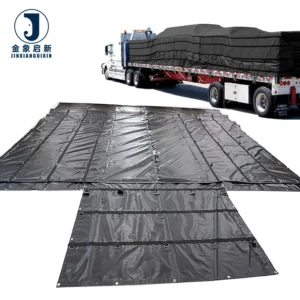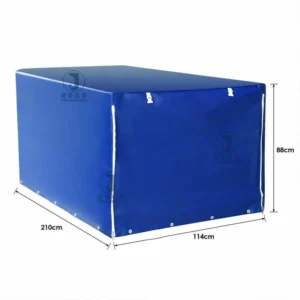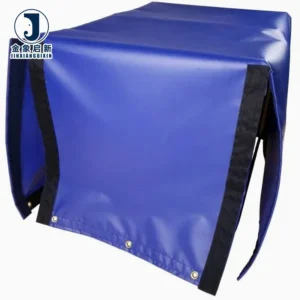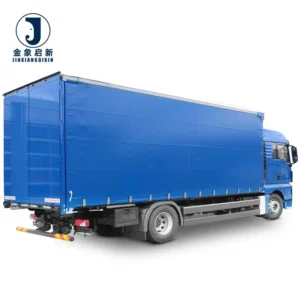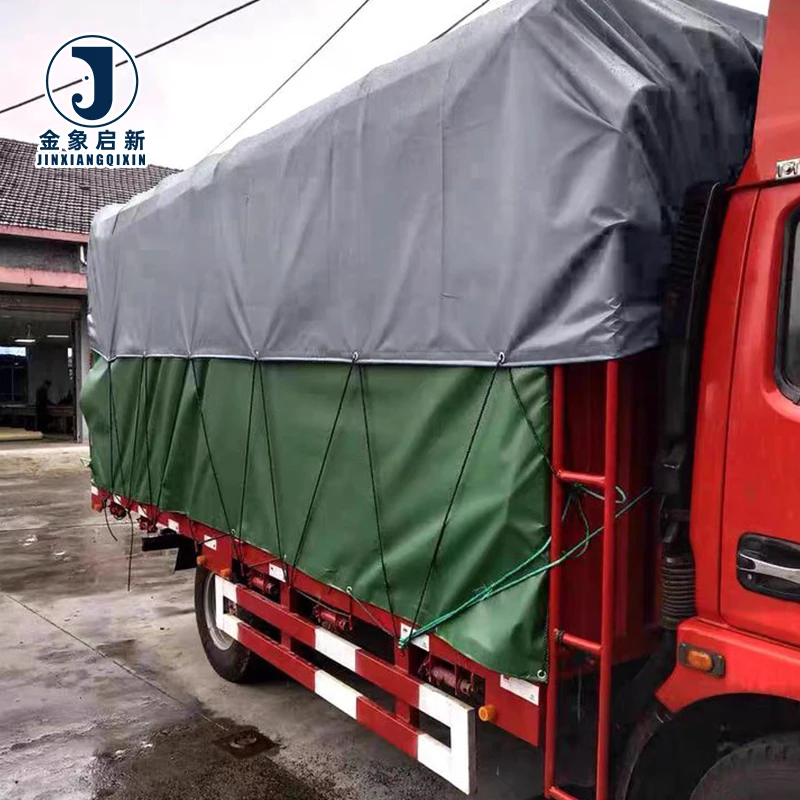
Trailer-Exact Fitment — covers are cut to the specific trailer model dimensions you supply, not pulled from a generic size chart, eliminating the dock-side mismatch that wastes a full shipment.
Technical Specifications
| Parameter | Value |
|---|---|
| Product Type | PVC Coated Tarpaulin / Truck Cover |
| Coating Material | PVC |
| Base Fabric | 100% high toughness polyester yarn |
| Coating Technology | Lamination and hot melt coating |
| Medium-duty Weight | 400-500 g/m² |
| Medium-duty Thickness | 0.35-0.45 mm |
| Medium-duty Base Denier | 500D |
| Medium-duty Tensile (Warp/Weft) | 1500-2000 / 1200-1800 N/5cm |
| Heavy-duty Weight | 700-1000 g/m² |
| Heavy-duty Thickness | 0.70-1.0 mm |
| Heavy-duty Base Denier | 1000D |
| Heavy-duty Tensile (Warp/Weft) | 2000-2500 / 1800-2200 N/5cm |
| Super Heavy Weight | 1100-1500 g/m² |
| Super Heavy Thickness | 1.2-1.5 mm |
| Super Heavy Base Denier | 500D-2000D |
| Super Heavy Tensile (Warp/Weft) | 2500-3000 / 2200-2800 N/5cm |
| Treatment Options | Flame retardant (confirm grade required); Anti-static (confirm standard required); Cold resistant; Mold proof; UV treatment |
| Outdoor Weather Resistance | 3-5 years (source value — verify against manufacturer catalog) |
| Welding Tear Strength | Excellent |
| Color Options | Blue, Blue/Orange, Green, Grey, Black, Clear, Grey/Green, Orange, or custom |
| Standards | ISO, CE |
Application Suitability
| Application | Exposure & Requirement |
|---|---|
| Flatbed trailer load cover | Constant road abrasion, high-speed wind uplift, tie-down strap friction at edges |
| Curtain-side truck fabric | Continuous vertical flexing along curtain runners, repeated folding at header rail |
| Tipper and dump truck cover | Heavy material drop impact, abrasion from aggregate and demolition debris |
| Construction site vehicle wrap | Mud, alkali exposure, UV from open-site parking, frequent removal and re-draping |
| Farm machinery shroud | Organic moisture, fungal spores, seasonal storage compression, UV from field standing |
What a Generic-Size PVC Truck Tarpaulin for Transport Actually Costs You
A cover cut to a standard rectangle will not seal a specific trailer profile, and the resulting gaps invite water ingress and load shift.
Fleet buyers often order a PVC truck tarpaulin for transport by quoting length and width only. The cover arrives, and the rear corners do not wrap around the headboard, or the rope rail sits two inches above the eyelet line. The fabric itself may be perfectly within specification, but the fitment failure means the load is exposed at the exact point where highway spray enters first. I have watched entire curtain-side replacements get delayed because the header pocket depth was assumed rather than measured. [NEED_CITE: trailer curtain dimensioning standards for side-shift and tension systems]
How Model-Specific Cut Eliminates the Dock-Side Surprise
Every trailer manufacturer publishes a body drawing with pocket depths, rope rail positions and header bow spacing. A PVC truck tarpaulin for transport ordered against that drawing arrives with eyelets, pockets and hem reinforcements placed to match — not approximated. This removes the most common reason fleet operators reject a shipment at the gate: dimensional non-conformance on a cover that is otherwise the correct weight and colour.
Where the Weld Line Meets the Flex Point
Trailer side curtains fold and unfold hundreds of times per week at the same horizontal line just above the load bed. If the PVC coating bond to the polyester base yarn weakens at that fold, the weld seam separates before the body fabric shows any wear. Hot melt coating and lamination technology is specified here because the adhesive layer penetrates the yarn interstices, producing a bond that survives repeated flex without delamination at the welded joint. [NEED_CITE: peel strength test methods for PVC coated polyester per ISO 2411]
Reading GSM, Denier and Tensile Together
A 700 g/m² cover with a 1000D base yarn carries higher warp and weft tensile values than a 700 g/m² cover woven from 500D yarn — the coating weight may be identical, but the yarn thickness and pick count change how the fabric distributes a point load from a ratchet strap. This is why the specification sheet must state base denier and knitting density alongside the GSM. A buyer comparing two quotations on GSM alone is missing the variable that actually determines whether the fabric tears when the load shifts during braking.
The Invoice Says Flame Retardant — the Site Inspector Asks for the Grade
Transport regulations in many jurisdictions require a specific flame-retardant classification for cargo covers entering tunnels, ports or chemical facilities. An invoice line reading "flame retardant" without a referenced standard will not satisfy a site safety officer checking documentation at the gate. The available flame retardant and anti-static treatment options must be confirmed against the exact standard your route demands before the order is placed, so the correct test report ships with the roll. [NEED_CITE: fire classification standards for transport tarpaulins in tunnel and port environments]
Why Procurement Focused on Price-Per-Roll Misses the Real Cost
A batch of covers arrives with visible colour variation from roll to roll — the first three are a consistent blue, the next two read slightly greener when installed side by side on identical trailers. The fleet now has a mixed appearance across vehicles that were supposed to carry a uniform brand colour. This happens when the coating batch is not matched across a single purchase order, and it forces either a full re-order or acceptance of a visibly inconsistent fleet. Colour reference locking at the sample approval stage prevents this. [NEED_CITE: colour consistency tolerances for PVC coated fabrics in fleet livery applications]
What the Production Floor Actually Controls
Coating weight is verified at the line, not assumed from the recipe, so the GSM on the pre-shipment inspection record matches the quotation. The three full production lines and 36 sets of equipment support bulk runs without sacrificing the batch-to-batch consistency that fleet colour standards require. The 10-person R&D team handles model-specific pattern cutting and sample development within days, meaning a trial cover for a new trailer type is on your dock before the full order commits. A dedicated QA/QC stage inspects every roll before it is packed, catching weld integrity and colour drift before the container is sealed. ISO and CE documentation is generated as part of the standard dispatch, not requested separately after the fact.
Documentation & Verification
- GSM and coating weight recorded per roll on the pre-shipment inspection record against your purchase order line
- Trailer model dimension confirmation sheet signed off before cutting begins
- Flame retardant or anti-static test report matched to the standard you specified at inquiry stage
- Roll packing list with batch numbers enabling colour traceability across the fleet order
- Certificate of origin and customs documentation generated with the shipping set
Fabrication, Handling & Storage
- Hot melt coated rolls respond to high-frequency welding — set dwell time to the specific GSM grade ordered
- Eyelet reinforcement patches should match the base fabric denier to distribute ratchet strap point loads evenly
- Store rolls horizontally on racking to prevent flat-spot creasing through the PVC coating layer
- Unroll cold-weather stock in a heated bay before fabrication to prevent coating crack at the fold line
- Clean with neutral detergent only — solvent-based cleaners attack the plasticiser in the PVC coating surface
- Field repairs use the same PVC grade and hot air welding to maintain coating bond integrity at the patch edge
What to Include with Your Inquiry
Send the trailer body drawing or the exact pocket, rail and hem dimensions for each vehicle model in the fleet. State the fire or anti-static classification your operating routes require, and confirm whether you need finished cut covers or roll stock for your own fabrication shop. Include the target colour reference and the total unit count per model so the production run can be batched for colour consistency.
Frequently Asked Questions
Q: How do I specify the exact cover size for my specific trailer model?
A: Provide the manufacturer body drawing or measure pocket depth, rope rail height, header bow spacing and overall curtain drop. The cover is then cut and welded to those dimensions rather than a generic rectangle, ensuring eyelets and hems align with the trailer hardware on arrival.
Q: Can I get a test report for the UV or flame retardant treatment I ordered?
A: Yes — state the specific standard your route or site requires at the inquiry stage. The corresponding test report is then generated for that treatment grade and included in the shipping documentation set, so it is available for compliance checks on arrival.
Q: What happens if colour varies between rolls in a single fleet order?
A: Colour reference is locked at sample approval and the production run is batched so all rolls for one order draw from matched coating batches. The roll packing list carries batch numbers, letting you trace and verify consistency before installation across the fleet.
Q: How are welded seams reinforced at high-stress flex points?
A: High-flex zones such as curtain fold lines and tie-down edges receive additional PVC coating layers or reinforcement patches during fabrication. The hot melt coating bond is specified to withstand repeated flexing without delamination at the welded joint under normal trailer operating conditions.