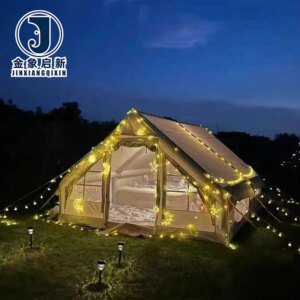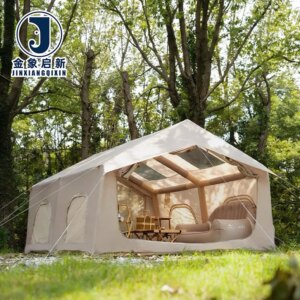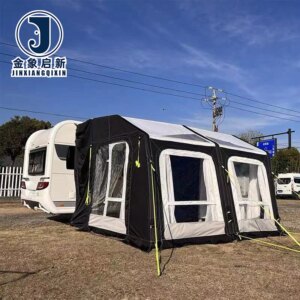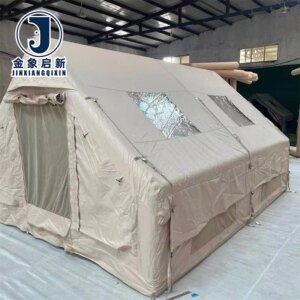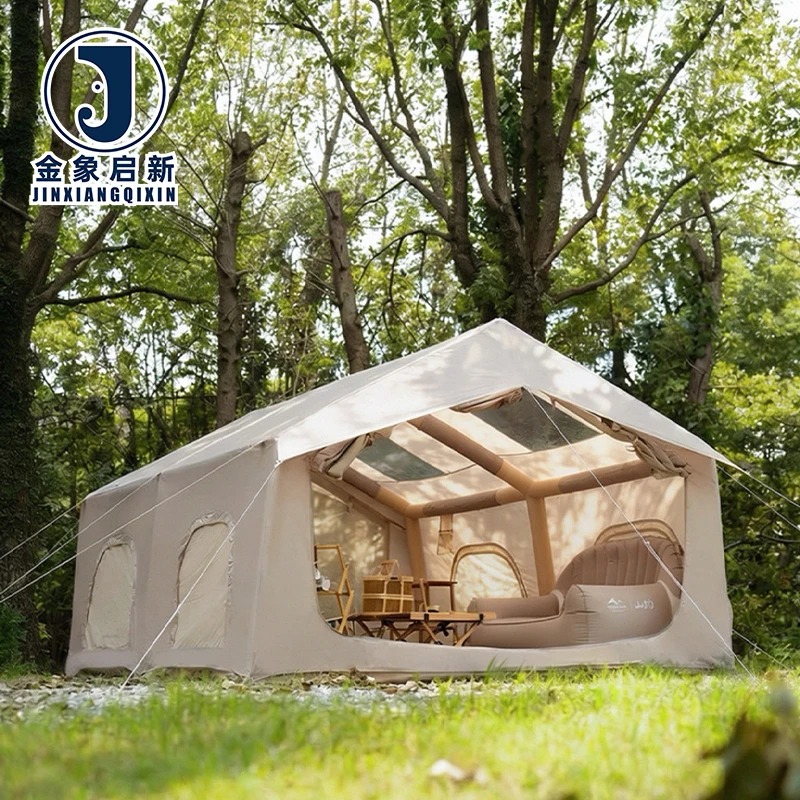
Rapid-Deployment Shelter Fabric — Three full production lines and 36 sets of professional equipment ensure that every PVC inflatable tent meets strict deployment timelines without compromising on weld integrity or coating consistency.
Technical Specifications
| Parameter | Value |
|---|---|
| Product Type | Inflatable Tent |
| Core Material | PVC tarpaulin |
| Product Form | Inflatable structure with quick automatic opening |
| Waterproof | Yes, fully coated construction |
| UV Treatment | Available with anti-UV treatment — confirm the grade required for your market |
| Flame Retardant | Available in flame retardant grades — confirm the grade required for your market |
| Anti-Static | Available with anti-static treatment — confirm the standard required for your site |
| Tear Resistance | Tear-resistant construction — test basis available on request |
| Certifications | ISO9001, ISO14001, ISO45001, CE |
| Production Lines | 3 full production lines |
| Processing Equipment | 36 sets of professional processing equipment |
| R&D Team | 10 technicians |
| Customization | OEM & ODM, sample customization, pattern printing |
| Quality Control | Full-process quality inspection with dedicated QA & QC staff |
Application Suitability
| Application | Exposure & Requirement |
|---|---|
| Emergency disaster relief shelters | Rapid deployment under adverse weather, high visibility, resistance to wind-driven rain and debris impact |
| Temporary medical operation tents in field conditions | Waterproof and flame retardant performance, fast inflation for time-critical triage setup |
| Construction site crew and equipment shelters | Prolonged UV exposure, mechanical abrasion from tools and materials, repeated inflation cycles |
| Logistical support facilities in disaster response | Heavy-duty floor-to-wall junctions, resistance to forklift and foot traffic wear |
| Industrial material storage shelters on-site | Moisture barrier integrity, anti-static treatment where sensitive equipment is stored |
Why Unverified Treatment Claims Stall Emergency Operations
When a batch of emergency shelters arrives with a "flame retardant" label but no test data to back it up, the entire procurement chain stalls at the compliance checkpoint. A PVC inflatable camping tent manufacturer must supply verifiable test documentation tied to the batch you receive, not a generic brochure claim.
I have watched relief shipments sit idle on tarmac for days because the local fire authority could not match the tent fabric to any recognized retardant standard. The inflatable structure was physically ready to deploy, but the paperwork gap forced a full quarantine. The same applies to UV treatment: a tent that performs well in a temperate European summer can degrade visibly within a single season in equatorial deployment zones when the UV package is insufficient for the actual irradiance level [NEED_CITE: UV degradation test methods for coated fabrics per ISO 4892]. Confirming the exact treatment grade against the deployment climate is a procurement step that cannot be skipped.
Deploying Faster Than Frame-Based Shelters
The inflatable structure eliminates the need for pole assembly, ground anchoring of rigid frames, and the multi-person coordination that conventional tents demand. A PVC inflatable tent aftermarket supplier engineers the air-beam channels from the same PVC tarpaulin used in the shell, ensuring that the inflation envelope shares the waterproof and tear-resistant properties of the outer skin. This single-material approach means fewer failure points at junctions and a dramatically shorter time from unloading to full pressurized shelter.
Engineered for Repeated Inflation Cycles
Every inflation and deflation cycle stresses the welded seams that form the air beams. The PVC tarpaulin core must maintain coating adhesion through hundreds of flex events without delaminating at the beam-to-shell bond line. Our 10-technician R&D team develops beam geometries that distribute internal pressure evenly, reducing peak stress at the weld. For buyers specifying a PVC inflatable camping tent manufacturer for multi-deployment relief programs, this cycle durability directly determines the usable service life of each unit in the field [NEED_CITE: coated fabric seam strength testing per ISO 1421].
Reading the Material Data Beyond GSM
Buyers often anchor their decision on grams per square metre, but GSM alone tells you nothing about how the PVC coating bonds to the base fabric. A heavy coating weight with poor adhesion will peel at the air-beam weld under repeated inflation pressure. The base fabric denier and weave density govern tear propagation — a higher thread count in the scrim resists the spread of punctures far more effectively than coating thickness alone. Surface finish also matters: a glossy topcoat sheds dirt and rain more readily in field conditions, while a matte finish may be preferred where low reflectance is tactically important. Treatment additives for flame retardancy or anti-static performance are compounded into the coating formulation, and their concentration determines whether the final product meets the target standard or merely claims to.
The Cost of Overlooking Batch Consistency
When multiple inflatable tents are deployed side by side at a relief site, a colour shift between units signals inconsistent coating formulation — and that inconsistency often extends to the treatment package as well. I have seen buyers receive a mixed batch where some units passed on-site flame testing while adjacent units from the same purchase order failed [NEED_CITE: batch-to-batch variability in flame retardant treatment of coated fabrics]. The consequence is not just a visual mismatch; it forces the buyer to segregate, retest, and potentially reject an entire shipment at the worst possible moment. Dedicated QA and QC inspection at every production stage, with 100 percent pre-shipment verification, is the only reliable guard against this outcome.
Why Source Inflatable Tent Fabric Through This Facility
The 9,180 square-metre facility runs three dedicated production lines, meaning your inflatable tent order does not compete for machine time with unrelated coated-fabric products. The 36 sets of processing equipment include specialised welding and inflation-channel forming tools that maintain dimensional accuracy across large production runs. A 10-person R&D team handles pattern printing, custom sizing, and material formulation adjustments, developing pre-production samples within days so you can approve before mass production begins. Full-process quality inspection covers coating weight, weld integrity, and treatment verification at each stage, not just a final spot-check. Every shipment carries documentation traceable to the specific production batch.
Documentation & Verification
- Material specification sheet stating base fabric, coating type, and treatment package per order
- Test reports for UV and flame-retardant grades supplied with batch number traceability
- ISO9001, ISO14001, ISO45001 and CE certificates included in the order documentation package
- Pre-shipment inspection record confirming weld integrity and inflation-channel dimensions
- Certificate of origin and customs support documentation for international dispatch
Fabrication, Handling & Storage
- Hot-air welding parameters must match the PVC tarpaulin coating thickness to avoid cold joints at beam seams
- Store inflated units in dry, ventilated conditions to prevent moisture trapping inside air-beam channels
- Avoid dragging the PVC tarpaulin shell across abrasive ground during deployment to protect the coated surface
- Clean with neutral-pH detergent only; solvent-based cleaners may compromise flame-retardant treatment compounds
- Field repair kits should use compatible PVC tarpaulin patches and adhesive rated for the same treatment grade
What to Include in Your Specification Inquiry
Provide the deployment environment and expected exposure conditions so the PVC tarpaulin formulation can be matched to the actual climate and site hazards. Specify any fire-safety or anti-static compliance requirements mandated by the receiving authority or project owner. Indicate whether you need finished inflatable tent units with custom dimensions and pattern printing, or roll-stock fabric for your own fabrication line. Confirming these details early allows the R&D team to prepare accurate samples and lead-time projections.
Frequently Asked Questions
Q: What customization options are available for PVC inflatable tents, including sizing, material, and printing?
A: OEM and ODM services cover custom dimensions, pattern printing, and PVC tarpaulin formulation adjustments. The 10-technician R&D team develops pre-production samples within days for your approval. Options include varying the treatment package for specific UV, flame-retardant, or anti-static requirements, and selecting surface finish to suit the deployment environment.
Q: How is flame-retardant performance tested and what certification is provided for export markets?
A: Flame-retardant grades are available and tested to the standard required by your destination market. Test reports are supplied with batch number traceability alongside ISO and CE documentation. Confirm the specific classification your project authority requires so the correct formulation is applied during coating production.
Q: How does the manufacturer ensure batch consistency across large-volume inflatable tent orders?
A: Dedicated QA and QC staff conduct full-process inspection at every production stage, with 100 percent pre-shipment verification. Coating weight, colour consistency, and weld integrity are checked per unit. Each shipment includes a batch inspection record and material specification sheet for your traceability.
Q: What documentation accompanies each shipment, and can test reports be requested post-delivery?
A: Every order ships with a material specification sheet, test reports for applicable treatments, ISO and CE certificates, a pre-shipment inspection record, packing list, and certificate of origin. Test reports remain traceable to your order number and can be reissued upon request for compliance audits.
Q: What is the sample development and approval process for custom OEM/ODM inflatable tent projects?
A: Submit your application requirements, target dimensions, and any treatment specifications. The R&D team produces a pre-production sample within days for your evaluation. Once approved, mass production begins under the same formulation and processing parameters, ensuring the delivered batch matches the sample exactly.