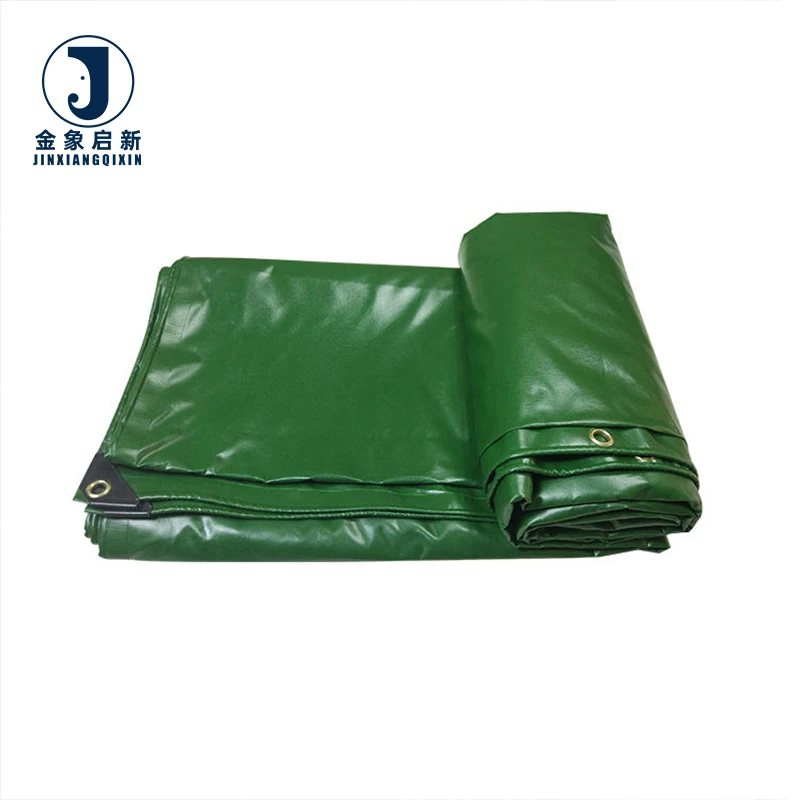
Hot-Melt Coated Strength — Adhesion between PVC layers and polyester mesh is controlled across three full production lines, keeping weld integrity intact under constant road vibration and load flex.
Technical Specifications
| Parameter | Value |
|---|---|
| Product Type | PVC Coated Tarpaulin |
| Material | PVC + High-strength polyester mesh fabric |
| Coating Method | Laminated technology & Hot-melt Coating technology |
| Weight (GSM) | 350gsm / 420gsm / 500gsm / 550gsm / 600gsm / 750gsm |
| Thickness | 0.32mm / 0.35mm / 0.4mm / 0.45mm / 0.5mm / 0.65mm |
| Roll Size | 2m width × 75m length / 2.1m width × 50m length |
| Finish Product Size | Custom items as per customer’s needs, or sold by inventory |
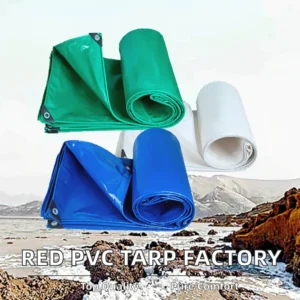
| Color | Blue / Red / Yellow / Light Blue / Grey (Customized) |
| Key Features | Cold crack resistance; Anti-mildew; Waterproof; Sunproof; Best color fastness; Anti-static treatment (standard not stated); Outstanding tearing strength for welding |
| Flame Retardant | Available in flame retardant grades — confirm the grade required for your market |
| UV Treatment | UV stable (test basis not stated in source) |
| Recyclable | 100% Recyclable |
| Repair | Easy to repair by welding |
| Standards | ISO 14001, ISO 45001, CE, RoHS |
Application Suitability
| Application | Exposure & Requirement |
|---|---|
| Dump truck cover | Daily load cycles, aggregate abrasion, repeated folding at tailgate and sides |
| Flatbed and curtain-side trailer | Continuous highway wind load, flexing at curtain runners, tie-down strap friction |
| Cargo ship deck cover | Salt spray, prolonged UV exposure, heavy weather during transit |
| Equipment covering on construction sites | Dust, rain, UV, and occasional impact from handling machinery |
| Tent and temporary shelter | Waterproofing under rain, wind load on frame, repeated setup and teardown |
Why Truck Tarps Fail at the Seams Before the Fabric Gives Way
A cover that splits at the weld costs more than the tarp itself — in cargo damage, downtime, and replacement logistics.
Fleet operators routinely report that the fabric body of a truck cover remains intact while welded seams open under load flex. The point where a trailer bends over speed bumps or during cornering places repeated peel stress on the seam. If the coating adhesion to the base fabric is weak, or if the welding temperature does not fully fuse both PVC layers, the joint becomes the first failure point [NEED_CITE: tensile and peel test methods for coated fabrics per ISO 1421]. A PVC coated truck tarpaulin built with hot-melt coating technology addresses this directly by ensuring the PVC bonds through the mesh rather than sitting on the surface, giving the weld zone a stronger substrate to fuse into.
Hot-Melt Coating and Weld Integrity on the Road
Hot-melt coating forces PVC into the interstices of the high-strength polyester mesh under heat and pressure, creating a mechanical lock between coating and yarn. This matters for truck and trailer covers because the welded seams that join panels together depend on coating-to-coating fusion. When the PVC has fully penetrated the mesh, the weld zone draws strength from the base fabric itself, not just the surface film. For fleet operators running curtain-side trailers, this translates to seams that hold through thousands of open-close cycles and road vibration without peeling back from the stitch line.
Custom Sizing to Exact Trailer Dimensions
Generic-size covers leave gaps at edges where wind gets underneath, causing flap fatigue and eventual tearing. This PVC coated tarpaulin for truck cover applications is cut and welded to the specific trailer model in the fleet, with hem reinforcement and eyelet placement matched to the tie-down configuration. Transport equipment builders integrating side curtain systems benefit from fabric supplied in roll form at consistent widths, while fleet operators receive finished covers ready to hang [NEED_CITE: OEM trailer dimension variance and its impact on tarpaulin fitment].
Reading the Spec Sheet Beyond GSM
GSM tells you how much material is in a square metre, but it does not tell you how that weight is distributed between base fabric and coating. A 500gsm PVC coated truck tarpaulin with a dense, high-tenacity polyester base and thin coating will tear differently from one with a light base and thick coating. The hot-melt coating method used here pushes PVC into the mesh rather than building thickness on top, which maintains flexibility in cold conditions while preserving tear propagation resistance. Thickness values ranging from 0.32mm to 0.65mm across the product family correspond to different base fabric densities and coating weights, so the GSM alone should not drive the specification decision. Coating adhesion strength, base yarn denier, and weave density together determine how the fabric behaves when a forklift pushes against it from inside or when a tie-down strap concentrates load on a single eyelet.
The Hidden Cost of Specifying on Price Per Kilogram Alone
When buyers select PVC coated tarpaulin solely on cost per kilogram, they often receive material with a lighter base fabric compensated by heavier filler in the coating. The roll arrives at the quoted GSM, but the tensile and tear values fall below what the application demands. On a dump truck running daily cycles, this material cracks at fold lines within months because the base fabric lacks the yarn density to resist repeated bending. In curtain-side applications, insufficient adhesion between coating and mesh means the weld zone delaminates under flex load, leaving the operator to replace covers far sooner than expected [NEED_CITE: coating delamination failure analysis in transport tarpaulins]. Batch-to-batch colour variation compounds the problem when replacement panels do not match the rest of the fleet.
What Production Control Means for Your Roll Quality
Deep process control over coating weight and adhesion is maintained across three full production lines with 36 sets of professional equipment, ensuring that every roll of PVC coated truck tarpaulin leaves the facility at the specified GSM and colour reference. A 10-person R&D team handles custom sizing, pattern printing specifications, and sample development so that fleet branding and dimensional requirements are confirmed before bulk production starts. Dedicated QA/QC runs at every production stage, with 100% pre-shipment inspection verifying weight, colour consistency, and weld readiness before dispatch.
Documentation & Verification
- Material specification sheet stating GSM, base fabric construction, coating method, and colour reference for each roll
- Pre-shipment inspection record confirming weight verification and visual consistency before dispatch
- Test report for UV stability and flame retardant grades where applicable to your market requirements
- Roll packing list with batch identification linking each roll to its production run
- Certificate of origin and customs documentation for cross-border shipment
Fabrication, Handling & Storage
- Hot-melt coated PVC layers fuse cleanly at standard welding temperatures, producing seams with tear strength matching the base fabric
- Reinforced hems distribute tie-down strap load across multiple yarns, reducing pull-through risk at eyelet points
- Store rolls upright on pallets to prevent flat-spot deformation that affects unrolling and cutting accuracy
- Unroll in temperatures above freezing to avoid cold crack risk at fold lines during fabrication
- Clean with mild detergent only; solvent-based cleaners can soften the PVC coating surface and reduce print adhesion
- Field repairs by hot-air welding patch seamlessly into the hot-melt coated surface without adhesive failure
Requesting a Specification That Fits Your Fleet
To receive an accurate recommendation, share your trailer model dimensions, the type of load exposure your covers face daily, and whether you need finished covers or roll stock for your own fabrication line. If your market requires flame retardant or anti-static certification, state the standard your site demands so the correct grade is quoted. Colour and branding requirements should be confirmed with a physical sample before production proceeds, especially for fleet-wide orders spanning multiple rolls.
Frequently Asked Questions
Q: How do I confirm the GSM on arrival matches what was quoted?
A: Request a pre-shipment inspection record that documents weight per square metre for each roll. On receipt, cut a measured sample from the roll edge and weigh it on a calibrated scale. Our QA process verifies GSM at production and again before dispatch, so any discrepancy can be traced back to the batch record.
Q: Can you cut covers to my exact trailer model dimensions?
A: Yes. Provide the trailer make, model, and year along with tie-down point locations. We cut and weld panels to those dimensions with reinforced hems and eyelet placement matched to your strap configuration. A sample cover can be produced for fitment check before the full fleet order runs.
Q: What test reports do you provide for UV and flame retardancy?
A: UV stability and flame retardant grades are available on request. Specify the standard required for your market — for example, a particular national fire classification — and we supply the corresponding test report. Where a grade is not yet assigned, we confirm the applicable testing standard before production.
Q: How is colour consistency maintained across multiple rolls?
A: Each production run uses a single colour formulation batch, and rolls are inspected side by side under controlled lighting before packing. For fleet orders requiring identical colour across all covers, we allocate rolls from the same batch and note the colour reference on the packing list for future reorders.
Q: What is the expected service life under continuous road exposure?
A: Service life depends on load cycles, UV exposure intensity, and how the cover is tensioned on the trailer. Hot-melt coated PVC on high-tenacity polyester mesh is built for extended outdoor road use. Share your operating conditions and we will recommend the appropriate GSM and thickness for your application.