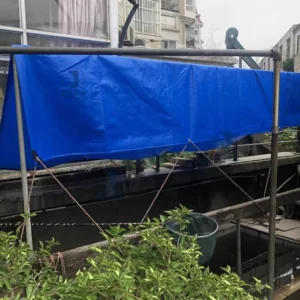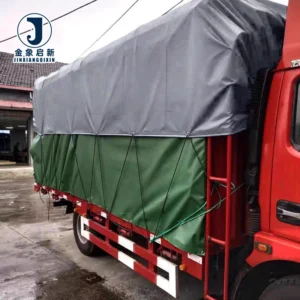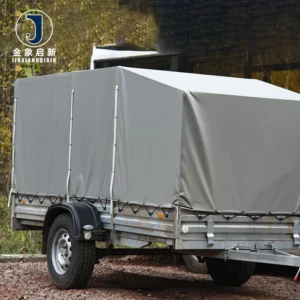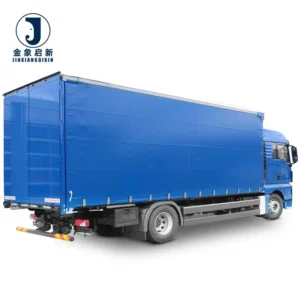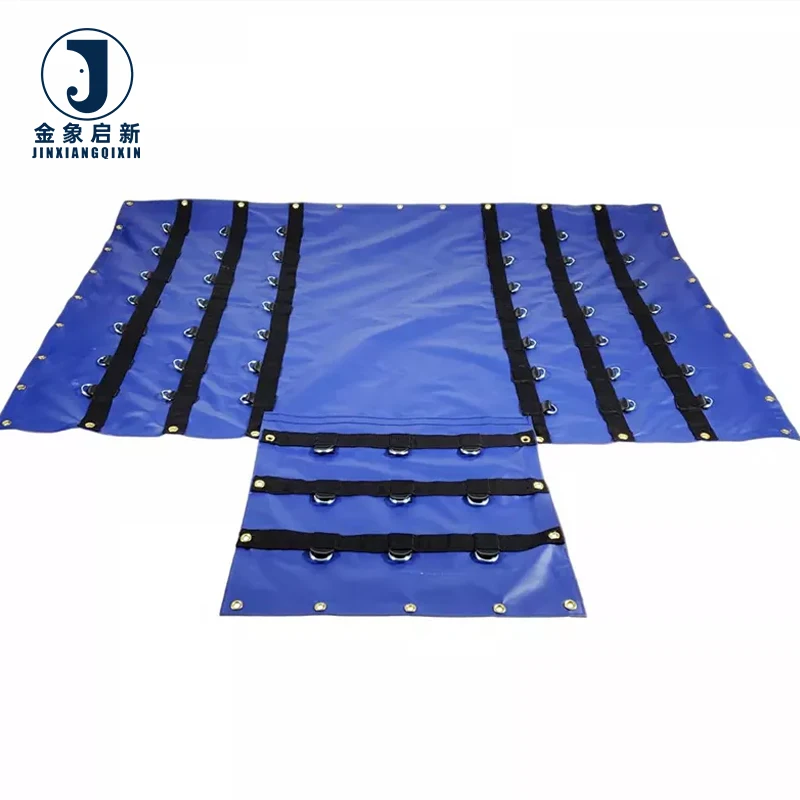
Deep Process Control Over Coating Weight and Adhesion — every roll of PVC coated fabric for flatbed lumber tarps is produced with monitored coating application across all three lines, ensuring the 610 gsm target is met consistently from edge to edge.
Technical Specifications
| Parameter | Value |
|---|---|
| Product Type | PVC Truck Cover |
| Base Fabric Denier | 1000D×1000D |
| Mesh Count | 20×20 / 18×18 |
| Coating Material | PVC (tool coating polyvinyl chloride) |
| Weight (GSM) | 18 ounces (610 gsm) / 16 ounces / 14 ounces |
| Total Thickness | 0.70–1.0 mm (heavy-duty) / 0.35–0.45 mm (medium) / 1.2–1.5 mm (super heavy) |
| Tensile Strength | Meridian 2000–2500 / Latitude 1800–2200 N/5cm (heavy-duty grade) |
| Temperature Range | -35 ~ 70 °C |
| D-Ring Configuration | 3 rows |
| Drop Depth | 8 ft. |
| Size | 24′ × 27′ |
| Color Options | Black / Blue |
| Surface Treatment | Acid-resistant coating |
| Certification | ISO and CE (certification details available upon request) |
Application Suitability
| Application | Exposure & Requirement |
|---|---|
| Flatbed lumber transport | Long highway hauls with rain, road debris impact, and wind-load tension across the tarp surface |
| Stacked timber and wall panels | End-grain exposure requiring full tail flap enclosure and vertical drop coverage |
| Building material hauling | Abrasive contact with rough-sawn wood edges and repeated folding at load tie-down points |
| Multi-load flatbed operations | Varying cargo heights requiring secure tensioning across different profiles without fabric slack |
Why a Flatbed Tarp That Shifts at 60 MPH Costs More Than the Cargo It Fails to Protect
A PVC Truck Cover for flatbed use must stay sealed under aerodynamic load — not just sit on top of it.
When a tarp billows or creeps forward on a loaded trailer, the exposed cargo absorbs rain and road spray that was supposed to be blocked. At the same time, the flapping fabric concentrates stress at the D-ring attachment points, accelerating seam fatigue far earlier than the base fabric itself would fail. Fleet operators replacing tarps mid-season often find the failure was not the material but the fit [NEED_CITE: tarp tension and aerodynamic lift on flatbed loads]. The 24′ × 27′ cut with an 8-foot drop on this lumber tarpaulin addresses that geometry directly, wrapping down past the deck rail to anchor below the load line.
D-Ring Placement Matched to Load Geometry
Three rows of D-rings on this PVC Truck Cover for flatbed trailers are spaced to align with standard flatbed tie-down rail positions, distributing tension across the tarp surface rather than concentrating it at two anchor lines. The 8-foot drop depth means the lower ring row sits below the deck edge, allowing straps to pull downward and inward. This geometry prevents the wind from lifting the tarp’s leading edge during highway transit, which is where most lumber tarp failures begin.
Tail Wing Design for End-Grain Protection
The 8-foot drop incorporates a tail wing configuration that wraps around the rear of stacked lumber loads. End-grain is the most water-absorbent face of any timber stack, and a flat-cut tarp that simply drapes over the top leaves this surface exposed to driven rain. The tail wing folds around the load end, creating an overlap that channels water down and away from the cargo face rather than into the stack joints.
How Base Fabric Density and Coating Weight Work Together on a Lumber Tarp [NEED_CITE: tensile and tear test methods for coated fabrics per ISO 1421]
The 1000D×1000D base fabric at 20×20 mesh count provides the structural skeleton that carries tensile load, while the PVC coating at 610 gsm fills the weave gaps and adds abrasion resistance at contact points. A higher mesh count with the same denier would produce a tighter weave with improved tear propagation resistance, because the yarn crossings act as arrest points for any tear that begins at a cut or puncture. The tool coating process applies the PVC in a controlled layer that bonds to each filament rather than sitting as a surface film, which is why heat-welded seams on this grade hold at loads approaching the base fabric strength. The acid-resistant surface treatment adds protection against chemical exposure commonly encountered at lumber treatment yards where preservative residues contact the tarp face during loading.
What Happens When Seam Welds Fail Before the Fabric Does
A PVC Truck Cover for flatbed lumber hauls flexes continuously as the trailer frame twists over uneven road surfaces, and the welded seams at the D-ring reinforcement patches absorb the highest cyclic stress. When welding temperature or pressure is not matched to the coating formulation, the bond between patch and main panel degrades under repeated flexing, separating cleanly while the surrounding fabric remains intact. This failure mode appears most often at the leading-edge D-rings where aerodynamic lift force peaks [NEED_CITE: weld seam fatigue at high-flex zones on transport tarpaulins]. Pre-shipment inspection that includes flex-cycle testing at each weld junction catches this before the tarp reaches the trailer.
Why Sourcing This PVC Truck Cover Directly from the Production Line Matters
Three full production lines with 36 sets of professional equipment support consistent output volume, so orders for fleet-standardized tarp sizes ship complete rather than in partial lots. The 10-person R&D team develops samples within days when a specific flatbed trailer model requires a non-standard cut or D-ring spacing adjustment. Dedicated QA/QC runs at every production stage with 100% inspection before dispatch, meaning dimensional checks on cut size and D-ring placement happen before packing rather than on your receiving dock. Deep process control over coating weight ensures the 610 gsm specification on the quotation is the same weight that arrives in the container. Material specification sheets ship with each order, documenting the base fabric denier, coating weight, and treatment applied to that production batch.
Documentation & Verification
- Material specification sheet stating 610 gsm, 1000D base fabric, and PVC coating weight per tarp grade
- Pre-shipment inspection record confirming 24′ × 27′ cut dimensions and 3-row D-ring placement accuracy
- Test report for UV and flame-retardant grades where applicable to route compliance requirements
- 100% inspection log documenting seam weld integrity at all D-ring reinforcement patches before dispatch
- Roll packing list and certificate of origin for customs clearance
Fabrication, Handling & Storage
- Heat-weld seams at temperatures matched to the PVC tool coating formulation to avoid bond separation at flex points
- Reinforce D-ring patches with additional fabric layers bonded to the 1000D base for cyclic load distribution
- Store folded tarps away from sharp-edged lumber contact during transport to prevent coating puncture
- Allow cold-stored tarps to reach above -35 °C before unfolding to avoid coating crack at fold lines
- Clean acid-resistant coating surface with neutral pH detergent to preserve treatment integrity over repeated use
What to Include in Your PVC Truck Cover Specification Request
Provide the flatbed trailer deck length, width, and required drop depth so the tarp cut can be matched to the actual load envelope. Confirm whether the cargo profile is standard stacked lumber or includes irregular items such as wall panel bundles that may require additional tail flap coverage. Specify the tie-down rail layout and strap spacing so D-ring rows can be positioned to align with existing hardware rather than requiring field modification.
Frequently Asked Questions
Q: How do I verify the GSM of a lumber tarp matches what was quoted?
A: Request the material specification sheet that documents base fabric denier, coating weight, and total GSM for each grade. A calibrated scale check on arrival confirms the weight per square meter against the stated 610 gsm for the 18-ounce grade. Jinan Jinxiang provides pre-shipment inspection records with weight verification included for every production batch.
Q: Can this tarp be cut to fit a specific flatbed trailer model?
A: Yes, custom sizing is available beyond the standard 24′ × 27′ format. Provide the trailer deck dimensions, required drop depth, and D-ring rail spacing so the pattern can be adjusted. The R&D team develops cut samples within days for approval before full production runs begin.
Q: How durable are the welded seams at high-flex points during transport?
A: Heat-welded seams at D-ring patches and panel joins are tested for peel strength against the PVC coating formulation used. Flex-cycle inspection during pre-shipment QA checks each weld junction under simulated load movement, identifying bond weaknesses before the tarp ships rather than after it fails on the highway.
Q: Is colour consistency maintained across multiple tarps for the same fleet?
A: Colour matching is controlled at the coating stage with reference standards checked per production batch. When ordering multiple tarps in black or blue for fleet standardization, all units are scheduled within the same coating run to eliminate inter-batch shade variation visible when tarps are installed side by side on adjacent trailers.