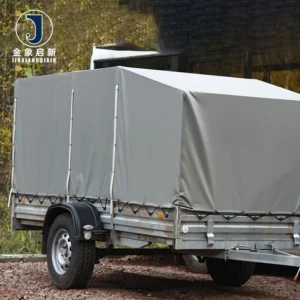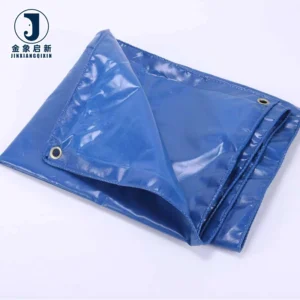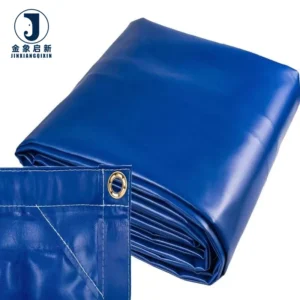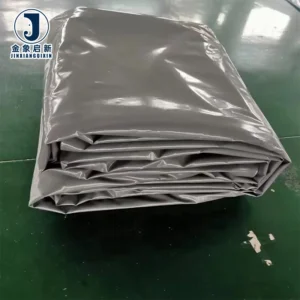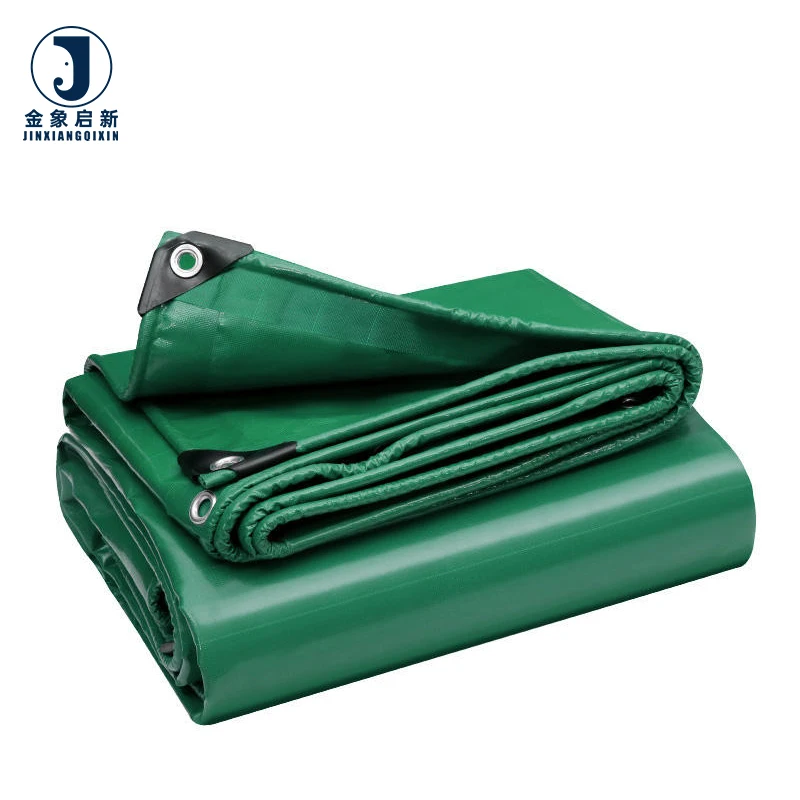
Custom-cut to your trailer bed dimensions — each tarp is measured against the specific truck or dump trailer model before cutting, preventing the edge flap and water pooling that generic sizes cause on the road.
Technical Specifications
| Parameter | Value |
|---|---|
| Product Type | PVC Coated Tarpaulin |
| Dimensions | 20×30 Feet (custom sizes: 3×4m, 6×8m, 8×10m, 10×12m) |
| Thickness | 13 mil |
| Weight Range | 250 gsm – 1500 gsm (confirm the grade for your application) |
| Base Fabric Denier | 200D×300D, 500D×500D, 840D×840D, 1000D×1000D |
| Surface Finish | Glossy or matte |
| Temperature Range | -15°C to 70°C |
| Treatment Options | Waterproof, UV resistant, flame retardant (grade to be confirmed per order), anti-fungal |
| Colour Options | Blue, yellow, black, green, white, or custom colour |
| Key Features | Tear-resistant, abrasion-resistant, flexible at low temperatures, welded seam construction |
| Certification | ISO, CE |
Application Suitability
| Application | Exposure & Requirement |
|---|---|
| Dump trailer cover | Aggregate abrasion, constant load flexing, highway debris impact, rain exposure |
| Flatbed truck tarp | Wind uplift at speed, tie-down stress at hems, UV from continuous outdoor parking |
| Side-curtain truck fabric | Repeated rolling and flexing, road spray, colour consistency across curtain panels |
| Boat transport cover | Highway-speed wind load, water ingress at seams, UV during storage between trips |
| Construction equipment wrap | Dust and moisture ingress, puncture from sharp edges, site handling abrasion |
Why Generic-Size Tarps Fail on Dump Trailers Before the Fabric Does
A cover cut to a standard size that does not match your trailer bed will fail at the hem and eyelet row — not because the PVC coated tarpaulin for dump trailer use was weak, but because the geometry was wrong.
Fleet operators routinely order tarps by a nominal size that sounds right for a 20×30 foot trailer bed, only to find the cover does not reach the tie-down rails or pools water in the centre when loaded. The resulting edge tension concentrates load at the eyelets, which pull through the hem within weeks. The fabric itself may be perfectly adequate, but the misaligned geometry turns a minor fitment gap into a field failure. [NEED_CITE: dimensional tolerance standards for transport tarpaulin cut sizes]
Cut to Your Trailer Model, Not to a Catalogue Number
Every dump trailer, flatbed and side-curtain truck has a different bed length, side wall height and tie-down rail position. A PVC coated tarpaulin for truck and trailer use must account for the drop distance from the load peak to the rail, the wrap-around at the corners and the spacing of the D-rings or rope hooks. We take your exact vehicle dimensions — not a generic catalogue size — and pattern the cover so the hems land on the tie-down points without stretching or sagging.
Reinforced at the Points Where the Road Tests the Cover Most
The highest stress on any transport cover is not in the field of the fabric but at the transition zones: the corners where the tarp wraps from top to side, the eyelet rows where ratchet straps pull, and the flex line where the load shifts under braking. These zones receive additional hem layers and closer eyelet spacing to distribute point loads across a wider area of the base fabric, reducing the risk of tear propagation from a single overstressed eyelet.
Welded Seams That Outlast the Fabric at Flex Points
The most common field failure on transport tarps is a seam that splits while the surrounding fabric remains intact. This happens when the weld adhesion strength is lower than the tear strength of the base fabric — the load flexes, the seam peels, and the cover opens mid-transit. Our welding process is calibrated so that the bond at the seam exceeds the fabric’s own tear resistance, ensuring the PVC coated tarpaulin for dump trailer applications fails as a single unit rather than delaminating at the join. [NEED_CITE: seam peel strength testing methods per ISO 1421]
Reading the Specs That Actually Matter for Transport Loads
The base fabric denier is the starting point for understanding how a tarp will handle a heavy, shifting load. A 1000D×1000D base provides substantially higher tear resistance than a 200D×300D weave, which matters when gravel or demolition waste pushes against the fabric at the trailer sides. However, denier alone does not determine performance — the coating weight and adhesion to the base fabric govern how well the cover resists water ingress and how the welded seams behave under tension. A heavy coating on a light base can crack at fold lines in cold weather, while a light coating on a heavy base may allow water penetration at the weave intersections. The 250 gsm to 1500 gsm range available across this product family covers everything from light equipment wraps to heavy aggregate haulage covers, and selecting the right grade within that range depends on what your load does to the fabric during transit. The temperature range of -15°C to 70°C sets the operational boundary: below -15°C the PVC stiffens and becomes susceptible to cracking at fold points, while sustained exposure above 70°C — possible on a dark-coloured tarp parked in direct sun — can soften the coating and reduce seam integrity.
What a Misread Specification Costs You on the Road
Ordering a 500D×500D tarp for a dump trailer hauling sharp-edged aggregate means the base fabric will puncture at the contact points within the first few loads, regardless of how thick the coating is. Conversely, specifying a 1000D×1000D cover for a light-duty boat wrap adds unnecessary weight and stiffness, making the tarp harder for a single operator to handle and fold. Batch colour variation is another hidden cost — if two rolls in the same order differ visibly once installed side by side on a fleet of trailers, the operator faces a credibility issue with their own client. Welding parameters that are not matched to the specific GSM and coating formulation produce seams that pass a bench test but fail under the cyclic loading of highway travel. [NEED_CITE: relationship between coating adhesion and cyclic flex fatigue in PVC tarpaulins]
Why Transport Fleets Source This PVC Coated Tarpaulin Here
Three full production lines and 36 sets of professional equipment support bulk orders with consistent on-time dispatch, so a fleet standardising covers across mixed trailer types receives matched lead times rather than staggered deliveries.
A 10-person R&D team handles pattern development for specific truck and trailer models, producing cut-to-size samples within days so you can verify fitment before committing to a fleet order.
Dedicated QA and QC at every production stage, with 100% pre-shipment inspection, catches GSM deviation, colour drift and seam defects before the rolls leave the facility.
Deep process control over coating weight and adhesion, built across nearly 30 years of focused coated fabric production, means the weld strength and surface finish remain consistent from the first roll to the last in your order.
Full documentation accompanies every shipment — material specification sheets, inspection records and certificates of origin — so your compliance team has what they need without chasing paperwork after delivery.
Documentation & Verification
- Material specification sheet stating confirmed GSM, base fabric denier and coating weight for your order
- Pre-shipment inspection record verifying dimensions match the trailer model specified
- UV and flame retardant test reports provided where those treatments are confirmed for your application
- Colour reference card matched to your fleet standard for batch consistency checking on receipt
- Certificate of origin and customs documentation included with every export shipment
Fabrication, Handling & Storage
- Weld temperature and dwell time must be matched to the specific GSM and coating formulation of the roll in use
- Eyelet placement should align with the reinforced hem zone to prevent pull-through under ratchet strap tension
- Rolls stored flat or on their cores in shaded conditions to prevent flat-spot creasing in the PVC coating
- Allow cold-stored tarps to reach ambient temperature before unfolding to avoid cracking the coating at fold lines
- Clean with mild detergent only — solvent-based cleaners degrade the surface finish and reduce UV treatment effectiveness
- Field repairs on welded seams require compatible PVC adhesive and heat reactivation, not standard fabric patches
Before You Enquire — What We Need to Quote Accurately
To provide a specification that fits your operation, share the make and model of each truck or trailer in your fleet along with the load types you carry. If your market requires a specific flame retardant grade or UV treatment standard, state the regulation or test method so we can match the treatment to your compliance requirement. Confirm whether you need finished, cut-to-size covers with hems and eyelets, or roll stock for your own fabrication.
Frequently Asked Questions
Q: How do I specify the right size tarp for my specific dump trailer model?
A: Provide the exact bed length, width, side wall height and tie-down rail position for your trailer model. We pattern the cover to these dimensions rather than a nominal catalogue size, ensuring the hems reach the tie-down points and the cover wraps correctly at the corners without tension gaps or excess material that flaps in transit.
Q: What denier and GSM should I choose for heavy abrasive loads like gravel?
A: For sharp-edged aggregate and demolition waste, a higher denier base fabric such as 840D×840D or 1000D×1000D provides the tear and puncture resistance needed at load contact points. The GSM grade within the available range should be confirmed based on your load weight and tie-down method — we recommend a sample cut to your trailer dimensions for field testing before a fleet order.
Q: Can I get a sample cut to my trailer dimensions before placing a fleet order?
A: Yes. Our R&D team develops cut-to-size samples within days of receiving your trailer dimensions. This allows you to verify fitment, hem placement and eyelet alignment on the actual vehicle before we proceed to bulk production, eliminating the risk of a fleet-wide sizing error.
Q: How do I verify the UV and flame retardant claims are backed by real test data?
A: Where UV or flame retardant treatment is specified for your order, we provide test reports referencing the applicable standard. If your market requires a specific grade — for example, a particular flame retardant classification — state this in your enquiry so we match the treatment and supply the corresponding documentation with the shipment.
Q: What reinforcement options are available at high-stress points like corners and tie-down zones?
A: Corners and eyelet rows receive additional hem layers and adjusted eyelet spacing to spread tie-down loads across a wider area of the base fabric. The specific reinforcement layout is matched to your trailer’s tie-down configuration, ensuring the PVC coated tarpaulin for truck and trailer use handles the strap tension without tearing at the stress points.