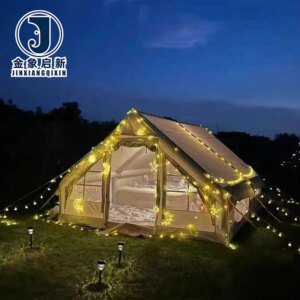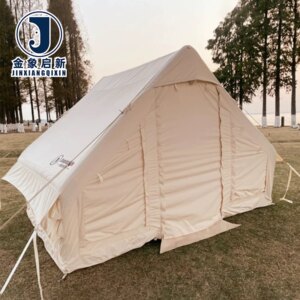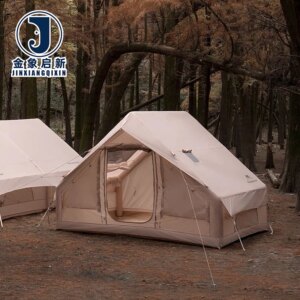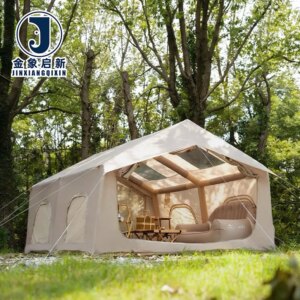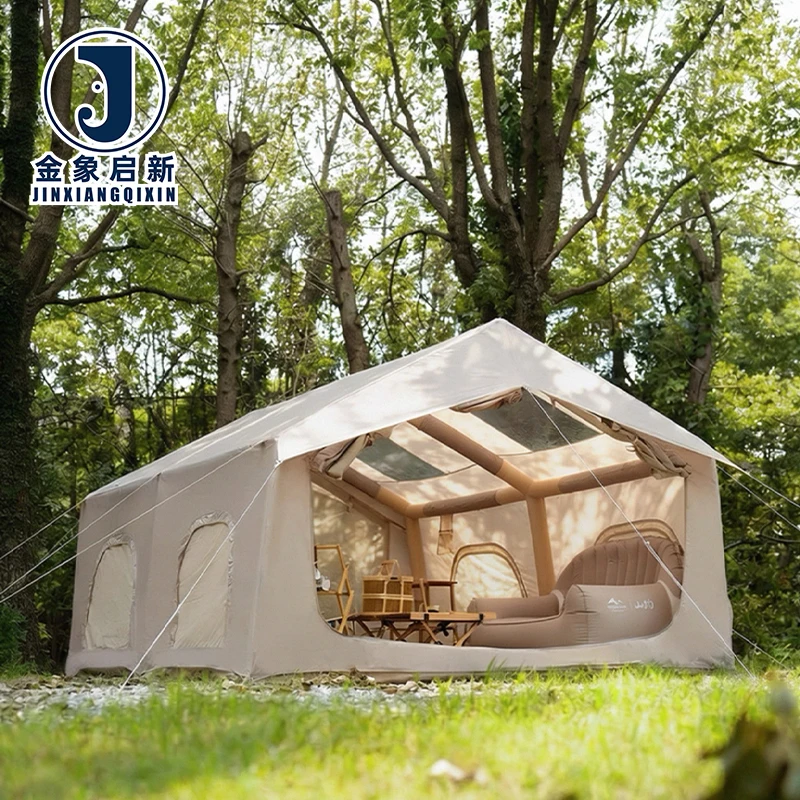
Direct factory supply — three full production lines and 36 sets of professional processing equipment support bulk inflatable tent orders with reliable on-time delivery for commercial fleet and site operators.
Technical Specifications
| Parameter | Value |
|---|---|
| Product Type | Inflatable Tent |
| Core Material | PVC Waterproof Fabric |
| Key Performance | Waterproof, UV-resistant, Tear-resistant, Fire-retardant, Anti-static |
| Product Forms | Inflatable structure with quick automatic opening |
| Waterproof Rating | ≥1000mm water column (source value — verify against manufacturer catalog) |
| Tear Resistance | ≥300N (source value — verify against manufacturer catalog) |
| Flame Retardancy | EN 13501-1 (source value — verify against manufacturer catalog) |
| Construction | Single layer |
| Customization Service | OEM & ODM (sample customization, pattern printing) |
| Standards | ISO9001, ISO14001, ISO45001, CE, EN 13501-1 |
Application Suitability
| Application | Exposure & Requirement |
|---|---|
| Fleet operator roadside shelter | Constant UV exposure, wind load, rapid deployment for driver rest and cargo protection |
| Transport yard equipment cover | Rain ingress, ground moisture, forklift abrasion, need for quick inflation and deflation |
| Construction site temporary accommodation | Fire safety compliance, personnel shelter, dust and weather resistance across seasons |
| Emergency response deployment | Minute-level setup, waterproof integrity, portability under austere conditions |
Why "Fire-Retardant" Without a Grade Is a Liability on Site
A tent that claims flame resistance but cannot show the test certificate will fail the site safety audit before it is even inflated.
Inflatable tent fabric for transport and site deployment must meet the specific fire classification demanded by the local authority or the principal contractor. Stating a fabric is flame retardant without citing a standard such as EN 13501-1 leaves the buyer exposed — the material may pass one market’s requirement and fail another’s entirely. Procurement teams sourcing for multi-site or cross-border operations regularly discover this gap only when the safety officer asks for paperwork on day one [NEED_CITE: EN 13501-1 fire classification of construction products and building elements].
Rapid Inflation Architecture for Transport Yard Operations
The quick automatic opening design eliminates manual pole assembly, allowing a single operator to inflate the structure within minutes using a standard air pump. For fleet operators managing tight turnaround schedules at transport yards, this means driver rest shelters or cargo inspection covers can be deployed between shifts without dedicated rigging crews. The inflatable tube framework maintains structural rigidity under wind load while remaining flexible enough to absorb impact from yard vehicles without permanent deformation.
Material Integrity Under Continuous Outdoor Exposure
PVC waterproof fabric forms the primary barrier against rain, ground splash, and humidity that accumulate around parked trailers and stored equipment. The coated construction prevents water penetration at the seams where stitched panels would otherwise wick moisture. UV-resistant treatment is applied to slow degradation from direct sunlight during extended outdoor standing, though buyers should confirm the specific UV test basis required for their operating region. Anti-static properties reduce dust adhesion on the fabric surface, keeping the interior cleaner in dry and arid site conditions [NEED_CITE: accelerated weathering test methods for PVC coated fabrics].
How Tear Resistance and Fabric Density Interact in Inflatable Structures
The stated tear resistance of ≥300N reflects the force required to propagate a tear once the fabric is punctured, which is critical for inflatable tent applications where the air bladder is under constant internal pressure. A small puncture in a low-tear-resistance fabric will rapidly zip open under inflation pressure, causing sudden structural collapse. The PVC coating weight and the base fabric denier together determine this performance — a heavier coating alone does not guarantee higher tear strength if the base weave is loosely constructed. Buyers evaluating inflatable tent fabric for transport and site deployment should request both the tear value and the base fabric specification to understand the complete performance picture [NEED_CITE: ISO 1421 tensile and tear test methods for rubber or plastic coated fabrics].
What Happens When Batch Consistency Fails Across a Multi-Tent Order
Colour variation between rolls becomes immediately visible when multiple inflatable tents are installed side by side at a single site or event. This problem typically originates from inconsistent pigment dispersion during the coating process or from mixing base fabric batches mid-production. For buyers outfitting an entire transport yard or construction camp, receiving tents in slightly different shades forces either a full reorder or an embarrassing visual compromise on site. Weld strength inconsistency across batches presents a more serious risk — a tent that holds pressure during factory testing may develop slow leaks at the seam within weeks of field use if the heat welding parameters were not locked to the specific material batch [NEED_CITE: heat welding parameters for PVC coated fabric seams].
Why Procurement Teams Choose This Supply Chain
In-process quality checks at every production stage mean the inflatable tent fabric for transport and site deployment is inspected during coating, cutting, and welding rather than only at final packing. The 10-person R&D team develops samples for custom sizing and valve configuration within days, allowing buyers to validate fit and inflation behaviour before committing to full production. Three full production lines operating in parallel ensure that large-volume orders for fleet or camp deployment are not bottlenecked on a single machine. CE certification accompanies each shipment, providing the documentation required for import clearance and site compliance audits. Every unit undergoes pre-shipment inflation and airtightness testing, recorded individually rather than sampled from the batch.
Documentation & Verification
- Material specification sheet stating PVC coating weight, base fabric denier, and waterproof rating
- EN 13501-1 flame retardancy test report where applicable to the order specification
- Pre-shipment inflation and airtightness inspection record for every inflatable unit
- ISO and CE certificate package supporting customs clearance and site safety audits
- Roll packing list with batch traceability for colour and material consistency tracking
Fabrication, Handling & Storage
- Heat weld temperature and dwell time must match the specific PVC coating thickness to prevent seam delamination under inflation pressure
- Store inflated or folded units away from sharp-edged objects that could puncture the single-layer PVC construction
- Avoid dragging the PVC waterproof fabric surface across abrasive ground during deployment at unpaved transport yards
- Clean with mild detergent only — solvent-based cleaners may degrade the PVC coating and compromise waterproof integrity
- Inspect valve seals and welded joints before each re-inflation cycle to catch slow leaks early
Request a Specification Match for Your Deployment
Provide your intended application environment, the fire classification or safety standard required by your site authority, and the approximate dimensions or number of units needed. If custom colour, pattern printing, or specific valve types are required, indicate these at the inquiry stage so sample development can begin immediately. Confirm whether you need finished inflatable units or fabric rolls for your own fabrication line.
Frequently Asked Questions
Q: How is the inflatable tent sized to fit specific transport or site requirements?
A: Each tent is developed from your exact dimensional drawings, including door openings, window positions, and internal partition layouts. The R&D team produces a sample unit within days so you can verify inflation behaviour, structural rigidity, and spatial fit before full-scale production begins. Custom valve placement and anchor point configuration are confirmed at this stage.
Q: What fire-retardant and anti-static certifications are included for site compliance?
A: Flame retardancy is tested to EN 13501-1 where specified, and anti-static properties are incorporated into the PVC formulation. The exact test report and certificate documentation depend on the grade selected for your order. Buyers should confirm the specific classification required by their local authority or principal contractor at inquiry stage.
Q: How is batch-to-batch color and material consistency controlled across large orders?
A: Pigment formulation is locked after sample approval, and the same base fabric batch is allocated to the full production run wherever possible. Each roll undergoes visual inspection against the approved colour standard before cutting. Pre-shipment inspection records document any variance detected, and 100 percent inspection ensures no off-standard unit is dispatched.
Q: What customization options are available for printing, valve types, and dimensions?
A: OEM and ODM customization covers overall dimensions, panel layout, colour selection, pattern printing, and valve type configuration. Sample development allows buyers to validate all custom features in a physical unit before production commitment. Multiple valve options are available to match different pump systems and inflation speed requirements.
Q: What documentation is provided for customs clearance and on-site safety audits?
A: Each shipment includes a material specification sheet, applicable test reports for flame retardancy and waterproof performance, CE and ISO certificates, a pre-shipment inspection record with individual unit test results, a roll packing list with batch traceability, and a certificate of origin. Additional documentation can be prepared to meet specific import or audit requirements.