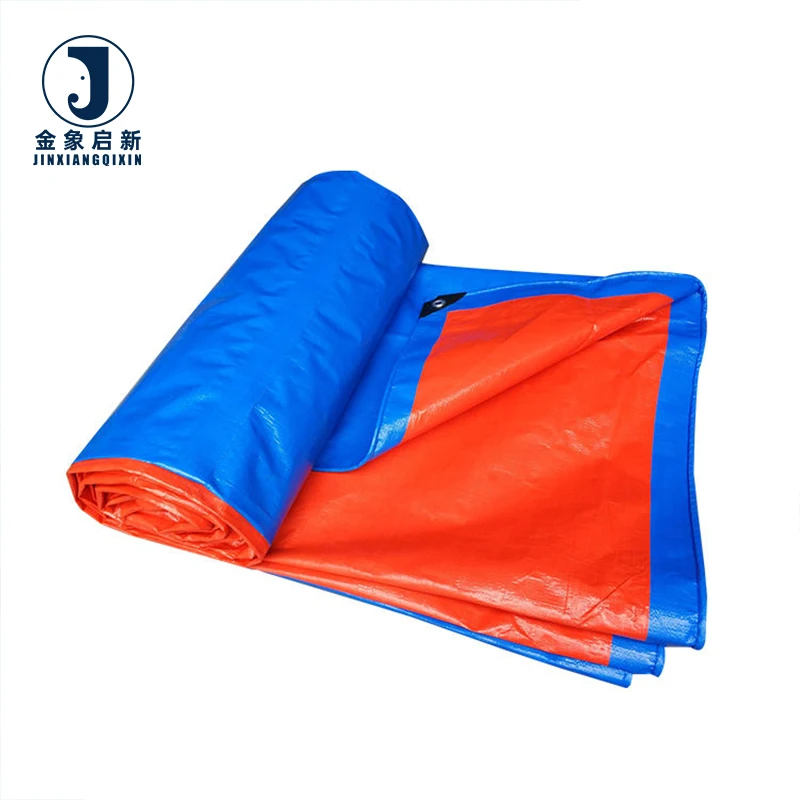
Proven Coating Expertise — Nearly three decades of focused coated fabric production ensures consistent LDPE adhesion across every HDPE woven roll we ship.
Technical Specifications
| Parameter | Value |
|---|---|
| Product Type | PE Tarpaulin |
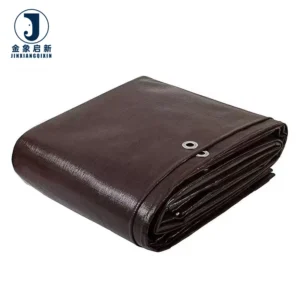
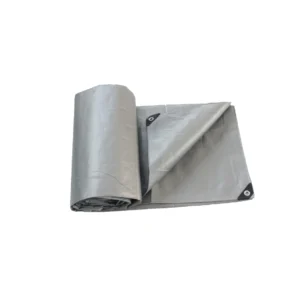
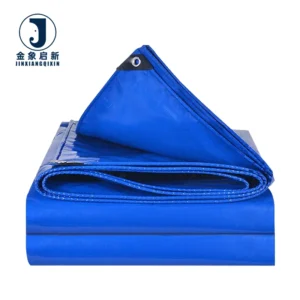
| Material | HDPE woven fabric with LDPE coat on both sides |
| Density | 6X6 to 16X16 mesh |
| Weight | From 50 g/m² up to 300 g/m² |
| Color | Blue, Orange, White, Black, Grey, Yellow, Green, Red, custom colors available |
| Printing Option | Logos or company information; reinforced strip optional |
| Sheet Size | 2X3, 3X4, 3X5, 4X5, 5X6, 6X8, 10X10, 10X12, 12X14, or custom |
| Roll Size | 100 m per roll or custom |
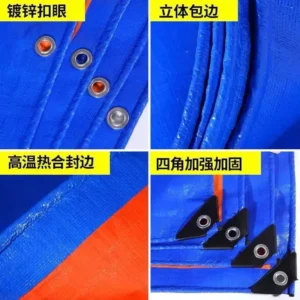
| Edge Making | PP rope hem on all edges |
| Corner Reinforcement | Black plastic triangle at each corner |
| Eyelets | Rustproof aluminum, spaced every 1 m or 1.5 m or custom interval |
| Packing | Each piece folded into plastic bag with customer label inserted |
| Special Treatment | Fire resistant and UV protection available on request — confirm the grade required for your market |
Application Suitability
| Application | Exposure & Requirement |
|---|---|
| Truck and trailer load covers | Road vibration, flex abrasion at tie-down points, weather and UV exposure during transit |
| Side curtain fabric for transport equipment | Continuous folding and unfolding, wind load, tension at eyelet reinforcement zones |
| Logistics pallet covers for regional hauls | Handling abrasion, stacking compression, moisture ingress during loading dock exposure |
| Flatbed oversize load protection | High wind flap forces, prolonged sun exposure, securing tension across large unsupported spans |
| Construction site equipment covers | Dust, debris impact, standing water, intermittent UV on stationary stored machinery |
Why Generic Sizing Leaves Your Load Exposed on the Road
A PE tarpaulin for truck and transport covering must be dimensioned to the exact trailer profile, not a standard sheet size.
Fleet operators routinely order covers that are nominally the right size but leave the rear corners or side overhangs exposed. When a load flexes under braking or cornering, the fabric shifts and the eyelets bear stress in locations the reinforcement was never designed to handle. [NEED_CITE: common failure modes in transport tarpaulin tie-down systems] The result is fraying at the hem, eyelet pull-out, and cargo exposed to rain within a few trips. Custom sizing based on the specific trailer model drawing eliminates this mismatch.
How Road Forces Shape the Material Choice
Every PE tarpaulin for truck and transport covering endures cyclic loading that stationary covers never face. The HDPE woven base provides dimensional stability in both warp and weft directions, resisting the stretch that leads to permanent deformation at tie-down points. Dual-side LDPE coating seals the woven structure against moisture penetration while maintaining enough flexibility for the fabric to fold and drape over irregular load profiles. The interplay between weave density and coating weight determines how well the material absorbs road vibration without delaminating at the fiber-coating interface.
Eyelet Spacing and Hem Engineering for Transit Loads
Rustproof aluminum eyelets positioned at one-meter intervals distribute tie-down tension across*o the folded edge acts as a load-spreading spine, preventing the concentrated point loads that cause eyelets to tear through the fabric under sudden braking forces. [NEED_CITE: tie-down tension distribution across reinforced hems in transport covers] Corner triangles add a secondary reinforcement layer precisely where multi-directional forces converge. For heavy or oversized loads, closer eyelet spacing and additional intermediate reinforcement strips can be specified before production begins.
Reading the Weight and Weave Specification Correctly
GSM alone does not predict how a PE tarpaulin performs under transport conditions. A 150 g/m² fabric woven at 8X8 mesh behaves differently from the same weight at 14X14 mesh — the former uses heavier yarn with wider gaps between intersections, while the latter distributes material across more crossing points for better puncture resistance. The LDPE coating weight accounts for a significant share of total GSM, so two fabrics at identical weight can have very different base fabric strengths depending on how much coating is applied. Buyers specifying material for moving loads should request the base fabric denier and weave count alongside the finished weight to understand where the mass is distributed.
The Hidden Cost of Specifying for Stationary Use on Moving Loads
A cover that performs well on a stationary construction site may fail within weeks when subjected to highway-speed wind flutter and constant tie-down tension. Fabric selected purely on price and minimum acceptable GSM often lacks the weave density needed to resist abrasion at the contact points where the material rubs against the load or trailer frame. [NEED_CITE: accelerated wear patterns in tarpaulins subjected to road vibration] Eyelets specified at standard spacing may be adequate for draping but insufficient for securing loads under dynamic forces, leading to pull-out failures that expose cargo mid-transit. Batch colour inconsistency across a multi-piece fleet order forces operators to install mismatched covers that undermine professional appearance.
Why Transport Operators Source This PE Tarpaulin From Jinxiang
Three full production lines with 36 sets of professional equipment provide the capacity to fulfil bulk fleet orders with reliable on-time delivery, even when multiple trailer models are specified in the same purchase. A 10-person R&D team handles pattern printing, custom sizing against specific truck and trailer drawings, and sample development so that fleet operators can verify fitment before committing to a production run. Dedicated QA/QC inspection at every production stage catches weave inconsistencies, coating thickness variation, and eyelet placement errors before the material leaves the factory. Samples are developed within days for custom dimensions or colours, allowing buyers to validate the specification against real-world trailer geometry. Pre-shipment inspection records confirm that GSM, hem reinforcement, and eyelet spacing match the agreed specification for every roll and sheet in the order.
Documentation & Verification
- Material specification sheet confirming HDPE base fabric density, LDPE coating type, and finished weight per roll or sheet
- Pre-shipment inspection record verifying GSM, eyelet spacing, and hem reinforcement against the order specification
- Test report for UV protection and fire resistant grades issued against the specific production batch where applicable
- ISO and CE certificates documenting quality management and product compliance standards
- Roll packing list with individual piece dimensions, colour reference, and customer label details
- Certificate of origin and customs documentation supporting international shipment clearance
Fabrication, Handling & Storage
- Heat-weld seams on LDPE-coated surfaces require controlled temperature settings matched to the dual-side coating thickness
- PP rope hem reinforcement distributes tie-down loads but must be stitched through the full woven structure, not just the coating layer
- Rolls stored flat on pallets prevent permanent creasing at contact points that can weaken the HDPE weave over time
- Aluminum eyelets resist corrosion in transit environments but should be inspected for deformation after repeated tie-down cycles
- Custom cut sheets should be folded along the weave direction to avoid diagonal creasing that stresses the fiber-coating bond
Preparing Your Specification for a Transport Cover Inquiry
To receive an accurate quotation for PE tarpaulin for truck and transport covering, provide the exact trailer model or load dimensions including any overhang or clearance requirements. Specify the tie-down method and expected tension loads so that eyelet spacing and hem reinforcement can be engineered accordingly. Indicate whether UV protection or fire resistant treatment is required by your operating region or customer contract, along with any colour consistency requirements for fleet-wide orders. Confirm whether you need finished sheets with eyelets and hems or roll stock for in-house fabrication.
Frequently Asked Questions
Q: How do you confirm the tarpaulin is cut to my exact trailer model dimensions?
A: We request the trailer model drawing or precise measurements including overhang allowances. A pre-production sample is developed and dispatched for physical fitment verification on the actual trailer before full production begins, ensuring the PE tarpaulin for truck and transport covering matches the load profile without gaps or excess material.
Q: How do I verify the GSM on arrival matches what was quoted?
A: Every shipment includes a pre-shipment inspection record documenting the measured weight of each roll or sheet against the specification. You can independently verify GSM by cutting a measured sample from the received material and weighing it on a calibrated scale to confirm the stated value.
Q: What fire resistant or UV protection grades are available, and what test reports come with them?
A: Fire resistant and UV protection treatments are applied based on your market requirements. Confirm the specific grade or standard your region mandates, and we will arrange the corresponding treatment with a test report issued against the production batch. Grades and test bases should be discussed at the quotation stage.
Q: Can eyelet spacing and hem reinforcement be customised for heavy tie-down loads?
A: Yes. Eyelet spacing is available at one-meter, 1.5-meter, or custom intervals. Additional reinforced strips can be integrated at high-stress zones, and the PP rope hem diameter can be adjusted to handle increased tie-down tension on oversized or heavy transport loads.
Q: How is colour consistency controlled when ordering covers for an entire fleet?
A: All rolls in a fleet order are produced from the same coating batch with in-process colour checks at each production stage. Pre-shipment inspection verifies roll-to-roll consistency before dispatch, and a colour reference sample is retained for comparison if future reorder matching is required.