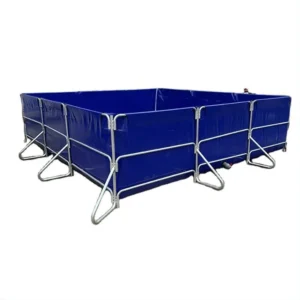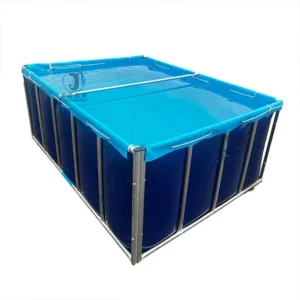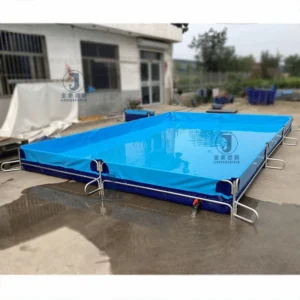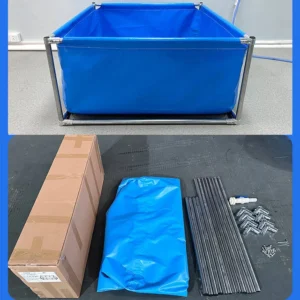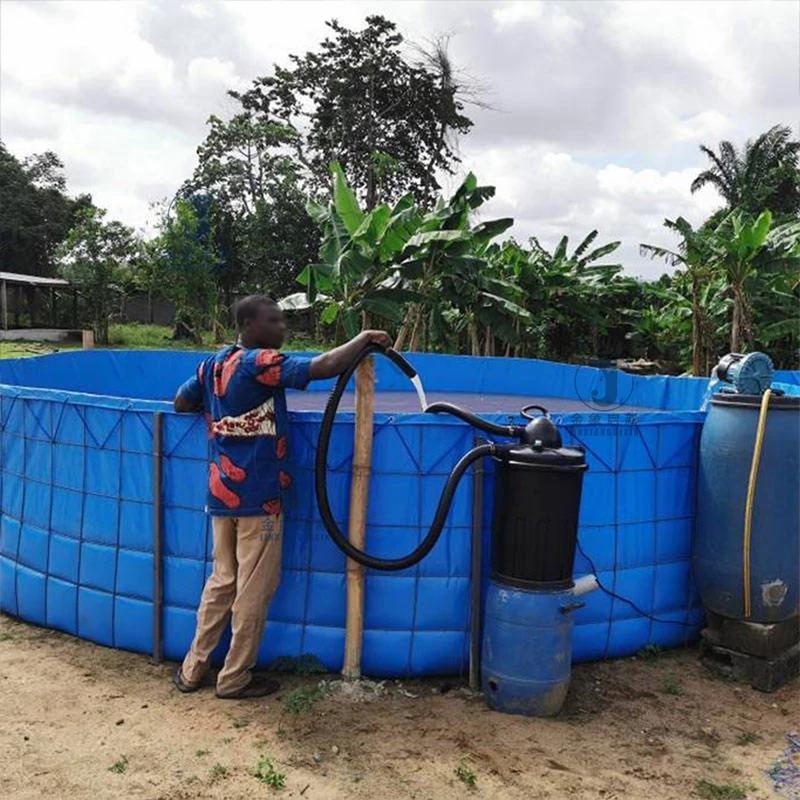
Hot-Air Weldable Pond Liner — double-sided PVC coating on high-tenacity polyester base, with seams that hold under continuous water exposure and resist delamination at flex points.
Technical Specifications
| Parameter | Value |
|---|---|
| Product Type | PVC Coated Tarpaulin |
| Base Fabric | Polyester, 1000D×2000D |
| Coating | PVC, double-sided |
| Yarn Count | 1000D×2000D |
| Density | 30×15 |
| Total Thickness | 0.65mm |
| Tensile Strength (Warp) | 3900 N |
| Tensile Strength (Pick) | 3500 N |
| Water Resistance | Waterproof, fully sealed coating |
| UV Treatment | Anti-UV treated (test basis not stated in source — confirm grade for your exposure conditions) |
| Flame Retardant | Available in flame retardant grades (grade not stated in source — confirm the standard required for your site) |
| Surface | Smooth, leather-like texture |
| Repairability | Hot-air weldable |
| Custom Options | Colour, printing, sizing |
Application Suitability
| Application | Exposure & Requirement |
|---|---|
| Aquaculture fish and shrimp ponds | Permanent water contact, biological loading, puncture risk from substrate and stock movement |
| Agricultural irrigation reservoirs | Sun exposure, temperature cycling, soil chemistry contact on underside |
| Hatchery and rearing tanks | Smooth non-abrasive surface to protect stock, frequent cleaning and partial drainage |
| Landscape and recreational water features | UV exposure, visible aesthetics, custom shape welding around contours |
Why Seams Fail First in Pond Liners and What to Do About It
Welded joints on standard pond liners crack and leak long before the fabric body degrades.
I have seen heavy-grade coated rolls fail at the weld line while the main body of the liner remained intact. The problem is not the fabric — it is the seam. When water pressure shifts with depth, temperature, and stock movement, stress concentrates at every joint. PVC tarpaulin for fish pond applications must be welded, not glued, so that the seam becomes as strong as the base material itself. [NEED_CITE: tensile and tear test methods for coated fabrics per ISO 1421]
Generic pond liners often arrive in standard sheets that require multiple overlapping joints. Each additional weld is a potential failure point under hydrostatic load. The solution starts with specifying the correct seam method and continues through to verifying that the liner arrives in dimensions that minimise on-site joining.
Hot-Air Welding: The Seam Method That Matches the Fabric
PVC coated polyester is inherently suited to hot-air welding because the coating melts and fuses under controlled heat, creating a monolithic bond at the joint. Unlike adhesive bonding, which introduces a foreign material layer that can degrade independently, hot-air welding uses the liner’s own PVC coating as the joining medium. For aquaculture operators installing large-dimension ponds, this means on-site repairs and custom-shape fabrication can be performed without returning the liner to a workshop.
Containment Without Abrasion
The smooth, leather-like surface of this PVC tarpaulin fish pond liner is not just an aesthetic choice. Fish and shrimp in intensive aquaculture systems constantly contact the liner walls and floor. A rough or textured surface can cause scale loss and skin abrasion, increasing susceptibility to infection. The double-sided PVC coating produces a uniform surface that minimises friction damage to stock while remaining easy to clean between production cycles. [NEED_CITE: DIN 4102 fire classification for building materials]
Reading the Specifications Beyond Weight
The 0.65mm total thickness and 1000D×2000D base fabric together determine how this liner behaves under load. Yarn denier controls individual thread strength — a 1000D warp thread carries substantially more load than a 500D thread before breaking. The 30×15 density figure describes how many threads per unit length run in each direction; a tighter weave resists tear propagation because a puncture must break more threads to spread. PVC coating weight, applied to both sides, fills the weave gaps and provides the waterproof barrier. When evaluating any pond liner, the relationship between these parameters matters more than any single number — a heavy coating on a weak base fabric will crack under tension, while a strong base with insufficient coating will leak at the weave intersections.
The Cost of Specifying the Wrong Grade
A liner that is too thin for the pond depth will stretch under hydrostatic pressure, thinning the coating at stress points and exposing the base fabric to water ingress. Conversely, a liner specified far beyond the required grade adds unnecessary weight and cost, making handling and installation more difficult without proportional benefit. Colour inconsistency between rolls becomes visible when multiple sheets are welded side by side in large installations — a batch mismatch means either accepting a patchy appearance or replacing entire sections. [NEED_CITE: PVC coated fabric colour consistency standards across production batches]
Why Procurement Verification Matters Here
Every roll is inspected before dispatch with documented weight verification against the quoted specification. The in-process QA system checks coating adhesion and fabric density at production stages, not just at final packing. A 10-person R&D team handles custom sizing and sample development, so pond dimensions can be matched precisely rather than forcing a standard sheet to fit. Hot-air weldability is confirmed as part of material selection, ensuring the liner you receive can be fabricated and repaired on-site. Pre-shipment inspection records accompany each order, giving you a traceable quality baseline before the material leaves the facility.
Documentation & Verification
- Material specification sheet listing base fabric denier, coating type and confirmed weight for each roll
- Pre-shipment inspection record with coating adhesion and dimension checks
- Anti-UV and flame-retardant test reports where applicable to your order grade
- Certificate of origin and customs documentation for international shipment
- Roll packing list with individual roll identification for traceability
Fabrication, Handling & Storage
- Hot-air weld temperature and speed must match the 0.65mm PVC coating thickness to avoid burning through or under-fusing the seam
- Store rolls upright on pallets to prevent flat-spotting and permanent crease marks in the PVC coating
- Unroll the 1000D×2000D liner on a clean, debris-free surface to prevent puncture before welding
- Use PVC-compatible cleaners only — solvent-based products can soften the coating and reduce weld integrity at repaired joints
- Allow the liner to acclimate to ambient temperature before welding in cold conditions to ensure consistent seam fusion
What to Include in Your Enquiry
Provide the pond dimensions, water depth and substrate type so the correct thickness and cut size can be specified. If your site requires flame-retardant certification for compliance, state the standard your local authority mandates. Confirm whether you need finished cut-to-size panels or full rolls for on-site fabrication, and specify colour requirements if multiple liners will be installed in visible proximity.
Frequently Asked Questions
Q: What GSM and thickness do I need for my pond depth?
A: Deeper ponds generate higher hydrostatic pressure, requiring a liner with greater tensile strength and coating thickness to resist stretching and thinning. The 0.65mm grade on a 1000D×2000D base suits standard aquaculture depths. For unusually deep installations or sites with sharp substrate, provide your exact dimensions and depth so a heavier grade can be evaluated.
Q: Can the liner be hot-air welded on-site for custom shapes and repairs?
A: Yes. The double-sided PVC coating fuses under hot-air welding, producing seams that match the liner’s base strength. On-site welding allows custom shapes to be fabricated around irregular pond contours, and punctures sustained during installation or operation can be repaired without replacing the entire sheet.
Q: Do you supply test reports for UV and flame-retardant treatments?
A: Test reports are provided for orders specifying anti-UV or flame-retardant grades. The applicable test standard and result are documented. If your site or local regulations require a specific certification standard, state this in your enquiry so the correct grade is supplied and documented.
Q: How do I order a custom-cut size to fit my pond dimensions exactly?
A: Provide the length, width and depth of your pond along with any contour details. Samples for custom requirements are developed within days. The R&D team prepares a cut layout that minimises on-site welding and material waste, and a quotation is issued with lead time and minimum order details.
Q: What is the expected service life under continuous outdoor water exposure?
A: Service life depends on UV exposure intensity, water chemistry, installation quality and substrate conditions. The anti-UV treated PVC coating is formulated for extended outdoor exposure in aquaculture environments. Request the anti-UV test report for your specific grade and discuss your site conditions to confirm suitability.