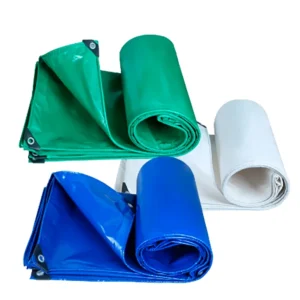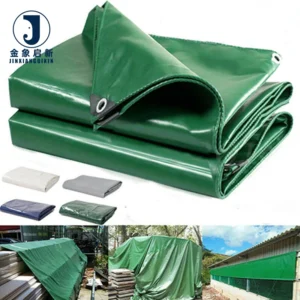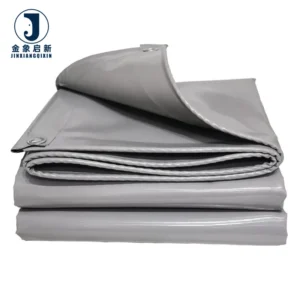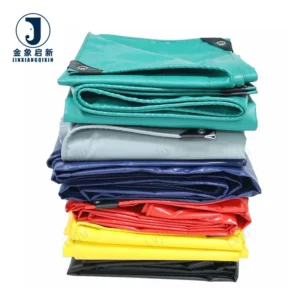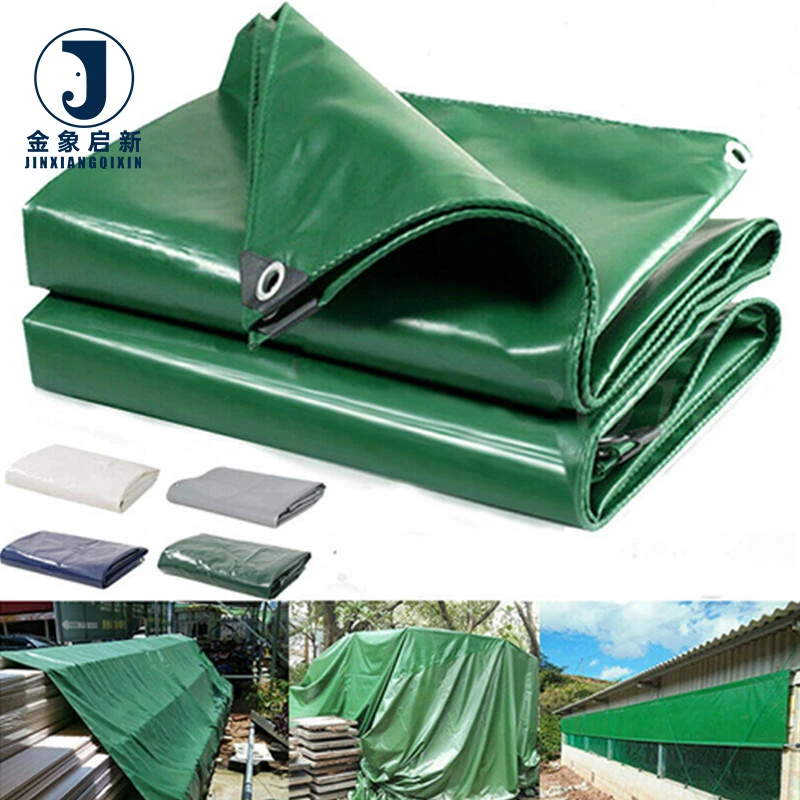
Precision Weld Integrity — three full production lines and 36 sets of professional equipment controlling coating adhesion and seam strength on every PVC coated tarpaulin for truck and transport roll that leaves the facility.
Technical Specifications
| Parameter | Value |
|---|---|
| Product Type | PVC Knife-Coated Fabric |
| Material | PVC coated polyester fabric |
| Weight Range | 400–1500 g/m² |
| Thickness | 0.35–1.5 mm |
| Base Fabric Denier | 500D–2000D |
| Tensile Strength (Warp) | 1500–3000 N/5cm |
| Tensile Strength (Weft) | 1200–2800 N/5cm |
| Available Width | 2m, 4m, 6m / 6ft, 8ft, 10ft, 12ft |
| Roll Length | 100 yards, 100 meters, or custom |
| Surface Finish | Glossy or matte |
| Treatment Options | UV resistant, flame retardant, anti-static, waterproof (confirm the grade required for your market) |
| Color Options | Blue, Blue/Orange, Green, Grey, Black, Clear, Grey/Green, Orange, or custom |
| Edge Reinforcement | PP rope reinforced hem (finished tarps) |
| Eyelet Spacing | Every 3ft or 1 meter (finished tarps) |
| Corner Reinforcement | Reinforced plastic corners (finished tarps) |
| Standards | ISO 9001, CE |
Application Suitability
| Application | Exposure & Requirement |
|---|---|
| Truck and trailer side curtains | Constant flexing, road abrasion, tie-down stress, UV exposure |
| Flatbed and tipper load covers | Weather exposure, wind lift, load shifting, mechanical abrasion |
| Curtain-sided fleet replacement fabric | Repeated rolling and tensioning, thermal expansion, colour consistency across fleet |
| Transport equipment builder OEM covers | Model-specific fitment, welded seam integrity at stress points, regulatory compliance |
| Palletised and bulk material protection | Rain ingress prevention, dust containment, stacking compression |
Why Welded Seams Fail Before the Fabric Does on Truck Covers
The weld line is only as strong as the coating adhesion and base fabric stability feeding into it — weight alone cannot save a poorly matched seam.
When a PVC coated tarpaulin for truck and transport use flexes under wind load or road vibration, the stress concentrates at the welded joints rather than distributing across the fabric body. A heavy-grade roll with weak coating adhesion will delaminate at the heat-affected zone while the base fabric remains intact [NEED_CITE: tensile and tear test methods for coated fabrics per ISO 1421]. This failure pattern repeats across fleets that specify by GSM without verifying coating bond strength, leaving operators replacing covers long before the base material has reached its service potential.
Coating Adhesion Determines What the Road Actually Tests
A truck side curtain undergoes thousands of flex cycles per journey. The PVC knife-coated fabric must maintain coating-to-yarn bond through every cycle, especially where the curtain attaches to the rail and where tie-down straps pass through. Knife coating builds the PVC layer by forcing compound into the base fabric weave under controlled blade pressure, producing a mechanical lock between coating and yarn that supports strong heat-welded seams. The PVC coated tarpaulin for truck and transport use performs at flex points only when this adhesion is verified against the peel strength required for the specific mounting system.
Model-Specific Fitment Eliminates the Gaps Generic Sizes Leave
A truck cover cut to a generic dimension rarely matches the exact trailer profile. Gaps at the corners allow water ingress, while excess material flaps in the slipstream, accelerating abrasion at the hem. Fleet operators specifying this PVC coated tarpaulin for truck and transport applications benefit from providing the exact trailer make, model and year so that the finished cover accounts for door furniture, hinge clearance and tie-down rail position [NEED_CITE: common truck trailer dimension standards and tarpaulin fitment practices]. The reinforced PP rope hem and galvanized eyelets then land in the correct positions for the existing fleet hardware.
Reading the Specification Sheet Beyond the GSM Figure
The weight in g/m² tells you how much material is present but not how it performs. A 400–500 g/m² grade in 500D base fabric serves medium-duty transport covers where loads are enclosed or journeys are short. Moving to 700–1000 g/m² with 1000D yarn adds tensile capacity for long-haul side curtains subjected to sustained wind pressure. At 1100–1500 g/m² and up to 2000D, the fabric handles the abrasion and puncture risk of open flatbed loads carrying sharp-edged materials. Thickness, measured from 0.35 mm through to 1.5 mm across these tiers, reflects total compound build and directly influences weld parameter settings on fabrication equipment. Available in widths from 2 m to 6 m, the roll stock allows fabricators to orient panels so that the warp direction aligns with the primary load axis, improving tear resistance where it matters most. Surface finish — glossy or matte — affects dirt retention and print receptivity, with matte surfaces generally holding printed branding more sharply under road grime exposure.
The Cost of Specifying by Weight Without Verifying the Batch
A quotation stating a target GSM means little if the rolls arriving at the dock are lighter. Fleet operators who have accepted delivery without weight verification often discover the shortfall only when the cover tears prematurely at an eyelet or hem [NEED_CITE: pre-shipment inspection practices for coated fabric rolls]. Similarly, a flame retardant claim without a supporting test report creates compliance risk when the vehicle enters a jurisdiction requiring documented fire classification. Colour variation between rolls in the same order becomes visible once fitted side by side on adjacent trailers, forcing a full fleet re-cover that no specification sheet warned against.
How Production Control Translates to Consistent Rolls
Three full production lines allow dedicated scheduling for knife-coated transport grades, so your order runs on equipment calibrated for the target GSM rather than sharing a line with unrelated products. The 10-person R&D team develops samples within days for custom colour and width requirements, enabling approval before the main production run begins. Each roll passes through in-process QA at the coating, curing and winding stages, with 100 percent inspection recorded before dispatch. Colour matching is controlled within the batch to prevent the side-by-side variation that causes fleet fitment problems. Available in UV resistant, flame retardant and anti-static treatment options, the PVC knife-coated fabric ships with documentation tied to the specific grade ordered — not a generic certificate.
Documentation & Verification
- Material specification sheet stating GSM, base fabric denier and coating weight for weight-on-arrival verification
- UV and flame retardant test reports provided where the specific treatment grade is ordered and confirmed
- Pre-shipment inspection record documenting 100 percent roll-by-roll check before container loading
- Roll packing list detailing roll count, individual roll weight and net/gross figures for customs clearance
- Certificate of origin and customs support documentation for cross-border shipment
Fabrication, Handling & Storage
- Heat-weld PVC knife-coated fabric using temperature and dwell time matched to the specific GSM and coating thickness of your grade
- Position galvanized eyelets at the specified 3ft or 1 m intervals to distribute tie-down load evenly across the reinforced PP rope hem
- Store rolls vertically on end in a covered area to prevent permanent flat spots and coating compression marks
- Allow rolls to acclimatise to workshop temperature before unrolling to prevent creasing in cold-stiffened PVC
- Cut panels with the warp direction aligned to the primary stress axis to maximise tear resistance at load-bearing seams
- Clean glossy or matte surfaces with mild detergent only, avoiding solvents that degrade the PVC coating layer
What We Need to Quote Your Requirement
Provide the trailer make, model and year, or the exact finished dimensions if ordering cut sizes. Confirm whether you need roll stock in a specific width or finished tarps with eyelets and hem reinforcement. State the treatment grade required by your operating region — UV resistant, flame retardant or anti-static — so the correct documentation accompanies the shipment. Let us know the colour reference and whether printed branding is needed so we can prepare a sample for approval before the production run.
Frequently Asked Questions
Q: How do I verify the GSM of the PVC coated tarpaulin on delivery?
A: Cut a measured sample from the roll, weigh it and calculate the weight per square metre against the specification sheet. We provide a pre-shipment inspection record documenting the weight of every roll before dispatch, so any discrepancy between the quotation and the delivered material is identified before the container is sealed.
Q: Why does a generic truck cover size not fit my trailer properly?
A: Generic dimensions do not account for door furniture, hinge clearance, tie-down rail position and bumper overhang specific to your trailer model. We cut to the exact vehicle profile when you provide the make, model and year, ensuring eyelets and reinforced corners align with your existing fleet hardware.
Q: What test documentation supports UV and flame retardant claims?
A: Where treatment is specified and confirmed for your order, we supply the corresponding test report documenting the grade achieved. Request the documentation at inquiry stage so we match the correct compound formulation and testing standard to your market’s regulatory requirements.
Q: How is colour consistency maintained across multiple rolls in one order?
A: All rolls in a single production batch are matched to the approved colour reference during the coating stage, with in-process QA checks at winding. The pre-shipment inspection record confirms colour consistency roll by roll before loading, preventing the visible variation that occurs when unmatched batches are fitted side by side.