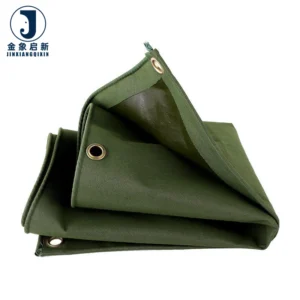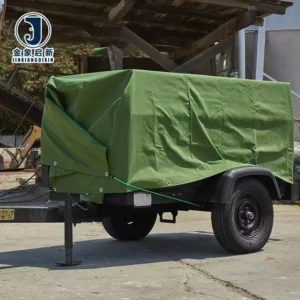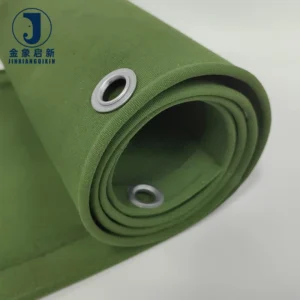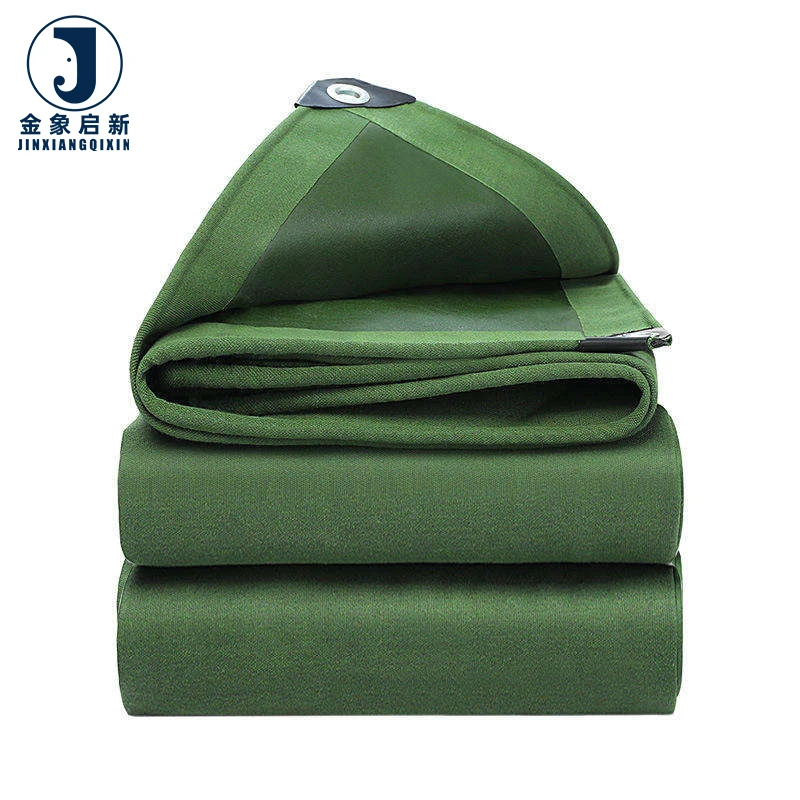
Custom Fabrication Precision — Each canvas tarpaulin for truck cover is cut to your specific trailer model, eliminating generic-size gaps and wind lift on the highway.
Technical Specifications
| Parameter | Value |
|---|---|
| Product Type | Canvas Tarpaulin |
| Material | Polyester cotton industrial textile, 8-12 strands of fine cotton yarn |
| Weight | 600gsm |
| Thickness Options | 0.5mm, 0.6mm, 0.7mm |
| Color Options | Army Green Camouflage, Custom colors available |
| Roll Size | 2m width × 100m length |
| Finish Product Size | Custom cut to vehicle model or sold from inventory |
| Waterproof | Yes (silicone canvas construction) |
| Anti-Mildew | Yes |
| UV Resistant | Available in UV resistant grades — confirm the grade required for your market |
| Edge Reinforcement | Rust proof aluminum eyelets every 1 meter at corners and hem |
| Seam Construction | Folded, welded and sewn with poly rope reinforcement |
| Standards | CE, ISO |
Application Suitability
| Application | Exposure & Requirement |
|---|---|
| Truck and trailer load covers | Constant road vibration, wind uplift at speed, cargo abrasion at flex points |
| Side curtain fabric for transport builders | Repeated rolling and folding, UV and weather exposure, structural tie-down loads |
| Open-air construction equipment covers | Rain ingress, dust and debris, long-term stationary UV and mildew exposure |
| Asphalt transport covers | Elevated material temperatures, direct contact with bitumen, rapid deployment and removal |
Why Generic Sizing Costs You More Than the Fabric Itself
A truck cover cut to your exact trailer model eliminates cargo exposure and reduces replacement frequency.
Fleet operators routinely replace covers that arrived in a nominal size but failed to account for corner radius, tie-down positioning or tailgate clearance. When a canvas tarpaulin for truck cover does not align with the physical trailer profile, wind gets underneath at highway speed, causing flap fatigue at the hem and premature eyelet pull-through [NEED_CITE: aerodynamic load testing on heavy vehicle covers per EN 12195]. The resulting cargo damage claims and downtime far exceed the cost of a pattern-accurate cut.
Pattern Cutting to Trailer Model Eliminates Wind Lift
Every truck and trailer model has a distinct footprint — wheel arch depth, rear door swing clearance, and side rail height all change where the fabric must sit. We take the specific vehicle dimensions you provide and generate a cutting pattern that positions eyelets directly at your existing tie-down anchors. This canvas tarpaulin for truck cover approach prevents the gaps and overhang that cause wind lift on the highway, and it ensures the reinforced hem sits flush against the load platform rather than flapping in turbulence.
Welded and Sewn Seams at the Points That Actually Fail
Most cover failures start where the load flexes — typically across the middle third of the trailer bed where cargo shifts under braking. The seams on this 600gsm canvas are folded, welded and sewn with poly rope reinforcement at those stress zones, distributing tension across a wider fabric area rather than concentrating it at a single stitch line. [NEED_CITE: seam strength test methods for coated technical textiles per ISO 1421] The poly rope inside the hem also prevents the eyelets from pulling through the fabric edge when straps are tensioned during transit.
How GSM and Yarn Count Interact in Canvas Weave
A 600gsm reading alone tells you the weight per square metre but nothing about the underlying weave density or yarn thickness. This canvas tarpaulin uses 8-12 strands of fine cotton yarn in a polyester-cotton industrial textile base, which produces a tighter weave with more yarn intersections per centimetre. More intersections mean higher resistance to tear propagation — a tear must break more individual yarns to spread, even if the total GSM were identical to a looser weave. The three available thicknesses (0.5mm, 0.6mm, 0.7mm) correspond to different coating build-up on this base fabric, allowing you to match abrasion resistance to your specific exposure conditions.
What Happens When Specifications Do Not Match the Application
Ordering a canvas tarpaulin for truck cover without confirming the actual GSM on arrival is a common source of fleet frustration. Material that arrives lighter than quoted has fewer yarns per centimetre and a thinner coating, meaning it wears through at abrasion points faster than expected [NEED_CITE: coated fabric weight tolerance standards for transport covers]. Similarly, specifying eyelet spacing that does not match the trailer’s tie-down rail positions forces operators to strap at angles, concentrating load on individual eyelets and tearing the hem. Batch colour variation across multiple covers on the same fleet also becomes visible once installed side by side, affecting corporate appearance without affecting function but prompting unnecessary replacement.
Why Procurement Teams Choose This Source
Deep process control over coating weight and adhesion on coated fabric is maintained across three full production lines, supporting bulk orders with consistent roll-to-roll weight verification. The 10-person R&D team develops pattern-accurate cutting templates from your trailer model drawings, producing physical samples within days so you can confirm fitment before committing to full production. Every roll passes through QA inspection at each production stage — coating adhesion, GSM weight check, eyelet pull-test — with a documented pre-shipment record accompanying dispatch. Custom widths, colours and eyelet configurations are produced on dedicated equipment rather than squeezed into standard production slots, reducing lead time variability for non-standard orders.
Documentation & Verification
- Weight verification per roll against stated 600gsm before dispatch, with signed inspection record
- Material specification sheet listing yarn count, base fabric weave and coating type for this canvas tarpaulin
- Colour reference card confirming batch consistency across multiple truck cover units in the same order
- Pre-shipment inspection record photographing eyelet spacing, seam reinforcement and hem construction
- Certificate of origin and customs documentation package for cross-border fleet procurement
Fabrication, Handling & Storage
- Weld seams on 600gsm canvas require controlled heat input to prevent cotton yarn scorching at the bond line
- Poly rope in the reinforced hem must remain continuous around corners to distribute eyelet load evenly
- Store rolls flat on pallets — vertical storage of 2m × 100m rolls creates permanent crease lines in silicone canvas
- Avoid folding the 0.5mm–0.7mm canvas at sharp angles during installation to prevent coating crack at the fold
- Clean with mild detergent only; solvent-based cleaners degrade the silicone waterproofing layer on this canvas tarpaulin
What to Include in Your Inquiry
Provide the exact trailer make, model and year along with measured bed dimensions and tie-down rail positions so we can generate a fitment-accurate cutting pattern. Specify whether you need finished covers with eyelets and welded hems or roll stock for your own fabrication facility. If colour consistency across a fleet order is required, state the total quantity upfront so the production run is scheduled as a single batch. Sample pieces confirming weight, hand feel and seam construction are available before production commitment.
Frequently Asked Questions
Q: How do I verify the 600gsm weight matches the quotation when the tarpaulin arrives?
A: Request the pre-shipment inspection record, which documents the weight check performed on each roll before dispatch. You can independently cut a measured sample from the roll edge and weigh it on a calibrated scale. Any discrepancy should be raised against the inspection record within the agreed claims window.
Q: What vehicle dimensions do you need to cut a truck cover to my specific trailer model?
A: Provide the trailer make, model, year, overall bed length and width, wheel arch depth, rear door clearance height, and the exact positions of your tie-down rails. This allows us to pattern the canvas tarpaulin so that eyelets align with your existing anchor points and the hem sits flush against the load platform.
Q: Are the aluminum eyelets and reinforced hems sufficient for highway-speed wind loads?
A: The rust proof aluminum eyelets are spaced every 1 metre along corners and hem, backed by a welded and sewn poly rope reinforcement that distributes strap tension across a wider fabric area. For high-speed motorway routes or exposed coastal corridors, we can adjust eyelet spacing closer together — specify your operating conditions when inquiring.
Q: Will colour be consistent if I order multiple truck covers for an entire fleet?
A: Colour consistency is maintained by scheduling the full fleet order as a single production batch with matched dye lots. We provide a colour reference card with the shipment for your visual check. If your fleet requires covers delivered in stages, request batch reservation at the time of the first order to lock the dye formulation.
Q: Which seam construction — welded or sewn — holds up better where the load flexes?
A: This canvas tarpaulin uses both methods together: seams are folded, welded and then sewn with poly rope reinforcement. The weld seals the seam against water ingress, while the stitching and internal rope carry the structural load. This combination prevents the common failure mode where a sewn-only seam opens under flex stress or a weld-only seam delaminates at the bond line.