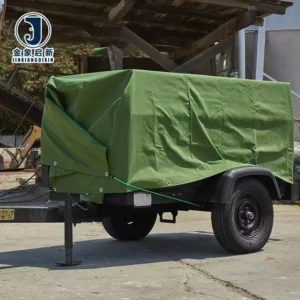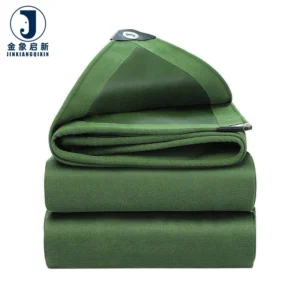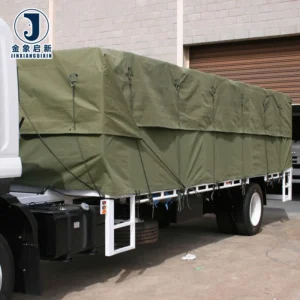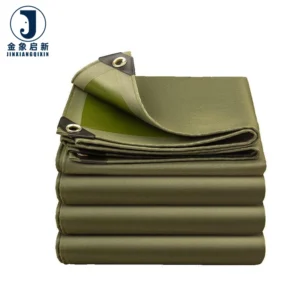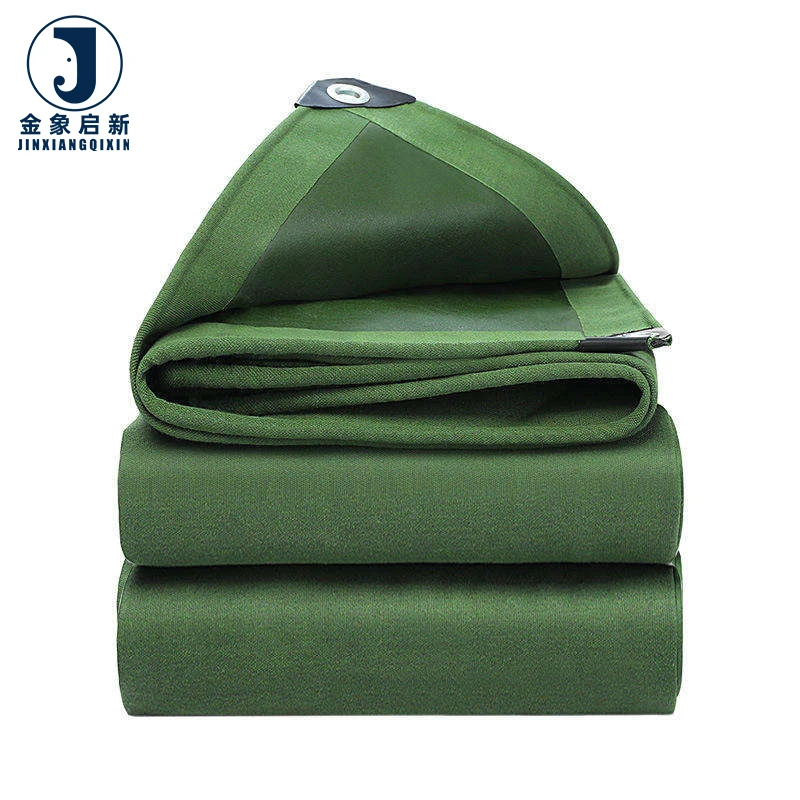
Truck and transport cover fabric engineered to vehicle dimensions — 600gsm PVC laminated polyester canvas cut and finished to match specific trailer models, eliminating the loose fit and edge tearing that generic-sized tarps cause under road vibration and wind load.
Technical Specifications
| Parameter | Value |
|---|---|
| Product Type | PVC Laminated Canvas Tarpaulin |
| Base Fabric | Polyester cotton industrial textile, 8-12 strands of fine cotton yarn |
| Weight | 600gsm |
| Coating Method | Laminated |
| Total Thickness | 0.5mm / 0.6mm / 0.7mm |
| Roll Width | 2m |
| Roll Length | 100m |
| Color Options | Army Green Camouflage / Custom |
| Eyelets | Rust-proof aluminum, spaced every 1 meter at corners and hem |
| Edge Reinforcement | Folded hems sewn with poly ropes, welded seams |
| Key Features | Waterproof, UV resistant (test basis not stated), anti-mildew (test basis not stated), wear-resistant, shrink-proof |
| Certifications | CE, ISO |
Application Suitability
| Application | Exposure & Requirement |
|---|---|
| Truck and trailer load cover | Road vibration, wind flap, UV exposure, flex at load shift points — requires welded seams and secure tie-down eyelets |
| Asphalt and construction material cover | Heat from fresh asphalt, abrasion from aggregate, weather exposure — demands puncture and temperature resistance |
| Transport equipment side curtain | Constant folding and unfolding, road debris impact, long-haul weather cycles — needs sustained tensile integrity at flex zones |
| Outdoor equipment and site cover | Standing water, soil contact, sun exposure — calls for waterproof coating and mildew resistance |
Heavy Duty Canvas Tarpaulin for Truck Cover: Why Generic Sizes Fail on the Road
A tarp that does not match your trailer’s exact dimensions will fail at the corners and hems long before the fabric itself wears out.
Every transport fleet operator has seen it: a Heavy Duty Canvas Tarpaulin for Truck Cover ordered in a standard size arrives on site, and the fit is either too loose — flapping in crosswinds and sawing against the load — or too tight, concentrating stress at the eyelet line until the aluminum pulls through the hem. Generic sizing ignores the specific deck height, side rail profile, and tailgate geometry of your vehicle. The result is premature edge failure, exposed cargo, and replacement orders placed far sooner than expected [NEED_CITE: common failure modes in truck tarpaulin installations]. Custom cutting to the vehicle model eliminates these misalignment failures and keeps the cover under even tension across the entire load surface.
Precision Fitment for Fleet Operators
When covering a moving load, the fit of the Heavy Duty Canvas Tarpaulin for Truck Cover matters as much as the fabric weight. This material is cut to the exact dimensions of your truck or trailer model — deck length, side drop, and overlap allowance — so the tarp seats flat without slack zones that collect water or flap zones that abrade against tie-down straps. The rust-proof aluminum eyelets, spaced every 1 meter along the hem and at every corner, align with standard vehicle tie-down points, distributing the load evenly and reducing the chance of eyelet pull-out under sustained highway wind.
Seam Construction at High-Stress Flex Points
The junction where a truck cover bends over the load edge and meets the tie-down rope is the most mechanically stressed zone in the entire installation. This PVC laminated canvas addresses that with a dual seam approach: structural hems are folded, sewn with poly rope reinforcement, and then welded. The welding fuses the PVC coating layers into a continuous bond that moves as one with the base fabric, preventing the seam separation that stitched-only construction often shows after repeated flexing [NEED_CITE: welded versus sewn seam longevity in coated transport fabrics]. This matters particularly for side curtain applications and covers that are removed and replaced frequently during multi-drop deliveries.
Reading the 600gsm Specification Correctly
The 600gsm weight of this canvas tarpaulin represents the combined mass of the polyester cotton base fabric and the laminated PVC coating per square meter. What determines real-world tensile and tear performance, however, is how that weight is distributed between base yarn and coating. A heavier coating on a lighter base may feel stiff and resist water well but will tear more easily under impact; a heavier base with a proportionate coat gives better rip-stop behaviour. The 8-12 strand cotton yarn construction here provides a dense weave that supports the 600gsm total with mechanical interlock at the yarn level. The laminated coating method — where a pre-formed PVC film is bonded to the base under heat and pressure — yields consistent coating thickness across the roll width and strong peel adhesion, which directly affects how well the material holds together at welded seams and cut edges during fabrication and use.
What Inconsistent Batch Colour Costs a Transport Fleet
When multiple rolls arrive on site for a fleet covering project and the shade differs from one roll to the next, the problem is not just cosmetic. Covers cut from different rolls and installed on adjacent trailers create a visibly mismatched fleet — a problem that reflects on the operator’s brand and may trigger rejection by the end client. This colour variation often traces back to insufficient pigment dosing control or raw material batch mixing during production [NEED_CITE: colour consistency control methods in PVC coated fabric manufacturing]. Ordering under a single production batch with a pre-shipment colour consistency check across all rolls in the order prevents this, but only if the buyer specifies it as a requirement at the inquiry stage rather than discovering it at the loading dock.
Sourcing the Heavy Duty Canvas Tarpaulin for Truck Cover Here
Production starts from dedicated polyester cotton base fabric rather than generic stock, maintaining control over yarn denier and weave density before lamination. The 10-person R&D team handles custom sizing, pattern development, and sample turnaround so that your specific trailer dimensions are confirmed in a physical sample before bulk production begins. Three full production lines and 36 sets of professional equipment support consistent roll-to-roll output, and every roll undergoes 100% pre-shipment inspection covering weight verification, colour match, and eyelet placement accuracy. Custom widths, lengths, and colours are produced with lead times and minimums stated at quotation — not introduced as surprises after the order is placed.
Documentation & Verification
- Material specification sheet confirming 600gsm weight, polyester cotton base fabric, and laminated PVC coating type
- Pre-shipment inspection record documenting GSM verification per roll against the quoted specification
- Colour consistency report comparing all rolls within the same production batch before dispatch
- Roll packing list with individual roll dimensions, weight, and batch identification number
- Certificate of origin and customs documentation for cross-border shipment
Fabrication, Handling & Storage
- Set welder temperature and dwell time for laminated PVC coating to ensure peel adhesion at seams without scorching the 600gsm base
- Store rolls upright on cores to prevent flat-spot creases that become visible after the canvas tarpaulin is unrolled and tensioned
- Position rust-proof aluminum eyelets to align with vehicle tie-down rails; reinforce high-load corners with additional welded patches
- Avoid dragging the 2m-wide roll across abrasive ground during deployment to protect the laminated PVC surface
- Clean with mild detergent only; solvent-based cleaners may soften the laminated coating bond over repeated use
- For on-site repair of punctures, apply PVC-compatible adhesive patches on both sides of the 0.5mm–0.7mm material
What to Include in Your Inquiry
To specify the right cover for your fleet or project, share your truck or trailer model designation, deck dimensions, and the type of cargo or load profile you are covering. Let us know whether you need finished covers cut and eyeleted to size, or roll stock for your own fabrication line. If your operation requires specific fire classification or anti-mildew certification for a regulated site, state the standard name and issuing body your market requires so that the correct treatment grade can be confirmed with test documentation before production.
Frequently Asked Questions
Q: Can you cut to my specific trailer model and what is the MOQ?
A: Yes. Provide the trailer make, model, and deck dimensions — including any side rail or tailgate profiles that affect the cover shape. We develop a cut pattern and produce a physical sample for your approval before bulk runs. Minimum order quantities for custom-cut finished covers are confirmed at quotation and vary by the complexity of the shape and total piece count required.
Q: How do you verify the 600gsm on arrival matches the quotation?
A: Every roll is weighed and measured during pre-shipment inspection, and the GSM is calculated and recorded on the inspection report. This report travels with the shipment so you can cross-check the documented weight against the physical roll upon receipt. If you require independent third-party weight verification at your end, we support that protocol and provide the necessary material samples.
Q: How do you ensure colour consistency across multiple rolls in one order?
A: All rolls within a single order are produced from the same pigment batch under continuous colour monitoring. Before dispatch, a pre-shipment colour consistency check compares every roll side by side under standardized lighting. Rolls that fall outside the acceptable tolerance are replaced before packing. The batch identification number on each roll label allows traceability back to the production run.
Q: What seam construction is used at the points where the load flexes most?
A: High-flex zones — typically the hem line and corners where tie-down ropes exert repeated pull — use a combination of folded and sewn poly rope reinforcement followed by heat welding of the PVC laminated coating. This dual approach prevents the seam from separating under cyclic loading. Standard panel joins where flex is minimal may use welding alone, depending on the cover design.
Q: What eyelet spacing and hem reinforcement options are available for tie-down?
A: Standard configuration is rust-proof aluminum eyelets placed every 1 meter along the hem and at each corner, with the hem folded and sewn around a poly rope for load distribution. Spacing can be adjusted for specific tie-down systems, and additional corner reinforcement patches can be added at points where concentrated loads are expected from ratchet straps or bungee cords.