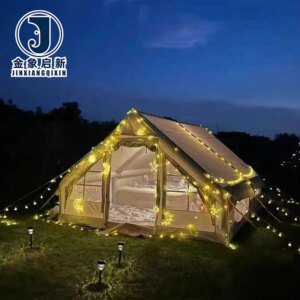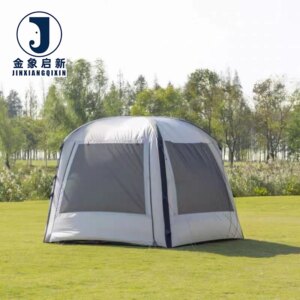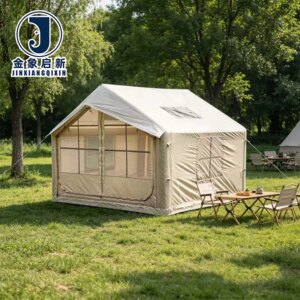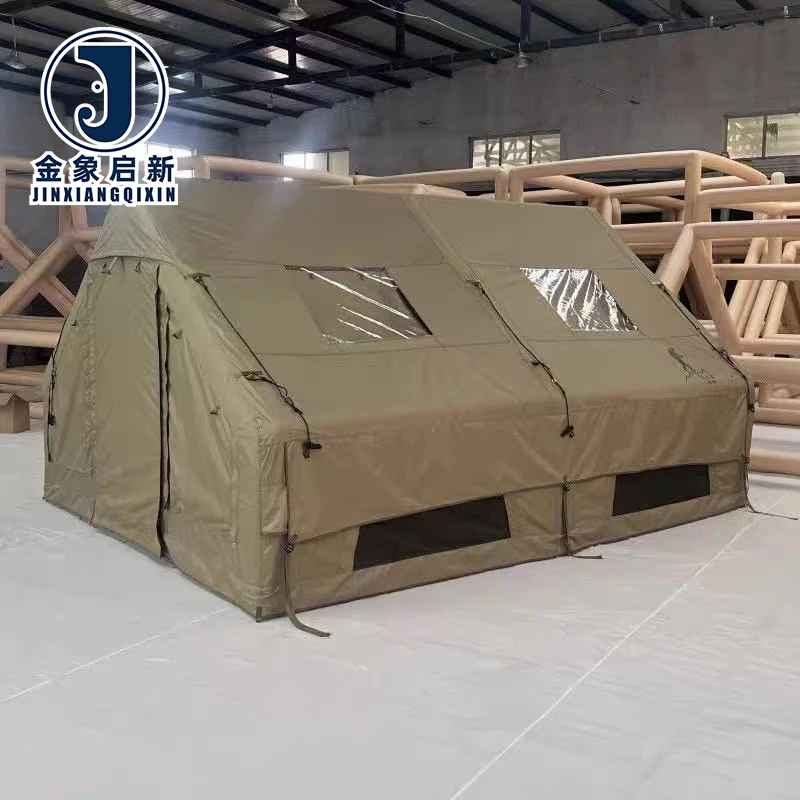
Coated Fabric Expertise — Nearly 30 years of PVC tarpaulin production informs every roll of Inflatable Tent Fabric for Truck and Transport Covering leaving our facility, supported by dedicated QA/QC at every stage.
Technical Specifications
| Parameter | Value |
|---|---|
| Product Type | Inflatable Tent |
| Core Material | PVC Tarpaulin |
| Product Form | Inflatable structure |
| Waterproof | Yes |
| UV Treatment | UV-resistant (test basis not stated in source) |
| Tear Resistance | Tear-resistant (test standard not stated in source) |
| Flame Retardant | Available in flame retardant grades — confirm the grade required for your market |
| Capacity Reference | 4-6 person |
| Customization | OEM & ODM, sample customization, pattern printing |
| Standards | ISO9001, ISO14001, ISO45001, CE |
Application Suitability
| Application | Exposure & Requirement |
|---|---|
| Commercial outdoor gear manufacturing | Repeated inflation cycles, seam stress at air chambers, abrasion from ground contact during setup |
| Camping equipment wholesale | Shelf-ready consistency across batches, branding compatibility, seasonal inventory turnover |
| Outdoor activity organizer supply | Rapid deployment and takedown, UV exposure at event sites, transport abrasion between locations |
| Industrial event supplier integration | Large-format inflatable structures, wind load resistance, public safety compliance at venues |
| Inflatable camping tent production | Heat-welded air beam integrity, waterproof performance in wet conditions, tear resistance at stress points |
Why Inflatable Tent Fabric for Truck and Transport Covering Demands More Than a Data Sheet
A specification sheet tells you what was ordered — traceable batch documentation tells you what actually arrived.
Commercial inflatable tent manufacturers face a recurring problem: the PVC tarpaulin roll that arrives on the production floor does not behave like the sample approved weeks earlier. Welding temperatures need adjustment, seam strength varies, and finished units fail air-hold tests at rates that disrupt delivery schedules. When Inflatable Tent Fabric for Truck and Transport Covering is sourced without verified batch-level consistency, the cost shows up in warranty claims and production downtime rather than in the purchase price [NEED_CITE: tensile and tear test methods for coated fabrics per ISO 1421].
How Batch Consistency Protects Your Production Schedule
Inflatable tent manufacturing depends on predictable heat-welding behaviour across every roll in a production run. When coating weight or formulation drifts between batches, weld parameters that produced strong seams on Monday produce weak joints on Thursday. Our Inflatable Tent Fabric for Truck and Transport Covering is produced on three dedicated lines with in-process QA checkpoints, so the material you validated during sampling performs identically during volume production.
Air Beam Integrity Under Repeated Inflation Cycles
Commercial inflatable tents are deployed and packed away dozens of times per season. Each cycle places stress on welded seams at air chamber junctions. The PVC tarpaulin used in these structures must maintain coating adhesion and tear resistance through repeated flexing [NEED_CITE: weld seam strength testing for inflatable structures]. Our R&D team develops samples within days so you can validate air-hold performance and seam behaviour before committing to a production order.
Reading the Specifications That Actually Matter
Waterproof performance in inflatable tent applications depends on coating continuity and seam integrity together — a fully waterproof PVC coating is only effective where heat-welded joints maintain equivalent protection. UV-resistant treatment is available to reduce surface degradation under prolonged sun exposure, though the specific test basis should be confirmed for your target market’s requirements. Tear resistance in inflatable structures is governed by base fabric denier and weave density as much as by coating weight, making the complete material construction relevant to structural performance. Capacity references such as 4-6 person configurations influence air beam diameter and therefore the stress profile on the fabric at chamber walls.
The Hidden Cost of Specifying on Price Alone
When PVC tarpaulin is selected primarily on cost per kilogram, the savings disappear quickly if the material arrives lighter than quoted or if flame retardant grades lack the certification documentation your end market requires. Inflatable tent manufacturers who have received rolls with inconsistent GSM report increased scrap rates during cutting and rejected units after air-pressure testing [NEED_CITE: pre-shipment inspection standards for coated technical textiles]. Batch colour variation between rolls compounds the problem when multiple units must match on a single event site.
What Our Production Capability Means for Your Orders
Our 10-person R&D team handles material selection, pattern printing, and custom sample development specifically for inflatable structure applications. Three full production lines with 36 sets of professional equipment support volume orders without extended delays. Dedicated QA/QC inspection at every production stage catches coating weight deviations before rolls reach dispatch. OEM and ODM customization extends from colour matching to printed branding, developed as samples before mass production begins. ISO9001, ISO14001, ISO45001, and CE certifications are maintained across our production processes.
Documentation & Verification
- Material specification sheet confirming GSM, base fabric, and PVC coating details per batch
- UV and flame retardant test reports supplied where applicable grades are specified
- Pre-shipment inspection record documenting weight verification before dispatch
- ISO9001, ISO14001, ISO45001, and CE certificates for market compliance
- Roll packing list with batch traceability for production floor tracking
- Certificate of origin and customs documentation for international shipment
Fabrication, Handling & Storage
- Heat-weld PVC tarpaulin seams at temperatures validated against your specific coating weight and formulation batch
- Store rolls upright in climate-controlled space to prevent creasing that weakens coating adhesion at fold lines
- Use compatible PVC adhesives for field repairs, testing bond strength on sample material first
- Plan cutting layouts around available roll widths to minimise waste and reduce seam count in finished inflatable units
- Clean surfaces with mild detergent only — abrasive solvents may compromise the UV-resistant coating layer
- Allow material to reach ambient temperature before unrolling in cold conditions to avoid surface cracking
What We Need to Prepare Your Sample
To develop an accurate sample of inflatable tent material for your evaluation, share the intended deployment environment, any fire safety or compliance grades required in your destination market, and your preferred roll width or finished unit dimensions. If pattern printing or specific colour matching is part of your product line, provide reference files or Pantone codes so our R&D team can prepare a representative sample before you commit to a production order.
Frequently Asked Questions
Q: How is GSM verified before inflatable tent fabric rolls are shipped?
A: Every roll undergoes weight verification against the stated GSM during our pre-shipment inspection process. The inspection record accompanying your shipment documents the actual measured values, so you can cross-reference on arrival without relying solely on the quotation specification. This batch-level traceability supports your own incoming quality checks.
Q: What test documentation supports UV-resistant claims for outdoor inflatable tents?
A: UV-resistant treatment is available on our PVC tarpaulin inflatable tent fabric, though the specific test basis depends on the grade selected. Request the applicable test report when confirming your material specification so you can verify the treatment meets the outdoor exposure requirements of your target market and end-user expectations.
Q: How do you control colour consistency across multiple rolls for a single inflatable tent order?
A: Colour matching is managed through controlled coating formulation and verified at each production stage. For large orders spanning multiple rolls, our QA process checks colour reference against the approved sample before dispatch, reducing the risk of visible variation when units are deployed side by side at commercial event sites.
Q: What are the key fabrication considerations for heat-welding inflatable tent air beams?
A: Welding temperature and dwell time must be matched to the specific PVC coating weight and formulation of your batch. We recommend validating weld parameters on the approved sample before production, as coating variations affect seam strength. Our material specification sheet provides the coating and base fabric details needed to set initial machine parameters.
Q: Can custom dimensions and branding be applied to inflatable tent fabric orders?
A: OEM and ODM customization is available, including custom roll widths, cut sizes, and pattern printing. Our 10-person R&D team develops samples within days so you can confirm dimensions, print quality, and material performance before mass production. Minimum order requirements vary by specification complexity and should be confirmed during the quotation stage.