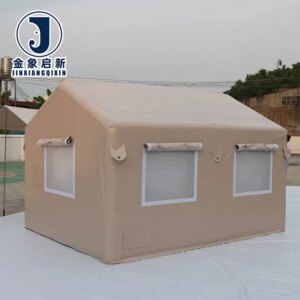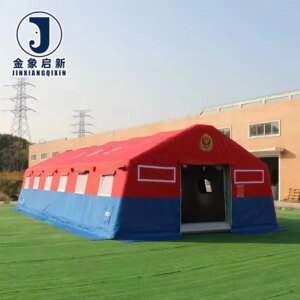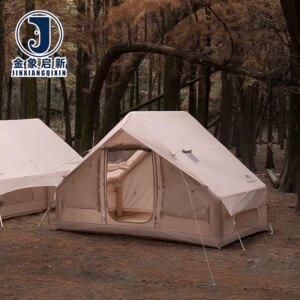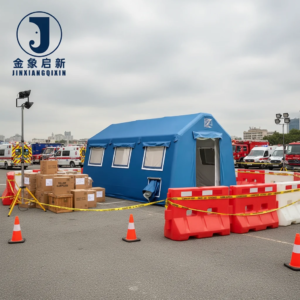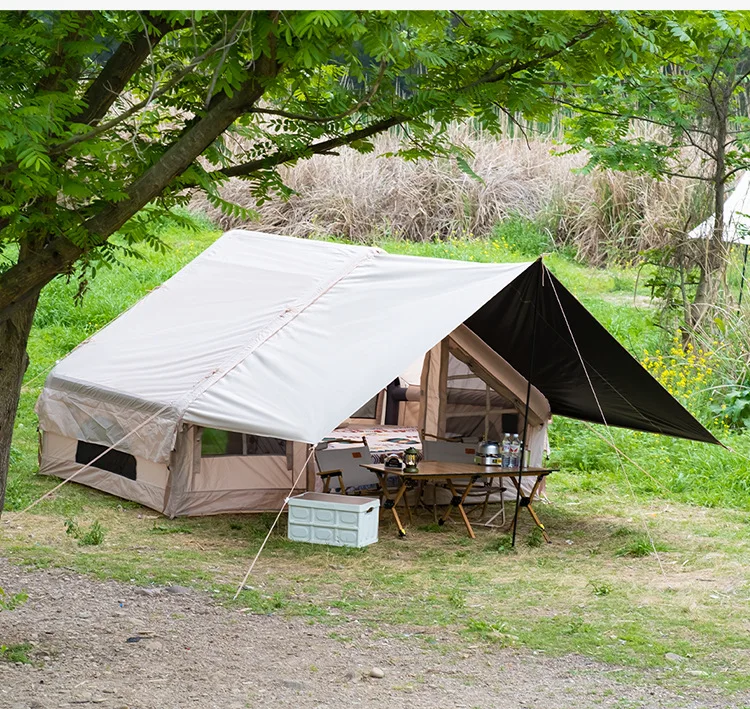
Coated Fabric Process Control — Nearly 30 years of PVC coating expertise applied to every inflatable tent shell, with dedicated QA and QC monitoring each production stage from base fabric selection through final pressure retention testing.
Technical Specifications
| Parameter | Value |
|---|---|
| Product Type | Inflatable Camping Tent |
| Core Material | PVC tarpaulin (single-layer PVC coated knife fabric) |
| Capacity | 2-3 Person |
| Waterproof Rating | Hydrostatic head exceeding 5000mm (source value — verify against manufacturer catalog) |
| UV Treatment | UV-resistant coating (minimum 5-year outdoor service life claimed; test basis not stated) |
| Flame Retardant | Fire-retardant properties claimed (grade not stated — confirm the grade required for your market) |
| Key Performance | Waterproof, UV-resistant, tear-resistant |
| Opening Mechanism | Quick Automatic Opening |
| Season Rating | Four-Season |
| Customization | OEM & ODM: sample customization, pattern printing, size adjustments, material thickness modifications, branding integration |
| Certifications | ISO9001, ISO14001, ISO45001, CE |
Application Suitability
| Application | Exposure & Requirement |
|---|---|
| Commercial outdoor gear manufacturing | Branded product lines requiring consistent roll-to-roll material quality, custom colour matching, and reliable inflatable frame integrity for retail distribution |
| Emergency response and industrial site operations | Rapid-deploy temporary shelter modules subjected to continuous UV exposure, precipitation, and mechanical abrasion from repeated inflation cycles and ground contact |
| Global outdoor equipment wholesale distribution | Bulk-packed inflatable tents requiring verified hydrostatic performance, batch-consistent coatings, and full documentation for international compliance audits |
Why Inflatable Tent Seams Fail Before the Fabric Does
Airtight welded seams verified by 24-hour pressure retention testing separate industrial-grade inflatable structures from field failures.
When an inflatable camping tent loses structural rigidity mid-deployment, the cause is rarely a puncture in the main fabric panel. More often, the failure originates at a heat-welded junction where the inflatable beam meets a cross-member, a point that flexes every time wind loads shift across the shelter surface. [NEED_CITE: tensile and tear test methods for coated fabrics per ISO 1421]. Buyers sourcing custom PVC inflatable tent products for commercial outdoor equipment lines frequently discover that seam adhesion was never validated under sustained internal pressure. The fabric itself may perform adequately in static tensile tests, yet the welded joint degrades under cyclic inflation and deflation, leading to air leakage that compromises the entire load-bearing frame.
Structural Integrity Under Field Wind Loads
An inflatable camping tent manufacturer must account for the fact that air-beam structures behave fundamentally differently from pole-supported shelters. Internal pressure keeps the frame rigid, but any loss of airtightness at beam junctions translates directly to reduced wind resistance. Our single-layer PVC coated knife fabric construction supports high-frequency welding that fuses the coating layers into a continuous bond, rather than relying on adhesive or thread that can wick moisture and degrade under UV exposure. This approach is critical for four-season deployment where temperature swings cause the PVC coating to expand and contract repeatedly across welded seams.
Waterproof Reliability Through Material and Process
The hydrostatic head rating exceeding 5000mm indicates that the PVC tarpaulin material resists water penetration under substantial column pressure, a requirement for shelters deployed in sustained rainfall or snow-melt conditions. However, waterproof performance depends equally on seam construction. Every custom PVC inflatable tent leaving our facility undergoes water immersion trials to confirm that welded junctions hold under direct water contact, not just the base fabric panel. [NEED_CITE: hydrostatic head testing methodology for coated technical textiles]. This dual validation — material specification plus assembled-product testing — addresses the gap that causes the most warranty claims in commercial outdoor gear distribution.
Specification Selection: What the Numbers Mean in Practice
The choice of PVC coated knife fabric for inflatable tent construction involves several interdependent factors. Coating weight and base fabric denier together determine how the material behaves during heat welding; too heavy a coating relative to the base yarn density can result in coating squeeze-out at the weld line, weakening the bond. The single-layer construction specified here balances portability for commercial shipping efficiency against the tear resistance needed when inflatable beams are pressurized. UV-resistant treatment is applied at the coating stage, meaning the protective chemistry is embedded throughout the coating thickness rather than applied as a surface finish that abrades away during transport and deployment. Buyers evaluating fire-retardant options should note that flame retardant grades vary by market jurisdiction, and the specific grade must be confirmed before production begins to ensure compliance with destination-country safety regulations.
The Hidden Cost of Unverified Material Claims
Procurement teams sourcing inflatable tent shells in bulk often receive quotations that list UV resistance and flame retardancy as standard features, only to discover upon delivery that no test reports accompany the shipment. When a batch of custom PVC inflatable tent units arrives with colour variation between rolls, the entire production run may require sorting or rejection, disrupting retail launch timelines. [NEED_CITE: batch consistency standards for PVC coated fabrics in outdoor equipment]. Welded seams that fail under 24-hour pressure testing reveal process inconsistencies that static material tests cannot predict. These issues compound across container-load orders, where a single undetected coating weight deviation affects hundreds of finished units already packed for international dispatch.
Sourcing Confidence Through Production Transparency
Our three full production lines and 36 sets of professional processing equipment support the volume consistency required for commercial outdoor gear manufacturing, with dedicated capacity allocated to inflatable tent fabrication runs. The 10-person R&D team develops pre-production samples within 5-7 days, allowing buyers to validate dimensional accuracy, weld seam quality, and inflation behaviour before committing to full-scale manufacturing. Every production stage includes in-process QA monitoring, with 100% pre-shipment inspection covering pressure retention, waterproof immersion tests, and visual coating consistency. OEM and ODM customization extends across size adjustments, material thickness modifications, pattern printing, and branding integration, all supported by the same quality verification protocols applied to standard products. Production lead times of 15-20 days for standard custom orders of 50-500 units reflect realistic scheduling that accounts for coating cure times and sequential pressure testing.
Documentation & Verification
- Material specification sheet stating PVC tarpaulin composition, coating method, and base fabric details for each inflatable tent batch
- Batch-specific test reports confirming hydrostatic head performance and UV-resistant coating validation
- Pressure retention data logs from 24-hour airtight testing on welded inflatable beam assemblies
- ISO9001, ISO14001, ISO45001, and CE compliance documentation included with every commercial shipment
- Pre-shipment inspection records covering dimensional accuracy, weld integrity, and visual coating consistency
- Certificate of origin and customs support documentation for international inflatable tent distribution
Fabrication, Handling & Storage
- Heat welding parameters calibrated to the single-layer PVC coated knife fabric thickness for consistent airtight seam bonds
- Inflated beam junctions reinforced with additional coating material at high-stress cross-member connection points
- Finished inflatable tents stored in climate-controlled conditions to prevent PVC coating adhesion between folded panels
- Cold-weather deployment requires gradual inflation to allow PVC tarpaulin material to reach operating flexibility
- Surface cleaning with pH-neutral agents preserves the UV-resistant coating chemistry without degrading fire-retardant treatment
- Field repair kits matched to the specific PVC coating formulation used in the original inflatable tent production run
Before You Request a Quotation
Provide your target deployment environment, including expected temperature range, wind exposure conditions, and any regional fire-safety regulations that apply to temporary shelter structures. Specify the custom dimensions, branding requirements, and annual volume projections so we can align production line scheduling and material procurement to your distribution timeline. Confirm whether you require finished inflatable tent units or fabric-only supply for your own assembly operations.
Frequently Asked Questions
Q: What test basis supports the UV-resistant coating claim and expected outdoor service life?
A: The UV-resistant coating is formulated for extended outdoor exposure in field conditions. However, the specific accelerated weathering test method and exposure hours behind the minimum 5-year outdoor service life claim should be confirmed with our technical team. Request the applicable test report before finalizing specifications for your target market.
Q: Which fire-retardant grade does the tent material meet, and does it comply with my target market’s safety regulations?
A: Fire-retardant properties are available, but the specific grade depends on the formulation selected during production. Different markets require different certifications, such as NFPA 701, DIN 4102 B1, or M2 classification. Provide your destination-country regulatory requirements so we can match the appropriate flame retardant grade and supply corresponding test documentation.
Q: What OEM and ODM customization options are available for size, thickness, printing, and MOQ?
A: Custom PVC inflatable tent orders support size adjustments, material thickness modifications, pattern printing, and full branding integration. Pre-production samples are developed within 5-7 days for your dimensional and performance validation. Production lead times for standard custom orders of 50-500 units typically run 15-20 days, with MOQ dependent on the customization scope.
Q: How are airtight seams ensured, and what welding process is used for inflatable structural frames?
A: High-frequency welding fuses the PVC coating layers at beam junctions, creating continuous bonds without thread or adhesive. Every inflatable frame assembly undergoes 24-hour pressure retention testing to verify that welded seams maintain structural integrity under sustained internal pressure. Water immersion trials confirm waterproof performance at all welded junctions.
Q: How can I verify the PVC tarpaulin material specifications upon delivery?
A: Each shipment includes a material specification sheet detailing PVC tarpaulin composition, coating method, and base fabric construction. Batch-specific test reports document hydrostatic head results and coating performance data. Our 100% pre-shipment inspection records are provided alongside ISO and CE compliance documentation for independent verification at your receiving facility.