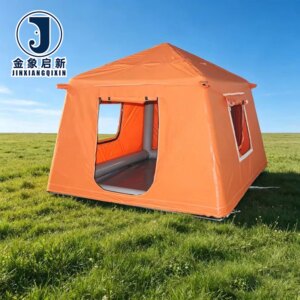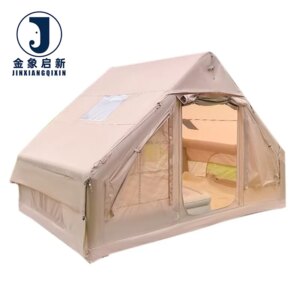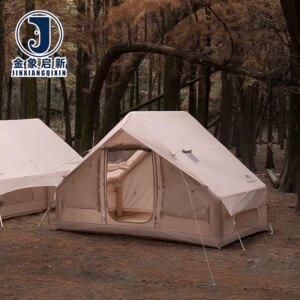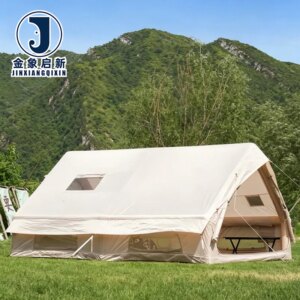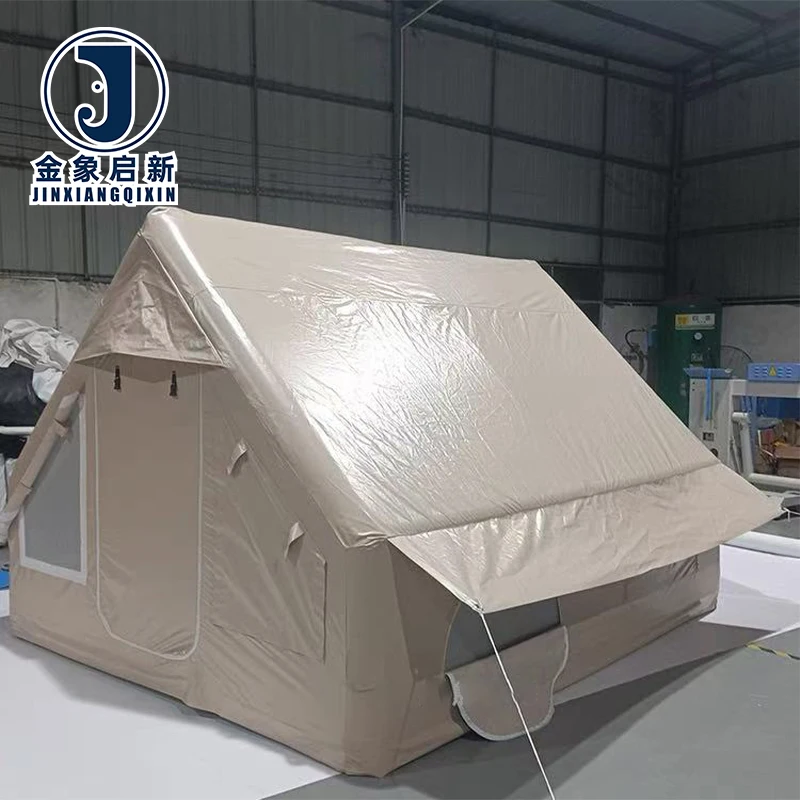
Deep Coating Adhesion Control — Our PVC knife-coated fabric process maintains consistent coating weight across every roll, eliminating delamination at seams and stress points under field deployment.
Technical Specifications
| Parameter | Value |
|---|---|
| Product Type | PVC Inflatable Camping Tent |
| Core Material | PVC Tarpaulin (PVC knife-coated fabric) |
| Coating Thickness | 0.4mm |
| Customizable Thickness Range | 0.3–0.6mm |
| Capacity | 5–8 Person (customizable 3–10 Person) |
| Construction | Single Layer |
| Seam Method | Heat-sealed |
| Deployment Mechanism | Quick Automatic Opening |
| Key Features | Waterproof, Tear-resistant |
| Fire Retardancy | EN 13501-1 compliance referenced (grade not stated) |
| UV Resistance | UV-resistant additives in fabric matrix (test basis not stated) |
| Anti-static Treatment | Available (standard not stated) |
| Color | Custom Pantone matching available |
| Printing Option | Custom pattern printing for branding |
| Production Facility | 9,180 m² with 3 full production lines |
| Processing Equipment | 36 sets of professional equipment |
| R&D Team | 10 technicians |
| Quality Control | 7-point inspection protocol |
| Certifications | ISO9001, ISO14001, ISO45001, CE |
Application Suitability
| Application | Exposure & Requirement |
|---|---|
| Commercial camping rental fleets | Repeated inflation cycles, abrasion from ground contact, UV exposure across seasons |
| Expedition and adventure operators | High-altitude or coastal weather exposure, rapid deployment under adverse conditions |
| OEM outdoor gear brands | Batch colour consistency across production runs, branded printing accuracy, compliance documentation for target markets |
| Professional glamping site operators | Long-term outdoor installation, guest safety requirements, fire-retardant compliance for commercial venues |
Why Batch Colour Consistency Matters More Than You Think for Inflatable Tent Production
Colour drift between production rolls turns a branded tent line into a visual liability the moment units stand side by side at a trade show or rental depot.
When sourcing PVC inflatable tents for a commercial product range, procurement teams focus on thickness, seam strength, and certifications. Colour consistency across rolls often gets assumed rather than verified. Yet for any outdoor gear manufacturer producing multiple units under a single Pantone reference, visible variation between tents in the same product line signals poor quality control to end users and damages brand perception at point of sale. Knife-coated PVC fabric batches that drift even slightly in pigment density create a mismatch that the human eye detects immediately under natural daylight. [NEED_CITE: colour tolerance standards for coated textile batches per ISO 105 series]
How PVC Knife Coating Secures Waterproof Integrity
The knife-coating method applied to this PVC inflatable tent fabric deposits a controlled layer of PVC compound directly onto the base scrim, producing a 0.4mm coating that fills the weave structure completely. Unlike laminated alternatives where the coating sits as a separate film bonded by adhesive, knife coating creates a mechanical bond between compound and yarn. For inflatable tent applications, this matters because air pressure cycles and fold-point stress test the coating-to-substrate bond repeatedly. Heat-sealed seams on knife-coated PVC fuse the coating layers together at the molecular level, producing joints that match the waterproof integrity of the field fabric itself.
Fire-Retardant Compliance and What Documentation Actually Proves
For PVC inflatable camping tent units destined for European commercial venues, EN 13501-1 compliance is frequently referenced in tenders and venue safety requirements. Fire-retardant additives integrated into the PVC compound during coating reduce flame spread rate and self-extinguish behaviour, but the specific grade achieved must be confirmed against your market’s regulatory threshold. [NEED_CITE: EN 13501-1 classification criteria for temporary outdoor structures] Anti-static treatment is available for environments where dust accumulation or electronic equipment proximity makes static discharge a concern — confirm the standard required for your application before specifying. Production documentation includes material composition certification and test reports where applicable, provided in English for international customs and safety audits.
What Coating Thickness and Base Fabric Together Determine for Field Performance
The 0.4mm coating thickness on this PVC inflatable tent fabric does not operate independently of the base scrim. Coating thickness governs waterproof barrier continuity and abrasion resistance at ground contact points, while the underlying polyester scrim denier and weave density determine how the fabric resists tear propagation when punctured or stressed at inflation valve surrounds. A thicker coating alone cannot compensate for a loosely woven base that allows tears to travel along yarn lines. Knife-coated PVC balances these two elements by penetrating the scrim interstices during application, locking warp and weft yarns in position. For OEM buyers comparing material options, requesting both coating thickness measurement and base fabric denier specification together provides a complete picture of how the finished tent will behave under inflation pressure and handling stress. Available in a customizable thickness range of 0.3–0.6mm to suit different capacity classes and deployment conditions.
The Real Cost of Specifying on Price Per Unit Without Verifying Coating Weight
When procurement decisions on PVC inflatable tent materials rest on unit price alone, the fabric arriving at the production floor may carry less coating compound than the sample approved during evaluation. Thinner coating at high-wear zones — base panels, door flap surrounds, inflation tube junctions — leads to premature coating loss and water ingress within the first season of rental use. Seams heat-sealed onto underweight coating fail because there is insufficient compound depth for a proper thermal bond. Batch-specific quality inspection reports with coating thickness measurements, included with each shipment, provide the verification layer that protects your production schedule from receiving material that does not match the approved specification. [NEED_CITE: coating weight verification methods for PVC tarpaulin per ISO 2286]
Why Manufacturers Choose This Supply Chain for Inflatable Tent Fabric
Nearly 30 years of focused coated fabric production means the knife-coating parameters for PVC inflatable tent material are controlled through established process recipes rather than trial adjustments. Three full production lines and 36 sets of professional processing equipment support volume commitments without splitting your order across facilities with different calibration standards. A dedicated 10-technician R&D team handles material selection, Pantone colour matching, pattern printing development, and pre-production sample creation — sample development proceeds within days rather than weeks. Quality control follows a 7-point inspection protocol at every production stage: raw material testing, coating thickness measurement, seam integrity testing, air pressure retention verification, UV aging simulation, flame retardancy assessment, and dimensional accuracy checks. Pre-shipment inspection covers 100% of units before dispatch, not statistical sampling.
Documentation & Verification
- Material specification sheet stating coating thickness, base fabric construction, and colour reference per order
- EN 13501-1 fire-retardant test report where applicable, in English for European market audits
- Batch-specific inspection record covering coating thickness, seam integrity, and air pressure retention
- ISO9001, ISO14001, ISO45001, and CE certificates included with shipment documentation package
- UV resistance and flame retardancy assessment data provided per batch on request
- Certificate of origin and customs documentation prepared for international shipment clearance
Fabrication, Handling & Storage
- Heat-seal temperature and dwell time must be calibrated to the 0.4mm coating thickness for optimal bond strength
- Store rolled PVC inflatable tent fabric in climate-controlled conditions to prevent crease marks setting into the coating
- Avoid folding at identical points across storage cycles to prevent coating crack initiation at repeated bend lines
- Clean with mild detergent only; solvent-based cleaners may degrade the PVC compound surface layer
- Field repairs require compatible PVC adhesive and heat-activated patch material matching the coating thickness
- Pre-production sample validation confirms heat-seal parameters before authorizing full production runs
What to Include in Your PVC Inflatable Tent Material Inquiry
Specify your target capacity range, preferred coating thickness within the 0.3–0.6mm available range, and the fire-retardant or anti-static standards required by your destination market. Provide Pantone references for colour matching and indicate whether custom pattern printing or branded packaging forms part of your product line. Confirm your annual volume estimate and whether you require pre-production samples before committing to a full manufacturing run.
Frequently Asked Questions
Q: What customization options are available for inflatable tent sizing, colour, and branding?
A: Capacity is customizable from 3 to 10 person configurations. Coating thickness ranges from 0.3mm to 0.6mm. Colour matching to specific Pantone codes is supported, and custom pattern printing for branded tent surfaces is available. OEM and ODM services cover material selection, product design, sample customization, and branded packaging integration for your product line.
Q: Which fire-retardant and safety standards does the tent fabric comply with?
A: EN 13501-1 compliance is referenced for European outdoor equipment safety regulations. Production holds ISO9001, ISO14001, ISO45001, and CE certifications. Fire-retardant grades and anti-static treatment standards should be confirmed against your specific market requirements before production. All applicable test reports and compliance documentation ship in English with each order.
Q: Can pre-production samples be provided before mass production begins?
A: Pre-production samples are developed by the R&D team for engineering validation before mass production authorization. Sample development typically proceeds within days of specification confirmation. Sample costs are refundable against qualifying production orders. Validating heat-seal parameters, colour accuracy, and dimensional tolerances on the sample stage prevents costly adjustments during full production.
Q: What quality documentation ships with each batch for audits and customs clearance?
A: Each shipment includes a material specification sheet, batch-specific quality inspection report covering coating thickness measurement, seam integrity testing, and air pressure retention verification. ISO and CE certificates, certificate of origin, and pre-shipment inspection records accompany the documentation package. UV aging simulation and flame retardancy assessment data are available per batch upon request.
Q: What minimum order quantity applies for full OEM customization services?
A: Minimum order quantities depend on the customization scope — Pantone colour matching, custom capacity sizing, pattern printing, and packaging specifications each carry different production thresholds. Sample cost refund applies at order volumes of 500 units and above. Contact the sales team with your specific customization requirements to receive confirmed minimum quantities and production lead time for your configuration.