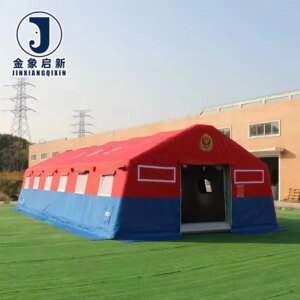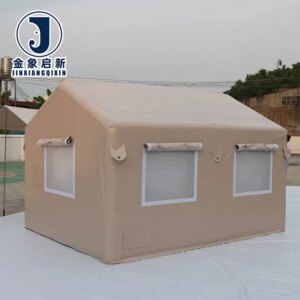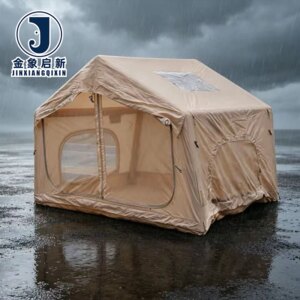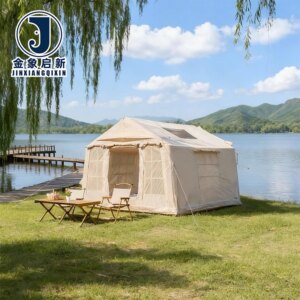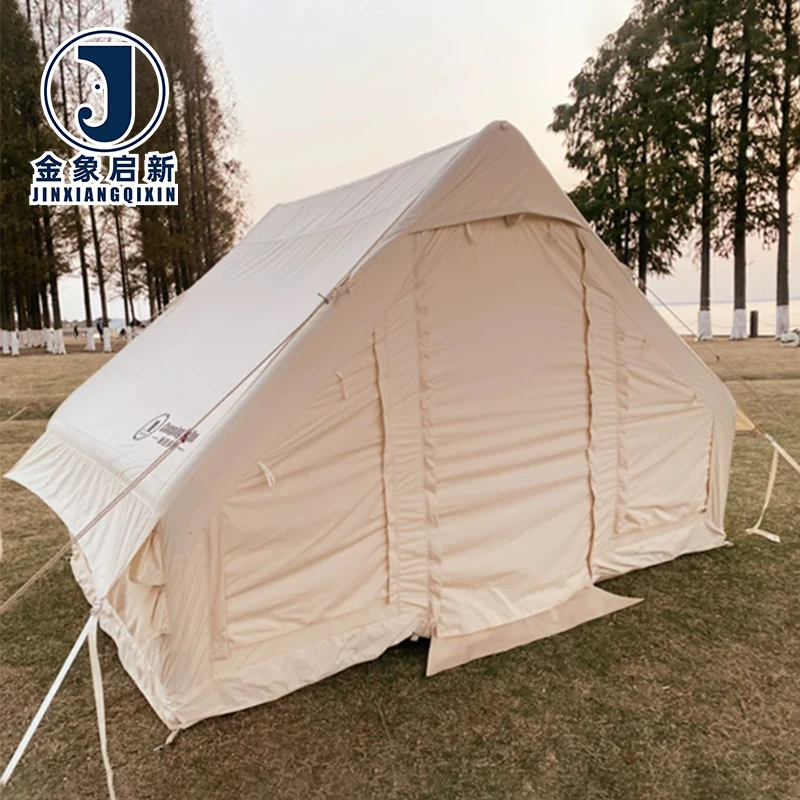
Rapid Custom Sampling — Inflatable tent prototypes developed within days, with structural adjustments validated through 24-hour pressure retention testing before bulk production begins.
Technical Specifications
| Parameter | Value |
|---|---|
| Product Type | Inflatable Tent |
| Core Material | PVC tarpaulin |
| Capacity | 2–8 person |
| Season Rating | 4-season design |
| Waterproof Rating | 3000mm water column (source value — verify against manufacturer catalog) |
| UV Resistance | 4000 hours accelerated aging test (source value — verify against manufacturer catalog) |
| Tear Strength Standard | ASTM D751 (source value — verify against manufacturer catalog) |
| Setup System | Quick automatic opening |
| Customization | OEM & ODM, sample customization, pattern printing |
| Quality Verification | 24-hour pressure retention testing per unit |
Application Suitability
| Application | Exposure & Requirement |
|---|---|
| Transport fleet crew base camps | Continuous outdoor deployment, wind loading, frequent inflation and deflation cycles, road dust and moisture |
| Construction site temporary storage shelters | Ground moisture, debris impact, UV exposure over multi-week staging periods, rapid setup requirements |
| Outdoor event mobile facilities | High foot traffic, repeated assembly, variable weather exposure, branded surface requirements |
| Industrial fieldwork command posts | Temperature extremes across seasons, prolonged sun exposure, need for stable internal environment |
Why Specified Capacity Alone Does Not Guarantee Field Reliability for a PVC Inflatable Camping Tent
A tent rated for eight persons that deflates at a seam under overnight temperature drop fails the crew it was meant to protect.
Fleet operators and site managers often source inflatable shelters based on person-capacity and waterproof claims alone, without verifying how the inflatable beam structure holds pressure across a full day-night cycle. PVC inflatable camping tent units deployed at remote logistics staging areas face repeated thermal expansion and contraction that expose weak heat-welded joints. When a beam seam gives way in freezing conditions, the entire shelter collapses — and the cargo or crew inside loses protection within minutes [NEED_CITE: heat-welded seam failure modes in inflatable PVC structures under thermal cycling].
Structural Integrity Under Repeated Deployment Cycles
Transport fleet operators require shelters that deploy rapidly at each stop without specialist tools or prolonged manual effort. The quick automatic opening system integrated into this PVC inflatable camping tent design reduces setup time and limits the chance of incorrect inflation that can stress beam joints unevenly. Each unit undergoes 24-hour pressure retention testing before dispatch, confirming that the airtight seam construction holds under sustained internal pressure — not just at the moment of inflation but across an extended holding period that simulates real overnight use.
Weatherproofing Across Seasonal Extremes
A 4-season inflatable shelter must perform when ambient temperature swings from summer heat to sub-zero nights within a single deployment. The PVC tarpaulin shell carries a 3000mm water column waterproof rating to resist driven rain and ground splash, while the UV-resistant treatment — supported by a 4000-hour accelerated aging test — addresses prolonged sun exposure that degrades untreated PVC surfaces over consecutive seasons [NEED_CITE: accelerated UV aging protocols for PVC coated fabrics per ISO 4892]. Tear resistance verified to ASTM D751 provides a baseline for how the material resists propagation from punctures caused by sharp gravel or site debris.
Understanding Material Behavior in Inflatable Applications
Inflatable tent structures concentrate stress at beam junctions and anchor points differently than pole-supported tents. The PVC tarpaulin used here must maintain coating adhesion to the base fabric under internal pressure that pushes outward on every seam. The coating method and base fabric denier together determine whether a beam wall stretches slightly under load — distributing force across a wider area — or concentrates it at the weld line until failure occurs. Tear strength tested to ASTM D751 measures how a small nick in the beam wall propagates under tension, which is critical because inflatable beams operate under constant positive pressure. Waterproof rating at 3000mm addresses hydrostatic head from rain pooling on horizontal roof surfaces, not just vertical wall splash [NEED_CITE: hydrostatic head testing methods for coated tent fabrics per ISO 811].
The Hidden Cost of Skipping Pressure Retention Verification
Buyers who accept inflatable shelters based solely on waterproof certificates and capacity labels often discover seam failures only after field deployment. When an inflatable beam loses pressure gradually rather than catastrophically, the shelter sags unevenly — pooling water on the roof, pulling anchor stakes from soft ground, and eventually collapsing onto whatever is stored or sheltered inside. Batch inconsistency in heat-welding temperature or dwell time can produce units within the same shipment that pass initial inflation but fail at different rates, making pre-shipment 24-hour pressure retention documentation essential rather than optional [NEED_CITE: batch variability in heat-sealed inflatable PVC product performance].
Why Sourcing Inflatable Tents Here Reduces Supply Risk
Three full production lines and 36 sets of professional processing equipment allow simultaneous sample development and bulk manufacturing without queue conflicts. The 10-technician R&D team handles structural pattern adjustments for custom footprint layouts and capacity requirements specific to your fleet or site configuration. A dedicated QA and QC team inspects every unit through production, not only at final packing — catching seam adhesion issues mid-run rather than after a full batch is complete. ISO9001, ISO14001, and ISO45001 certified management systems provide traceable process records for each production lot. CE certification documentation ships with every order to support regulatory clearance in destination markets.
Documentation & Verification
- Material specification sheet stating PVC tarpaulin composition, coating weight, and capacity rating per unit
- Batch-specific inspection report with waterproof rating, UV aging test results, and tear strength data
- 24-hour pressure retention test record for each inflatable tent unit before packing
- ISO9001, ISO14001, ISO45001, and CE certificates included with every shipment
- Pre-shipment inspection record documenting seam integrity and inflation system function
Fabrication, Handling & Storage
- Heat-weld all PVC tarpaulin beam seams at manufacturer-recommended temperature to maintain coating adhesion under internal pressure
- Store inflated units deflated and flat to prevent permanent crease marks in the PVC tarpaulin shell surface
- Avoid dragging units across abrasive ground during deployment to protect the PVC tarpaulin outer coating layer
- Clean with pH-neutral detergent only to preserve the UV-resistant treatment on the PVC tarpaulin surface
- Repair minor punctures using compatible PVC adhesive patches applied to clean, dry coating surfaces
Preparing Your Inflatable Tent Specification for Quotation
Provide the intended deployment environment — including typical wind exposure, temperature range, and ground conditions — so the structural design and PVC tarpaulin grade can be matched to actual field loads. Confirm whether custom dimensions, capacity adjustments, or branded surface printing are required for your fleet or site layout. Specify any fire-retardant or compliance standards your destination market mandates, as available grades vary by regulation. Request a production sample to validate fit, inflation behavior, and surface finish before committing to a bulk order.
Frequently Asked Questions
Q: How is waterproof performance verified before shipment for each batch?
A: Every inflatable tent unit undergoes inspection against the stated 3000mm water column rating as part of the pre-shipment quality process. A batch-specific quality report documents the waterproof test outcome alongside UV aging and tear strength data. This record ships with the order, giving you traceable evidence of what was tested and when, rather than relying on a generic material certificate.
Q: What UV resistance test basis supports the outdoor lifespan claim?
A: The UV resistance claim rests on a 4000-hour accelerated aging test conducted under controlled laboratory conditions. This test simulates extended sun exposure on the PVC tarpaulin surface. We recommend requesting the specific test report for your batch and comparing the methodology against your local climate exposure expectations before finalizing specifications for long-term outdoor deployment.
Q: Can dimensions and capacity be customized for specific fleet or site layouts?
A: Yes. The R&D team develops custom samples within days, adjusting footprint dimensions, beam configuration, and capacity to match your operational requirements. Pattern printing and branding are available for fleet identification or event visibility. Each custom design is validated through the same 24-hour pressure retention test applied to standard configurations before production approval.
Q: What documentation is provided for customs clearance and regulatory compliance?
A: Each shipment includes CE certificates, ISO9001, ISO14001, and ISO45001 certification documents, a certificate of origin, and a detailed packing list. Material specification sheets and batch inspection reports accompany the documentation package. For markets requiring specific fire-retardant or safety classifications, confirm the grade needed before ordering so the correct certification can be prepared and included.
Q: How does the 24-hour pressure retention test ensure inflatable structure reliability?
A: Each unit is inflated and held under pressure for a full 24 hours before packing, simulating sustained field use rather than a brief factory check. This test reveals slow leaks at beam junctions, valve seats, and heat-welded seams that a short-duration inflation would miss. Units that do not hold pressure are reworked or rejected, and the test record for every unit is documented and shipped with the order.