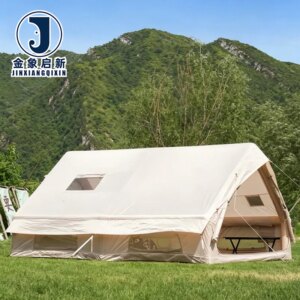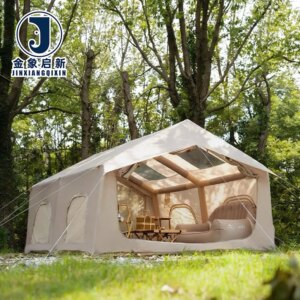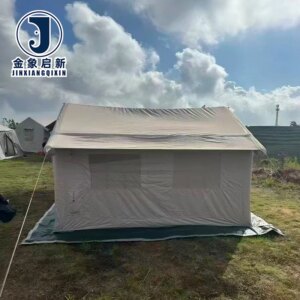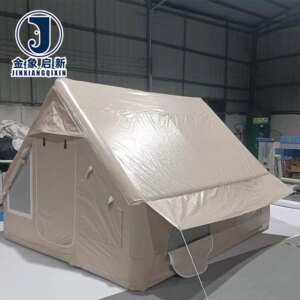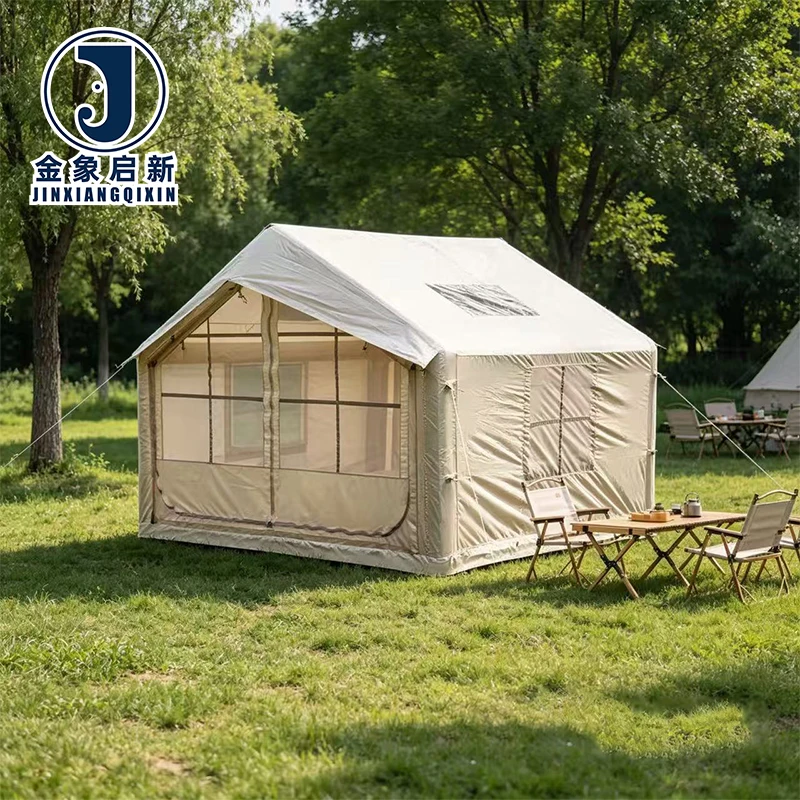
Process-Controlled Coating — Every roll of PVC inflatable tent fabric passes through in-process QA checkpoints to confirm coating weight and adhesion before leaving the factory.
Technical Specifications
| Parameter | Value |
|---|---|
| Product Type | Inflatable Tent Fabric |
| Core Material | PVC tarpaulin |
| Product Form | 4-6 Person Quick Automatic Opening Tent |
| Waterproof | Fully waterproof coated construction |
| UV Treatment | UV-resistant (test basis not stated in source) |
| Flame Retardant | Fire-retardant (grade not stated in source) |
| Anti-Static | Anti-static (surface resistance or standard not stated in source) |
| Tear Resistance | Tear-resistant (test standard not stated in source) |
| Customization | OEM & ODM — sample customization, pattern printing, material selection, product design |
| Certifications | ISO 9001, ISO 14001, ISO 45001, CE |
Application Suitability
| Application | Exposure & Requirement |
|---|---|
| Commercial inflatable camping tent production | Repeated inflation cycles, outdoor UV exposure, ground abrasion, user safety compliance |
| Transport fleet temporary shelters at loading sites | Rapid deployment, wind load resistance, weather protection during extended stops |
| Commercial event and outdoor trip services | Frequent setup and teardown, varied terrain, public fire-safety audits |
| Outdoor equipment supplier industrial procurement | Batch consistency across container orders, OEM branding requirements, regulatory documentation |
Why "Fire-Retardant" Means Nothing Without a Grade Behind It
A PVC Inflatable Tent for truck and transport cover manufacturer must back every fire-safety claim with a verifiable test certificate.
Inflatable tent fabric that arrives labeled "fire-retardant" but without a specific grade creates immediate risk at the customs desk and the job site. Buyers who skip this verification step frequently discover, mid-project, that the material does not satisfy the fire code enforced in the destination market. Rework, shipment rejection, or on-site audit failure then falls on the procurement team, not the supplier [NEED_CITE: fire classification standards for temporary structures and textile membranes].
How Coated Fabric Meets Inflatable Structure Demands
Inflatable tent tubes rely on the air-holding integrity of heat-welded seams as much as the base fabric itself. PVC inflatable camping tent material must sustain internal pressure across repeated inflation and deflation cycles without the weld lines cracking or peeling. Coating adhesion to the base fabric directly determines whether the seam holds under cyclic stress or delaminates at the flex point.
Quick-Deploy Shelter Requirements for Transport Sites
Transport fleet operators setting up temporary rest or loading shelters need fabric that unfolds, inflates, and withstands wind gusts without excessive anchoring weight. The PVC inflatable tent for truck and transport cover manufacturer market demands material that balances low pack volume with sufficient tear resistance to survive contact with rough ground and vehicle hardware [NEED_CITE: tensile and tear test methods for coated fabrics per ISO 1421].
Reading the Specification Sheet Beyond GSM
Coating weight and base fabric denier together determine how the material behaves under load. A heavier coating does not automatically mean higher tear strength if the underlying weave is loosely constructed. Conversely, a tightly woven base fabric with insufficient coating adhesion will separate at the weld before the fabric itself fails. Understanding this balance helps buyers select a specification that matches the inflation pressure and structural span of the tent design rather than chasing a single number on the quote. Surface finish — glossy or matte — also influences cleaning ease and the adhesion of printed branding applied during OEM production runs.
What Happens When Batch Color Drifts Mid-Order
A container-load inflatable tent order split across two production runs can arrive with visible shade variation between rolls. When tent panels cut from different rolls are welded side by side, the color mismatch becomes obvious once the structure is inflated and displayed at a commercial event or retail showroom. This defect is rarely caught at the incoming inspection stage because individual rolls look acceptable in isolation [NEED_CITE: color consistency measurement methods for coated textile batches].
Why Procurement Teams Choose This Facility
Three full production lines and dedicated processing equipment allow bulk inflatable tent fabric orders to run without competing for capacity with unrelated product families. A ten-technician R&D team handles material selection, pattern printing alignment, and sample development within days rather than weeks. Every roll passes through full-process QA inspection with dedicated on-site staff, and pre-shipment checks cover coating weight, color reference, and seam sample integrity before dispatch.
Documentation & Verification
- Material specification sheet listing GSM, base fabric, and coating type per roll
- Fire-retardant and UV test reports matched to the destination market standard
- Pre-shipment inspection record covering weight and color consistency
- Certificate of origin prepared for smooth customs clearance
- ISO and CE certificates included with each commercial shipment
Fabrication, Handling & Storage
- Heat-weld parameters must match the specific PVC coating formulation to prevent delamination at tube seams
- Store rolls vertically on pallets to avoid flat-spot creases that weaken the coated surface
- Confirm inflation pressure limits against the tensile rating before finalizing tent tube diameter
- Use compatible PVC adhesive for field repairs on punctured inflatable chambers
- Allow material to acclimatize before unfolding in cold conditions to avoid low-temperature cracking
Starting Your PVC Inflatable Tent Material Inquiry
Provide the intended application, expected environmental exposure, and target market fire-safety or compliance requirements. Include the annual volume estimate and whether you require roll stock or finished cut-and-welded panels. If pattern printing or custom color matching is needed, share the reference codes early so sample development can begin before bulk commitment.
Frequently Asked Questions
Q: How do I confirm the fire-retardant grade matches my destination market?
A: Share the specific fire code or standard enforced in your market before sampling. The factory can then produce test reports against that standard. Available fire-retardant grades vary, so confirming the required classification early avoids shipment rejection at customs or on-site audit failure after delivery.
Q: Can color consistency be maintained across multiple production runs?
A: Yes, provided a signed color reference sample is approved before each run. Batch-to-batch color is checked during in-process QA and again at pre-shipment inspection. For large orders spanning several runs, request a color comparison panel from each batch before final dispatch.
Q: What is involved in the OEM sample approval process?
A: Samples cover material weight, coating adhesion, color match, and weld seam integrity. Once you approve the physical sample and the accompanying specification sheet, bulk production follows the confirmed parameters. Pattern printing alignment is also verified at the sample stage.
Q: Are UV-resistance test reports provided with shipment documentation?
A: UV treatment is available, and test reports can be issued upon request. Specify the UV exposure standard relevant to your market during the inquiry stage so the correct test protocol is applied and documented before bulk production begins.
Q: What information is needed for custom sizing and pattern printing?
A: Provide tube diameter, panel dimensions, print artwork files, and color references. The R&D team develops a sample with your custom layout for approval. Minimum quantities depend on the degree of customization and the number of print colors involved.