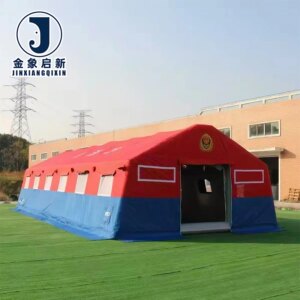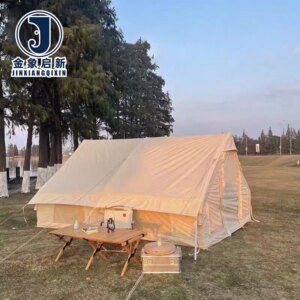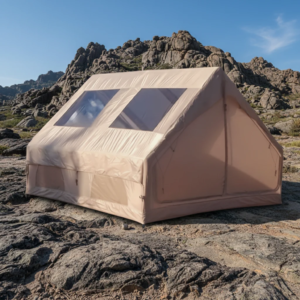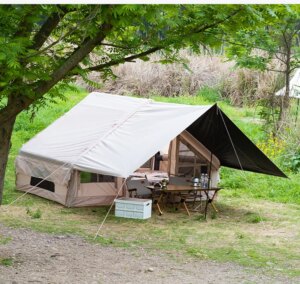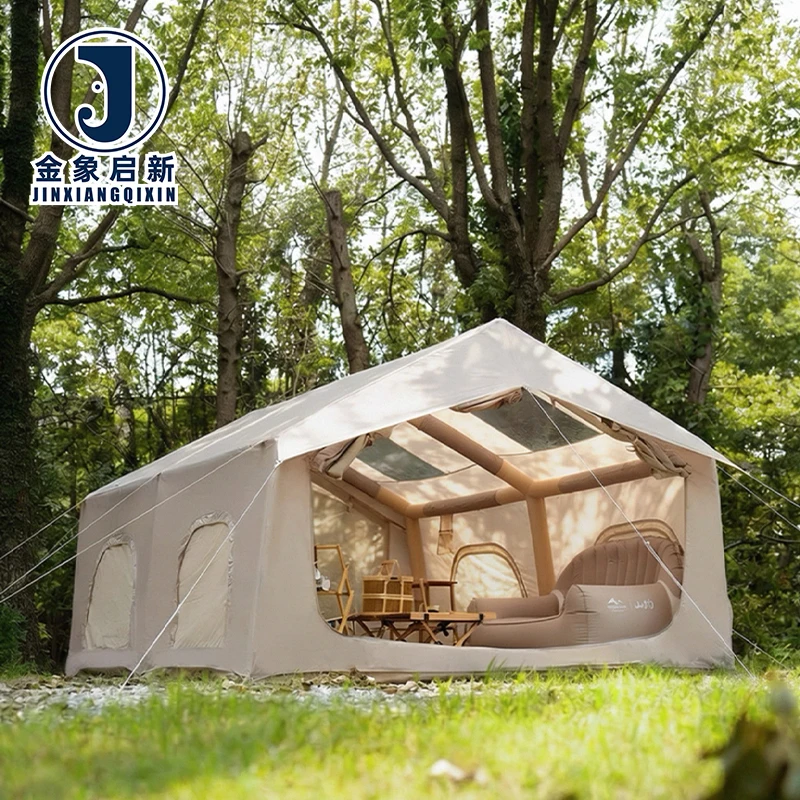
Coating Weight Control — Every roll of PVC tarpaulin leaving our Jinan facility undergoes in-line weight verification to ensure the stated GSM matches the delivered material, eliminating the gap between quotation and arrival.
Technical Specifications
| Parameter | Value |
|---|---|
| Product Type | Inflatable Tent |
| Core Material | PVC tarpaulin |
| Capacity Options | 1 to 12 person configurations |
| Season Rating | Four-season |
| Opening Mechanism | Automatic pneumatic inflation |
| Key Features | Waterproof, tear-resistant, UV-resistant (test basis not stated in source), fire-retardant (grade not stated in source), anti-static (standard not stated in source) |
| Customization Scope | OEM and ODM: sample customization, pattern printing, material selection, structural modifications, color selection, size adjustments |
| Certifications | ISO 9001, ISO 14001, ISO 45001, CE |
Application Suitability
| Application | Exposure & Requirement |
|---|---|
| Construction crew temporary accommodation | Sustained wind loading, ground moisture, repeated inflation and deflation cycles across project phases |
| Transport staging yard shelters | Diesel particulate exposure, heavy vehicle vibration, rapid deployment and teardown between shifts |
| Outdoor event base camp | High foot traffic floor abrasion, prolonged sun exposure, multi-day continuous inflation |
| Disaster response field station | Unpredictable terrain, extreme weather windows, immediate readiness without specialized labor |
| Research expedition mobile shelter | Remote logistics constraints, temperature fluctuation, minimal anchoring substrate |
Why Generic Tent Dimensions Compromise Fleet and Site Operations
Sized to your operational footprint, not a catalog default.
Procurement teams sourcing temporary shelters for transport staging yards and remote construction sites frequently discover that standard-dimension tents leave gaps around vehicle perimeters or fail to align with existing pad foundations. An Inflatable Camping Tent for truck and transport operations must account for the exact clearance envelope of the vehicles it shelters, the tie-down points available on the ground surface, and the inflation clearance needed overhead [NEED_CITE: site-specific dimensional surveys for temporary industrial shelters]. When dimensions are approximated, crews spend additional hours rigging supplementary tarps and windbreaks, negating the rapid-deployment advantage that inflatable structures are designed to deliver.
Sizing That Matches the Vehicle and the Site Pad
Our OEM and ODM capability means an Inflatable Camping Tent for truck and transport use is dimensioned against your specific trailer wheelbase, deck height, and the hardstand area at your depot. Pattern printing and color selection allow fleet branding to remain visible on site, while structural modifications can introduce additional entry bays or partition walls for mixed-use staging areas.
Material Integrity Under Continuous Inflation and Weather Load
The PVC tarpaulin core is heat-sealed at every seam junction to maintain waterproof integrity through repeated inflation cycles and sustained internal pressure. UV-resistant formulation options are available to reduce surface degradation during multi-week deployments in open terrain — confirm the UV test basis required for your regional compliance framework before order placement [NEED_CITE: UV exposure testing standards for PVC coated fabrics in temporary structures].
Rapid Deployment Without Specialized Rigging Crews
The automatic opening mechanism allows a single operator to achieve full structural inflation without crane support or scaffolding assembly, which matters when shelters must be erected at incident sites or remote survey locations where labor availability is constrained.
How Coating Weight and Base Fabric Interact to Determine Field Performance
The relationship between GSM and actual field durability is not linear. A PVC tarpaulin’s tensile and tear resistance depends on the denier of the base yarn, the weave density of the scrim, and the coating adhesion achieved during the lamination or knife-over-roll process. A heavier coating alone does not compensate for a loosely woven base fabric — in fact, excessive coating weight on a low-density scrim can increase stiffness and promote crack propagation at fold lines during transport and storage. Buyers specifying an Inflatable Tent for commercial fleet and site use should request the material specification sheet detailing both base fabric construction and coating weight independently, rather than relying on a single GSM figure [NEED_CITE: relationship between scrim density and coating adhesion in PVC tarpaulin per ISO 1421].
The Hidden Cost of Specification Misalignment
When a shelter is deployed on a construction staging yard or transport depot and the PVC tarpaulin does not meet the fire-retardant grade mandated by the site safety officer, the entire installation is rejected at inspection — regardless of how well the tent performs structurally. Similarly, anti-static properties that are claimed but unsupported by a recognized test standard leave buyers exposed in environments where combustible dust or flammable vapor is present. Batch-to-batch color variation across a multi-unit order can undermine corporate branding consistency when tents are positioned side by side at a public-facing event site [NEED_CITE: batch color consistency standards for coated fabrics in commercial applications]. These failures are specification failures, not manufacturing defects, and they are avoidable with proper documentation review before production begins.
What Verification Looks Like Before Your Order Ships
Our QA and QC staff conduct full-process inspection with dedicated personnel stationed at coating, cutting, heat-sealing, and final packing stages. The 10-person technical team handles material selection, sample development, and structural design review for every custom Inflatable Camping Tent for truck and transport configuration. Three full production lines and 36 sets of professional equipment support volume output without compromising the 100 percent pre-shipment inspection standard. Sample development is completed within days for custom sizing, pattern printing, or material specification changes, allowing buyers to validate physical properties before committing to full production runs.
Documentation & Verification
- Material specification sheet confirming PVC tarpaulin GSM, base fabric denier, and coating type for each Inflatable Tent unit
- Fire-retardant test report and anti-static certification matched to the grade required by your site safety protocol
- Pre-shipment inspection record documenting seam integrity and inflation test results before dispatch
- Color reference sample retained against production batch for multi-unit order consistency verification
- ISO 9001, ISO 14001, ISO 45001, and CE certificates included in shipment documentation package
Fabrication, Handling & Storage
- Heat-sealed seams on PVC tarpaulin require controlled temperature and dwell time parameters — confirm equipment compatibility before field repair attempts
- Store inflated or deflated units flat or loosely rolled to prevent permanent creasing in the PVC coating layer
- Avoid dragging the tent floor across aggregate or reinforced concrete surfaces to protect the base PVC tarpaulin from puncture
- Use only PVC-compatible cleaning agents; solvent-based products may degrade the coating surface and compromise waterproof integrity
- Deflate completely and dry all internal air chambers before extended storage to prevent mildew formation inside the structure
Requesting a Quotation for Your Deployment Scenario
Provide the exact site dimensions or vehicle footprint you need the tent to cover, the fire-retardant or anti-static grade mandated by your local regulations, and the anticipated deployment duration and climate zone. Include color references, branding artwork files if pattern printing is required, and confirm whether you need finished units with inflation hardware or fabric-only supply for your own assembly line. Specify your annual volume and required delivery schedule so production capacity can be reserved accordingly.
Frequently Asked Questions
Q: What fire-retardant certifications can be supplied with the inflatable tent?
A: Fire-retardant treatment is available in multiple grades depending on your market requirements. We provide the corresponding test report with your shipment documentation. Buyers must specify the exact standard — such as the grade required by their local building authority or site safety officer — at the inquiry stage so the correct formulation is applied during production and verified before dispatch.
Q: How is UV resistance validated for prolonged outdoor deployment?
A: UV-resistant formulation options are available for the PVC tarpaulin used in our inflatable tents. The specific test basis and exposure duration rating depend on the formulation selected. Request the UV test report and material specification sheet during the sampling phase to confirm the product meets your regional outdoor exposure requirements before placing a full production order.
Q: Can dimensions be customized to fit a specific vehicle or site pad?
A: Yes. OEM and ODM customization covers exact sizing, structural modifications, and capacity configurations from 1 to 12 person layouts. Provide your site pad dimensions or vehicle footprint, and our technical team will develop a sample reflecting the requested proportions for your approval before bulk production begins.
Q: How is color consistency maintained across multiple units in one order?
A: Color reference samples are retained and matched against every production batch. Our QA staff verify shade consistency across all rolls cut for your order during the pre-shipment inspection. For large fleet deployments requiring tents positioned side by side, we recommend requesting batch color verification documentation with your shipment.
Q: What documentation accompanies each shipment for customs and site compliance?
A: Each shipment includes the material specification sheet, applicable fire-retardant and anti-static test reports, ISO and CE certificates, pre-shipment inspection record, packing list, and certificate of origin. Additional customs support documentation is provided as needed for your destination market.