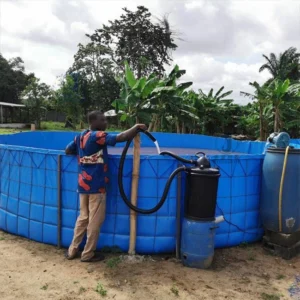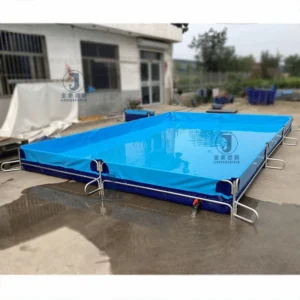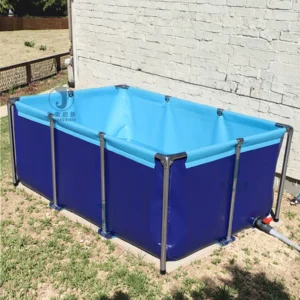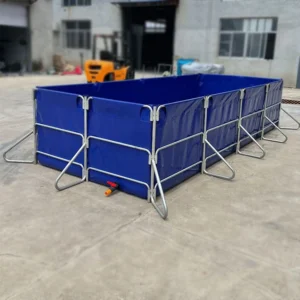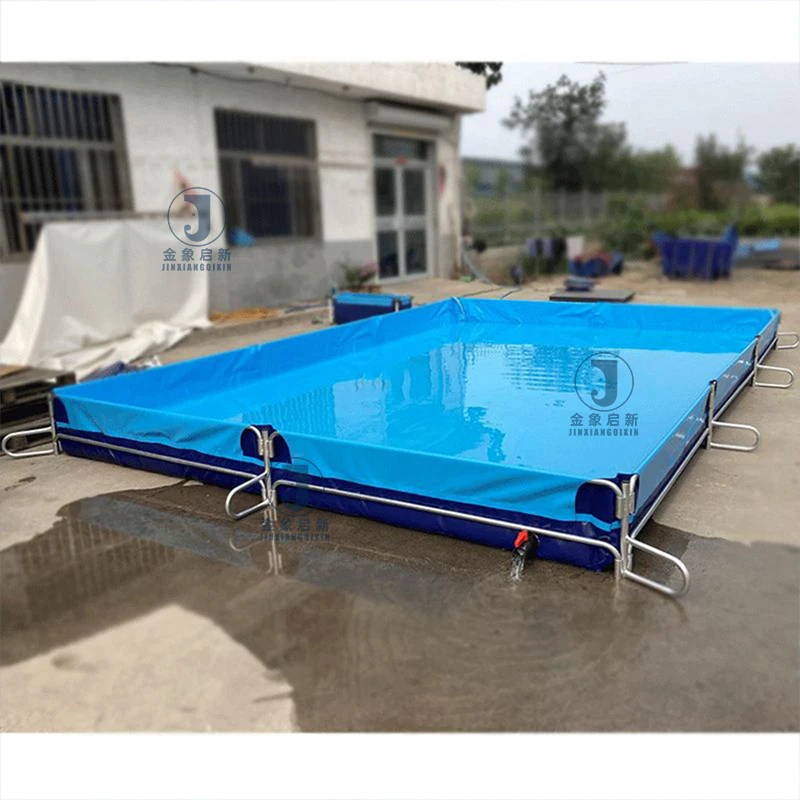
Integrated pressing construction — eliminates stitch-line leaks that plague conventional pond liners during water pressure cycles and field handling.
Technical Specifications
| Parameter | Value |
|---|---|
| Product Type | PVC Coated Tarpaulin Fish Pond Liner |
| Base Fabric | Polyester, 500D-500D yarn count |
| Coating Material | Double-sided PVC coating |
| Coating Method | Integrated pressing |
| Thickness Measurement | 450-900 g/m² (range covers product family — confirm the grade for your project) |
| Surface Characteristics | Smooth, leather-like texture |
| Flame Retardancy | Available in flame-retardant grades — confirm the grade required for your market |
| UV Resistance | Available with anti-UV treatment — request test basis for your specification |
| Key Features | Water resistant, waterproof, abrasion resistant, hot-air weldable for field repair |
| Color | Customizable |
| Shape Options | Rectangular, round, square — custom sizing available |
Application Suitability
| Application | Exposure & Requirement |
|---|---|
| Transport of foldable aquaculture tanks | Flexing on flatbed trailers, abrasion against tie-downs, repeated folding and unfolding |
| Large-scale fish and shrimp pond installation | Unrolling over uneven ground, backfill contact, permanent water containment pressure |
| Seasonal agricultural water reservoirs | UV exposure, temperature swings, mechanical contact from stock and equipment |
| Construction site containment ponds | Debris impact, soil chemistry, short to medium-term water holding |
Why Welded Seams Outperform Stitched Joints in PVC Pond Liner Applications
Integrated pressing creates a continuous bond that water pressure cannot penetrate.
Most pond liner failures do not start in the middle of the fabric. They begin where two panels meet. Stitched seams leave thousands of needle holes that allow water to migrate under hydrostatic pressure, and the thread itself degrades long before the PVC does. In transport applications where pre-assembled tanks flex on trailers, seam stress accelerates this breakdown. Our PVC pond liner for aquaculture uses integrated pressing to fuse panels into a single coated surface, removing the needle-hole leak path entirely [NEED_CITE: hydrostatic pressure test methods for pond liner seam integrity per relevant standards].
Seam Integrity Under Transport and Deployment Stress
When a foldable aquaculture tank travels on a flatbed trailer, every turn and braking event flexes the liner at the joints. A PVC pond liner for aquaculture with stitched seams concentrates stress at the thread line, where the fabric has already been perforated. Integrated pressing distributes that load across the full bonded width, so the joint behaves like the parent material. This matters equally during on-site deployment, where rolls must be dragged, positioned, and overlapped over rough ground before final welding.
Field Repair Without Full Liner Replacement
Puncture damage is inevitable when heavy stock, feeding equipment, or maintenance tools contact the liner surface. Hot-air weldable construction means the PVC pond liner for aquaculture can be patched on-site using standard hot-air welding equipment — no adhesive tapes, no full drain-and-replace cycle. A repair patch bonds at the molecular level with the PVC coating, restoring waterproof continuity at the damage point [NEED_CITE: hot-air welding bond strength on PVC-coated polyester fabrics].
Reading the Specifications That Actually Matter
The 500D-500D polyester base fabric defines the liner’s structural backbone. Denier count indicates the thickness of individual yarns — 500D warp and weft yarns create a grid that resists tear propagation when the fabric encounters sharp stones or root systems during unrolling. GSM alone does not determine strength; a heavier coating adds waterproof mass but does not improve tensile resistance if the base fabric is lighter. The integrated pressing coating method bonds PVC to both sides of the polyester simultaneously, producing peel strength that outperforms laminated alternatives and supports reliable hot-air welding at seams. Surface characteristics described as smooth with a leather-like texture reduce friction during deployment and resist soil adhesion when the liner must be repositioned.
The Hidden Cost of Specifying on GSM Alone
Buyers who select pond liner based solely on quoted GSM frequently encounter material that measures lighter on arrival. Coating weight can vary between production runs when process control is inconsistent, and a lighter coat reduces both waterproof integrity and abrasion resistance at the contact surface. For aquaculture operators, this means the liner wears through at the pond floor where sediment and stock movement concentrate friction, leading to leaks that require emergency draining and repair. In fleet transport of foldable tanks, underweight coating cracks at fold lines after repeated cycles [NEED_CITE: relationship between coating weight consistency and field failure rates in coated fabrics].
Why Source This PVC Pond Liner for Aquaculture Here
Three full production lines and 36 sets of professional equipment support bulk roll output with controlled lead times for project-scale pond orders. A 10-person R&D team handles custom sizing, colour matching, and sample development within days rather than weeks. Dedicated QA/QC runs at every production stage with 100% inspection before shipment, catching coating weight deviations before rolls leave the facility. Deep process control over coating weight and adhesion, built over nearly 30 years of coated fabric specialization, means the GSM on the quotation is the GSM that arrives on site.
Documentation & Verification
- Material specification sheet stating confirmed GSM, base fabric denier, and coating type per roll
- UV and flame-retardant test reports supplied for applicable grades with test basis documented
- Pre-shipment inspection record with coating weight verification against stated specification
- Roll packing list and certificate of origin included for customs clearance
- ISO and CE certificates available for compliance documentation
Fabrication, Handling & Storage
- Hot-air weld at seams using temperature settings matched to the PVC coating thickness for full bond penetration
- Store rolls horizontally on pallets to prevent flat-spot deformation of the 500D-500D polyester base
- Unroll on cleared ground free of sharp debris to protect the smooth leather-like surface from puncture
- Field-repair punctures with matching PVC patch material using standard hot-air welding equipment
- Avoid dragging rolls across abrasive surfaces during deployment to preserve the coating integrity
- Clean with mild detergent only — solvent-based cleaners degrade the PVC coating surface
Requesting a Quotation
Specify your pond dimensions, preferred shape, and required GSM grade so we can calculate panel layout and seam count. Confirm whether your site requires flame-retardant or anti-UV certification and the applicable standard for your market. Indicate whether you need finished cut-to-size panels or full rolls for on-site fabrication.
Frequently Asked Questions
Q: How is GSM verified before shipment?
A: Every roll undergoes coating weight verification during our 100% pre-shipment inspection. The result is recorded on the material specification sheet included with your dispatch documentation, so the GSM you quoted is the GSM you receive on site.
Q: Can pond liners be custom-cut to exact dimensions?
A: Yes. We produce rectangular, round, and square configurations cut to your specified dimensions. Provide pond measurements including depth, and our R&D team will confirm panel layout, seam positions, and tolerances before production begins.
Q: What flame-retardant grades are available?
A: Flame-retardant treatment is available in customizable grades. Confirm the fire classification standard required by your local regulations or project specification, and we will supply the matching grade with supporting test documentation.
Q: How do I repair a puncture in the field?
A: The PVC-coated construction supports hot-air welding for field repairs. Clean the damage area, apply a matching PVC patch, and use standard hot-air equipment to fuse the patch to the liner surface, restoring waterproof continuity without draining the pond.
Q: Is colour consistent across multiple rolls in one order?
A: Batch colour consistency is controlled through our in-process QA at the coating stage. The pre-shipment inspection includes visual comparison across rolls in the same order to prevent visible variation when panels are installed side by side.