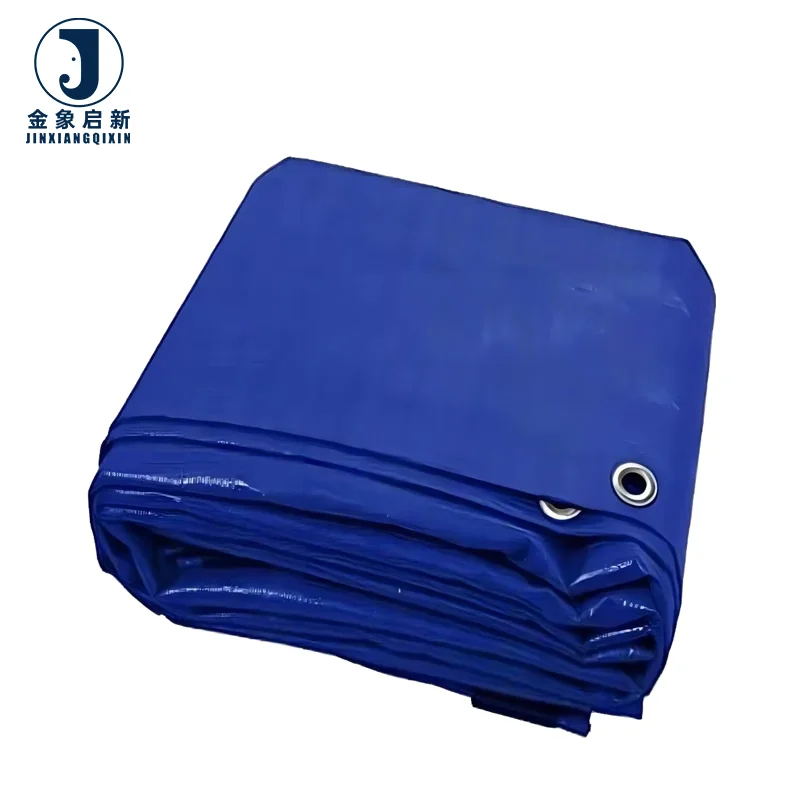
Precision Fitment — custom-cut truck tarpaulin covers are developed from exact trailer dimensions, not generic templates, with reinforced hems and eyelets built for road vibration and tie-down stress.
Technical Specifications
| Parameter | Value |
|---|---|
| Product Type | Truck Tarpaulin Cover |
| Material | PVC + High-strength polyester mesh fabric |
| Coating Technology | Laminated technology & Hot-melt coating technology |
| Weight Options | 350gsm / 420gsm / 500gsm / 550gsm / 600gsm / 750gsm |
| Thickness Range | 0.32mm / 0.35mm / 0.4mm / 0.45mm / 0.5mm / 0.65mm |
| Roll Width | 2m / 2.1m |
| Roll Length | 75m (2m width) / 50m (2.1m width) |
| Finished Product Size | Custom per customer requirement |
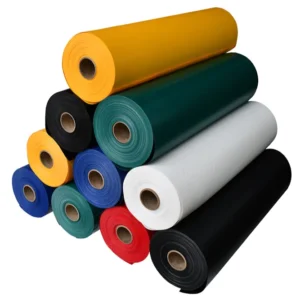
| Color Options | Blue / Red / Yellow / Light Blue / Grey (Customized) |
| UV Treatment | Sunproof claimed (test basis not stated — confirm grade for your market) |
| Anti-Static | Treatment claimed (surface resistance or standard not stated — confirm requirement) |
| Cold Crack Resistance | Yes |
| Anti-Mildew | Yes |
| Waterproof | Yes |
| Printing Option | Customized printing accepted |
| Service Life | 3–7 years under normal conditions (source value — verify against conditions) |
| Standards | ISO, CE |
Application Suitability
| Application | Exposure & Requirement |
|---|---|
| Flatbed and tipper truck covers | Constant highway wind flex, road spray, UV exposure, tie-down abrasion at hems |
| Side curtain fabric for curtain-sider trailers | Repeated opening and closing cycles, lateral flexing, rail contact wear, weather sealing |
| Trailer load protection for construction materials | Heavy cargo edge pressure, puncture risk from angular loads, crane and forklift handling |
| Agricultural equipment transport covers | Dust and moisture exposure, vibration on unpaved roads, extended outdoor parking between hauls |
Why GSM Alone Does Not Define Road-Ready Performance
A heavy gsm reading on the quotation does not guarantee the cover will survive its first crosswind on the motorway. Tear resistance at welded seams and flex points determines real-world durability far more than weight alone.
Fleet operators routinely receive truck tarpaulin covers that match the quoted GSM but fail at the weld lines where the load shifts most during braking and cornering. The PVC coating may separate from the polyester base fabric at these stress points, leaving a gap that grows with every trip [NEED_CITE: tensile and tear test methods for coated fabrics per ISO 1421]. A PVC coated truck tarpaulin for truck and trailer use must be evaluated on coating adhesion, base fabric denier, and seam construction together — not on a single weight figure.
Fitment That Matches Your Trailer, Not a Catalogue Template
Generic-size truck covers leave gaps at corners and tailgates where water enters and wind lifts the fabric. Every PVC coated truck tarpaulin for truck and trailer produced here is cut to the exact dimensions of your vehicle model, with allowance for the specific curvature of your roof bows and side rails. This eliminates the loose fabric that flaps in highway drafts and accelerates wear at the mounting points.
Reinforcement Where Road Forces Concentrate
The tie-down points and hem edges absorb the highest cyclic loads during transport. Hot-melt coating technology bonds the PVC layer to the high-strength polyester mesh with sufficient adhesion to resist delamination at these stress zones. Eyelet spacing and hem reinforcement are configured to match the tie-down system on your specific trailer, preventing the pull-through failures that occur when standard spacing meets non-standard load geometry [NEED_CITE: coated fabric adhesion strength testing standards].
Reading the Specification Sheet Beyond the Weight Number
The weight range from 350gsm to 750gsm covers duty cycles from short urban deliveries to long-haul motorway exposure. Selecting the correct grade requires matching both the gsm and the total thickness to the mechanical demands of your route. The base fabric is a high-strength polyester mesh, and its yarn tenacity combined with the coating method determines how the material behaves when a loaded trailer flexes through a curve. Laminated technology produces a distinct bond character compared to hot-melt coating, affecting both the hand feel and the heat-weld response during fabrication. Cold crack resistance matters for operators running through cold-region winters, where stiffened fabric can fracture at fold lines rather than flex with the load. Colour consistency across rolls in the same order prevents the visible shade variation that appears when multiple panels are installed side by side on a single trailer.
The Hidden Cost of Specification Mismatches
A cover that is too light for the route cycle will develop pinholes at the weld seams within months, requiring replacement far sooner than a correctly graded material would [NEED_CITE: common failure modes in transport tarpaulin covers]. Batch colour inconsistency across rolls forces the fleet to either accept a patchwork appearance or reject the shipment entirely. Anti-UV treatment claimed without a supporting test report means the operator has no basis for predicting how the material will hold up after extended sun exposure on parked trailers. When welded seams fail before the fabric itself does, the entire cover must be removed and reworked — downtime that compounds with every delayed load.
What This Supply Chain Delivers for Transport Operators
Three full production lines with 36 sets of professional equipment support the volume demands of fleet-scale orders without compressing lead times into unmanageable windows. The 10-person R&D team develops cut-to-model samples within days, allowing fleet operators to verify fitment on a physical prototype before committing to bulk. Dedicated QA and QC inspection runs at every production stage, with 100% pre-shipment checks ensuring that every roll or cut cover meets the specification stated on the order. Batch-consistent colour is controlled through process parameters at the coating stage, not left to chance at the mixing bench. Full documentation accompanies each dispatch — from material specification sheets to packing lists and certificates of origin — so customs clearance and compliance audits proceed without delays.
Documentation & Verification
- Material specification sheet stating exact GSM, base fabric construction, and coating weight per roll
- Pre-shipment inspection record confirming welded seam integrity and dimensional accuracy
- UV and flame-retardant test reports provided where applicable, linked to the specific batch
- Colour reference card per roll for batch consistency verification on arrival
- ISO and CE certificates included with every shipment for customs and compliance documentation
- Roll packing list with net and gross weight for container loading verification
Fabrication, Handling & Storage
- Heat-weld parameters must be adjusted to the specific coating technology — laminated and hot-melt grades respond differently to temperature and dwell time
- Reinforced webbing at hem edges distributes tie-down load across the PVC coated truck tarpaulin for truck and trailer panels, reducing pull-through risk
- Store rolls vertically on pallets to prevent flat-spot deformation that shows as permanent creases on the installed cover
- Allow cold-stored rolls to reach ambient temperature before unrolling to avoid cracking the PVC coating at fold lines
- Use mild detergent for cleaning — abrasive solvents can degrade the anti-mildew and surface treatments
- Field repairs require compatible PVC patch material with matching thickness for reliable heat-weld adhesion
Preparing Your Enquiry for a Transport-Grade Cover
To move from general interest to a firm specification, provide your trailer make, model, and year along with the internal cargo bay dimensions measured at the roof bows and floor rails. State the primary route climate — whether the covers will see sustained motorway speeds in rain, prolonged sun exposure while parked, or cold-region winter conditions. Confirm whether you need finished cut-and-welded covers with eyelets and reinforcement, or roll stock for your own fabrication shop. If your fleet requires specific colour matching or printed branding, note the Pantone or RAL reference so that sample development can begin immediately.
Frequently Asked Questions
Q: How do I specify my trailer model and dimensions for a custom-fit truck cover?
A: Provide the trailer make, model, and year, along with measured internal dimensions at the roof bows, side rails, and floor edges. Photographs of the existing cover or tie-down arrangement help confirm eyelet placement. A cut sample is developed within days for your physical fitment check before bulk production begins.
Q: How is GSM verified on arrival to ensure the material matches the quotation?
A: Each shipment includes a material specification sheet stating the base fabric denier, weave, and coating weight. The pre-shipment inspection record documents the measured GSM per roll. Buyers may conduct independent weight verification on receipt against the documented values.
Q: What eyelet spacing and hem reinforcement options are available for tie-down systems?
A: Eyelet spacing is configured to match your trailer’s tie-down rail layout rather than set to a generic interval. Hem reinforcement uses additional PVC-coated webbing bonded by heat welding, sized to the gsm and thickness of the selected grade to distribute load without pull-through.
Q: How do welded seams perform at flex points compared to stitched seams under road conditions?
A: Heat-welded seams fuse the PVC coating layers into a continuous bond, eliminating the needle holes that allow water ingress and the thread abrasion that causes stitched seams to unravel under cyclic road vibration. Weld strength is verified during the in-process QA stage.
Q: What UV and weather resistance evidence supports the sunproof claim for long-haul exposure?
A: UV treatment is applied during the coating stage, and test reports are provided where applicable to confirm performance. Buyers should state their market’s specific exposure requirements so the correct treatment grade can be matched and documented before production.