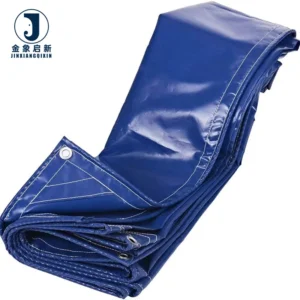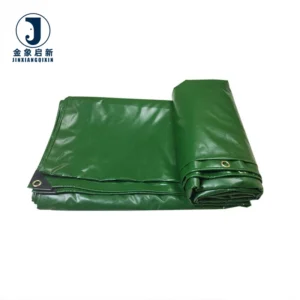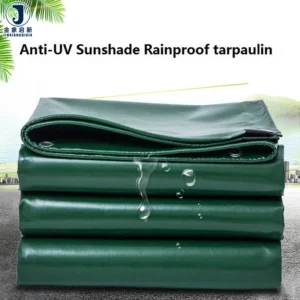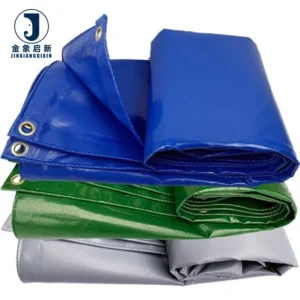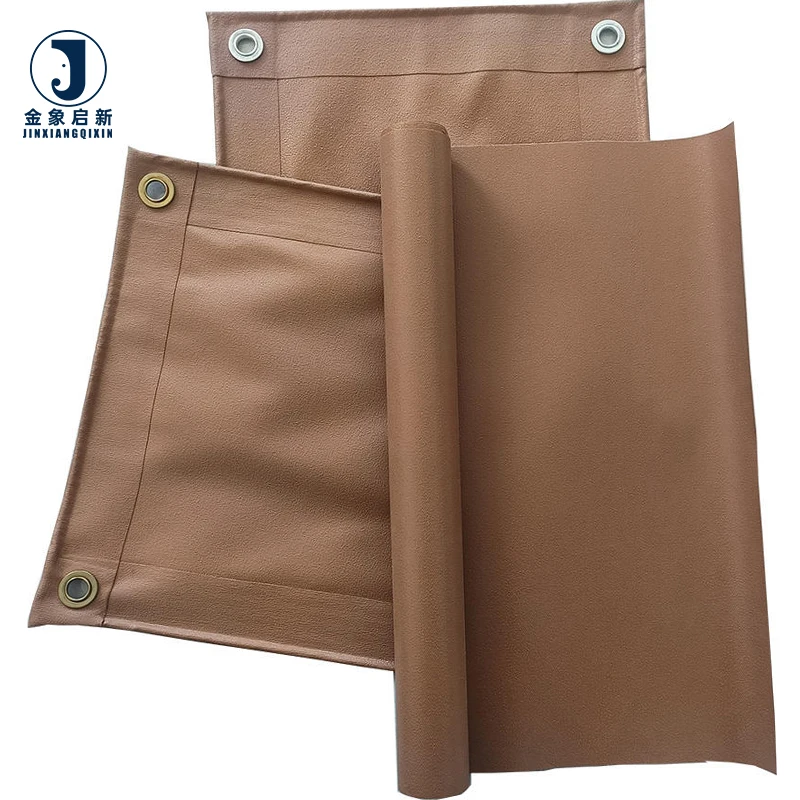
Coating Process Mastery — Deep control over hot melt adhesion and lamination ensures this PVC coated tarpaulin fabric withstands the flex points where transport loads shift and seams typically fail.
Technical Specifications
| Parameter | Value |
|---|---|
| Product Type | PVC Coated Tarpaulin Fabric |
| Material | 100% high toughness polyester yarn with PVC coating |
| Coating Technology | Lamination technology and hot melt coating technology |
| Weight (Medium-sized) | 400-500 g/m² |
| Thickness (Medium-sized) | 0.35-0.45 mm |
| Knitting Density (Medium-sized) | 500D |
| Tensile Strength (Medium-sized) | Longitude 1500-2000 / Latitude 1200-1800 N/5cm |
| Weight (Heavy-duty) | 700-1000 g/m² |
| Thickness (Heavy-duty) | 0.70-1.0 mm |
| Knitting Density (Heavy-duty) | 1000D |
| Tensile Strength (Heavy-duty) | Meridian 2000-2500 / Latitude 1800-2200 N/5cm |
| Weight (Super heavy) | 1100-1500 g/m² |
| Thickness (Super heavy) | 1.2-1.5 mm |
| Knitting Density (Super heavy) | 500D-2000D |
| Tensile Strength (Super heavy) | 2500-3000 warp / 2200-2800 weft N/5cm |
| Key Features | Waterproof, cold resistant cracking, mold proof, anti-static treatment (grade not stated), UV resistant (test basis not stated), flame retardant (grade not stated) |
| Color Fastness | Best color fastness (test basis not stated) |
| Welding Tear Strength | Excellent |
| Weather Resistance | 3-5 years outdoor living guarantee (test basis not stated) |
| Custom Options | Flame retardant, anti-static, cold prevention, mold prevention, 3P treatment |
| Certifications | ISO, CE |
Application Suitability
| Application | Exposure & Requirement |
|---|---|
| Truck tarpaulin & side curtain | Constant flexing, road abrasion, UV exposure, high-speed wind load |
| Heavy truck tarpaulin | Heavy cargo tie-down tension, repeated folding, extreme weather |
| Industrial pipe canopy | Outdoor weathering, structural tension, prolonged sun exposure |
| Tensioned structural fabric | High tensile load, long-term dimensional stability, weld integrity |
| Engineering protective cloth | Site debris impact, moisture ingress, repeated handling |
Why Seam Failure Outpaces Fabric Failure on the Highway
A PVC coated tarpaulin fabric can be strong in the field yet still fail at the weld line when the coating chemistry and hot melt process are not matched to the base fabric. The weld must be as strong as the fabric itself, or the cover will split at the flex point long before the body of the material shows wear.
Fleet operators regularly report side curtains splitting along horizontal seams after months of highway use, even when the fabric body remains intact. The failure is almost never the yarn — it is the boundary layer between coating and substrate where adhesion was insufficient for the cyclic bending that every trailer curtain endures. [NEED_CITE: weld integrity and adhesion test methods for PVC coated polyester]
How Hot Melt Coating Secures the Weld Line
Hot melt coating technology forces the PVC compound into the interstices of the polyester yarn under heat and pressure, creating a mechanical bond that goes beyond surface adhesion. When the PVC coated tarpaulin fabric is later heat-welded into a truck side curtain, the weld zone re-melts this penetrated layer, fusing two panels through the full thickness rather than at a shallow skin. This is what gives the joint its tear resistance under cyclic flexing.
What Lamination Adds for Flat Truck Covers
Lamination technology bonds a pre-formed PVC film to the woven base under controlled temperature, producing a uniform coating thickness across the full width. For flat truck covers that are folded and unfolded repeatedly, this uniformity means the cover bends consistently without stiff spots that concentrate stress. The result is predictable handling and predictable wear across the entire surface, rather than localized cracking at thin-coat zones.
Reading the Weight Grades Against Actual Use
The three weight tiers — medium, heavy-duty and super heavy — map to different points on the exposure spectrum. A 500D base with 400-500 g/m² coating suits side curtains where weight must stay manageable for manual rolling and the fabric flexes thousands of times per journey. The 1000D base at 700-1000 g/m² handles flat covers and heavy cargo tie-downs where puncture resistance and tensile load matter more than drape. Super heavy grades at 1100-1500 g/m² with up to 2000D yarn serve tensioned structures and industrial canopies where the fabric is installed once and must hold dimensional stability under permanent load. Knitting density and coating weight work together: a heavier coat on a low-density base adds stiffness without proportional tear strength, while a high-density base with a thin coat may abrade through quickly. [NEED_CITE: relationship between base fabric denier and coating weight for tensile performance per ISO 1421]
What Happens When the Grade Is Wrong for the Route
Specifying a medium-weight PVC coated tarpaulin fabric for a flatbed cover that crosses cold-climate routes leads to early cracking at fold lines, because the cold resistant cracking threshold of a lighter grade is exceeded in winter conditions. Conversely, running a super heavy curtain on a high-frequency curtain-sider trailer adds dead weight to every load cycle, increasing fuel consumption and making manual handling a safety issue for drivers who open and close the curtain multiple times per shift. Batch-to-batch colour variation compounds the problem: when one roll in a multi-roll order fades at a different rate than the next, the fleet livery looks inconsistent within the first season of road exposure. [NEED_CITE: cold flex cracking thresholds for PVC coated polyester at sub-zero temperatures]
Why Fleet Buyers Source This Fabric Here
Three full production lines running hot melt and lamination coating give consistent output across the medium, heavy-duty and super heavy tiers without switching costs that delay your order. A 10-person R&D team develops samples against your specific vehicle dimensions or curtain track profiles within days, so you verify fit before committing to full-roll production. Every roll passes dedicated QA/QC at coating, laminating and winding stages, with 100% pre-shipment inspection catching thickness or adhesion deviations before they leave the facility. ISO and CE certified production underpins the documentation your compliance team needs. Export experience across North America, Europe and Asia means packing, labelling and customs paperwork arrive in the format your freight forwarder expects.
Documentation & Verification
- Material specification sheet stating verified GSM weight, base fabric denier and coating method for each roll
- Pre-shipment inspection record confirming thickness, tensile and coating adhesion before dispatch
- UV and flame retardant test reports provided where specific treatment grades are confirmed at inquiry
- Roll packing list with weight and dimensions for container loading calculations
- Certificate of origin and customs support documentation for cross-border shipment clearance
Fabrication, Handling & Storage
- Heat-weld at temperatures matched to the hot melt coating layer to ensure full-thickness fusion at seam lines
- Reinforce eyelet zones with extra PVC patches on heavy-duty and super heavy grades to resist tie-down pull-through
- Store rolls horizontally on padded racks to prevent permanent creasing in the 0.70-1.0 mm heavy-duty grades
- Allow cold-stored rolls to reach ambient temperature before unrolling to avoid stress cracking in cold prevention grades
- Clean with neutral pH detergent only; solvent-based cleaners degrade the anti-static treatment surface layer
- Plan cutting layout across the roll width to minimise off-cuts and reduce weld seam count on large covers
What We Need to Move Your Inquiry Forward
Share the truck or trailer model you are covering, the exposure conditions your fleet operates in, and the weight grade you have specified historically. Let us know whether you need flame retardant or anti-static treatment and which market certification your end-user requires. If you are buying by the roll, confirm the width, colour reference and estimated annual volume so we can match production scheduling.
Frequently Asked Questions
Q: What GSM should I specify for truck side curtains versus flat covers?
A: Side curtains benefit from the medium weight range where 500D base fabric keeps the curtain manageable for daily rolling and the hot melt coating provides sufficient flex endurance. Flat covers handling heavy tie-down loads typically need the heavy-duty tier at 1000D for puncture resistance. We supply samples of both so you can test drape and weld strength before committing.
Q: Are UV and flame retardant treatments supported by test certificates?
A: Both treatments are available in multiple grades. Because requirements differ by market — some regions require NFPA 701, others DIN 4102 B1 — we ask you to confirm the standard your end-user specifies. We then supply the corresponding test report matched to that grade, rather than a generic certificate that may not satisfy your local inspector.
Q: Can fabric be supplied in custom widths and roll lengths?
A: Custom widths are produced on our lamination and hot melt lines to reduce your welding seams and off-cuts. Roll lengths are adjusted to match your cutting table or curtain panel dimensions. Provide your maximum width requirement and target roll length at inquiry so we confirm feasibility and lead time against current production scheduling.
Q: What welding methods work best with this PVC coated fabric?
A: Hot air welding and high-frequency welding both perform well with our hot melt coated construction, because the PVC has already penetrated the base fabric during coating and re-melts uniformly at the joint. We recommend testing weld temperature and dwell time on a sample piece of your chosen weight grade to dial in parameters before production runs.
Q: How is color consistency maintained across multiple rolls in one order?
A: All rolls in a single production run use the same PVC compound batch and pass through identical coating and curing conditions. Our 100% pre-shipment inspection includes visual comparison under standard lighting to catch any roll-to-roll variation before packing. For fleet-wide branding, ordering the full quantity in one production slot gives the tightest colour match.