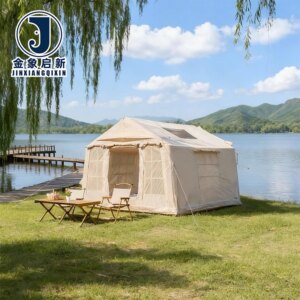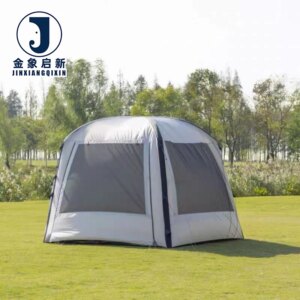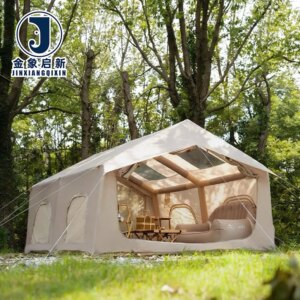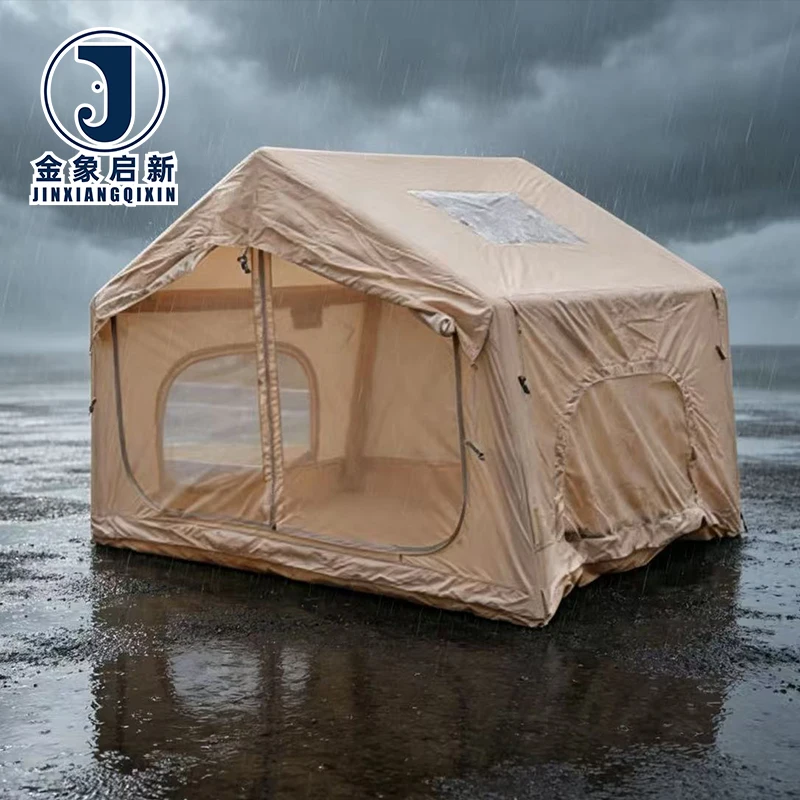
Precision seam engineering — every welded joint on this inflatable tent is inspected against flex-stress data before dispatch, eliminating the most common failure point in temporary field shelters.
Technical Specifications
| Parameter | Value |
|---|---|
| Product Type | Inflatable Tent |
| Core Material | PVC tarpaulin |
| Capacity | 5-8 Person |
| Key Performance | Waterproof, UV-resistant (test basis not stated in source), tear-resistant |
| Opening Mechanism | Automatic inflatable opening |
| Season Rating | 4-Season |
| Customization | OEM & ODM, sample customization, pattern printing |
| Quality Control | Full-process inspection with dedicated QA & QC staff |
| Standards | ISO 9001, ISO 14001, ISO 45001, CE |
Application Suitability
| Application | Exposure & Requirement |
|---|---|
| Temporary site offices for construction | Continuous outdoor exposure, wind loading, frequent relocation |
| Mobile command centers for outdoor events | Rapid deployment, weather protection, branding visibility |
| Field operations shelter for transport crews | Roadside vibration, dust, UV exposure during loading and unloading stops |
| Industrial field operation enclosures | Abrasion from equipment movement, repeated assembly and teardown cycles |
Why Inflatable Tents Fail Where the Fabric Folds Most
Seam integrity at flex points determines whether an inflatable tent survives its first season or gets written off after a single deployment.
Most inflatable shelters do not fail because the PVC tarpaulin itself tears. Failure concentrates at welded seams and junction points where the structure bends under wind load, inflation pressure, and road vibration during transport [NEED_CITE: tensile and tear test methods for coated fabrics per ISO 1421]. When a transport fleet or construction contractor specifies an Inflatable Tent aftermarket supplier, they are often reacting to a previous tent that split at the air-beam sleeve or the base-to-wall weld after repeated setup cycles. The fabric may still be intact, but the structure is useless once a seam opens under pressure.
Designed for Repeated Assembly on Active Job Sites
This Inflatable Tent for truck and transport operations is built around a PVC tarpaulin shell rated for four-season use, meaning the fabric maintains flexibility and waterproof integrity across the temperature swings that field crews encounter between summer deployment and winter storage. The automatic inflatable opening mechanism cuts setup time on time-sensitive sites where crews cannot afford to spend hours on manual pole assembly.
Welded Seams Tested at the Points That Actually Bend
Every inflatable structure concentrates stress at the junctions where air beams meet the base panel and where wall sections fold during packing. Our production process applies reinforced welding parameters at these specific zones, with QA staff checking peel strength at each junction before the tent moves to final inspection [NEED_CITE: welded seam peel strength testing for coated technical textiles]. This focus on junction integrity is what separates a field shelter that holds pressure through a wind event from one that slowly deflates overnight.
Reading the Specification Sheet Beyond Marketing Claims
Waterproof performance in a PVC tarpaulin inflatable shelter depends on both the coating weight applied to the base fabric and the seam construction method. A coated fabric may resist water penetration across its flat surface while still allowing moisture ingress through capillary action at stitch lines or poorly welded overlaps. The tear-resistant classification of this Inflatable Tent custom fabric reflects the combined contribution of base fabric denier and coating adhesion — a heavy coating on a low-denier scrim will crack before it tears, while a lighter coating on a high-denier weave will stretch and resist propagation differently. Understanding these relationships helps buyers match the right inflatable tent specification to the actual abuse the structure will face on site.
What Happens When the Wrong Specification Reaches the Site
Contractors who select inflatable shelters based solely on capacity rating or price often discover the mismatch when the tent is inflated for the third or fourth time. Colour variation between units in the same order becomes visible when two tents stand side by side at an event site, undermining the professional image a fleet operator or project manager intended to project [NEED_CITE: batch colour consistency standards for coated fabric production]. Welded seams that were not reinforced for the specific inflation pressure of the air-beam design may hold during factory testing but open after transport vibration loosens the bond at the overlap edge.
Why Procurement Teams Source This Inflatable Tent Here
Three full production lines and 36 sets of professional processing equipment allow us to hold delivery schedules on custom inflatable tent orders without compromising in-process inspection at each welding station. Our 10-technician R&D team handles pattern printing, custom sizing, and material selection for every Inflatable Tent custom project, developing samples within days rather than weeks. Dedicated QA and QC staff conduct 100 percent inspection before dispatch, checking seam integrity, inflation pressure retention, and surface finish on every unit. The 9,180 square meter production facility supports both single-unit prototype runs and volume orders for fleet-wide deployment.
Documentation & Verification
- Material specification sheet stating base fabric type, coating method, and colour reference for each Inflatable Tent custom order
- UV-resistant test report provided where applicable, with grade and standard clearly stated
- Pre-shipment inspection record confirming seam peel strength and inflation pressure hold on every unit
- ISO 9001, ISO 14001, ISO 45001, and CE certificates available for compliance filing
- Roll-level weight verification documented before tent fabrication begins
Fabrication, Handling & Storage
- Heat-weld seams at temperatures matched to the PVC tarpaulin coating weight to prevent over-melt or under-bond at air-beam junctions
- Store inflated or partially inflated tents away from sharp-edged equipment to protect the PVC tarpaulin surface from puncture
- Avoid folding the tent at the same crease line repeatedly to prevent coating crack propagation at stress folds
- Clean the PVC tarpaulin shell with mild detergent only — solvent-based cleaners degrade coating adhesion over time
- Transport deflated tents in protective sleeves to prevent road abrasion from damaging the outer coating during transit
Request a Specification Match for Your Application
Send us your deployment scenario — including expected wind exposure, frequency of assembly and teardown, and any branding or colour requirements for fleet identification. If your site requires specific fire-retardant or UV-resistant grades for regulatory compliance, state the standard your market enforces so we can confirm available treatment levels. For custom sizing or pattern printing, provide dimensional drawings or reference images with your inquiry.
Frequently Asked Questions
Q: How is batch-to-batch colour consistency controlled across multiple inflatable tent orders?
A: Each production run references a master colour standard established during sample approval. Our QA team compares every batch against this reference under controlled lighting before the PVC tarpaulin moves to cutting and welding. If your order spans multiple shipments, request the colour inspection record for each dispatch to verify consistency across your fleet deployment.
Q: What welded seam reinforcement options are available at high-stress flex points?
A: Air-beam junctions and base-to-wall overlaps receive additional welding passes calibrated to the PVC tarpaulin coating weight. For tents deployed in high-wind environments or subject to frequent transport vibration, we can apply reinforced overlap strips at specified junction zones. Confirm your typical deployment conditions so our R&D team can recommend the appropriate reinforcement configuration.
Q: How to verify UV-resistant treatment claims with supporting test documentation?
A: We provide a UV-resistant test report for inflatable tent orders where this treatment has been specified. The report states the test standard and results achieved. If your market requires a specific UV exposure duration or classification, communicate that requirement at inquiry stage so we can confirm whether the available treatment grade meets your regulatory threshold.
Q: What custom sizing and pattern printing options are available for fleet-branded tents?
A: OEM and ODM customization covers dimensional adjustments, colour selection, and pattern printing for corporate or fleet branding on the PVC tarpaulin surface. Sample customization allows you to approve colour registration and print durability before full production begins. Provide artwork files and dimensional requirements with your inquiry for a feasibility review.
Q: What is the sample approval process before mass production begins?
A: Our 10-technician R&D team develops a physical sample based on your specification within days of order confirmation. You review material feel, colour accuracy, welding quality, and inflation performance before authorising production. Any adjustments to seam construction, print placement, or sizing are incorporated into a revised sample until the configuration meets your approval.