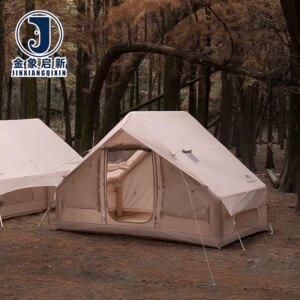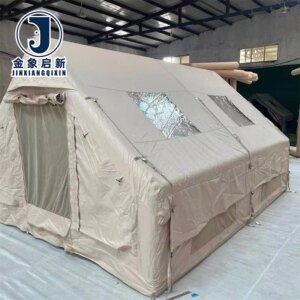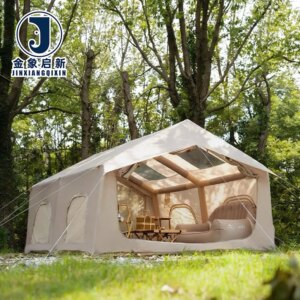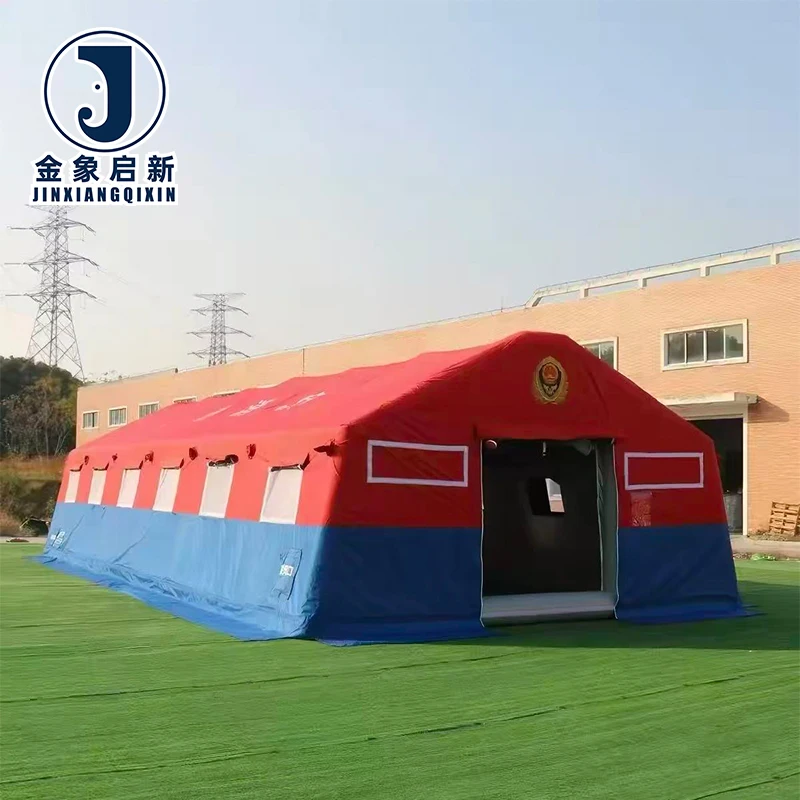
Full-Process Coating Control — nearly 30 years of PVC tarpaulin production ensures every inflatable tent roll maintains consistent coating weight and adhesion before it leaves the line.
Technical Specifications
| Parameter | Value |
|---|---|
| Product Type | PVC Inflatable Tent |
| Core Material | PVC Tarpaulin |
| Product Form | Extended Type, Single Layer Construction |
| Waterproofing | Fully waterproof coated construction |
| UV Treatment | Available with UV-resistant treatment (test basis not stated in source) |
| Tear Resistance | Tear-resistant PVC tarpaulin base |
| Certifications | ISO 9001, ISO 14001, ISO 45001, CE |
| Customization | OEM & ODM — sample customization, pattern printing, size and material thickness adjustments |
Application Suitability
| Application | Exposure & Requirement |
|---|---|
| Disaster Relief Rapid Deployment | Immediate weather exposure, repeated inflation cycles, transport abrasion during emergency logistics |
| Construction Site Command Centers | Prolonged outdoor UV and rain exposure, dust and debris contact, frequent relocation between sites |
| Logistics Mobile Shelter Units | Loading dock wind and moisture, constant setup and teardown by fleet crews, forklift proximity puncture risk |
| Temporary Equipment Storage | Standing water on uneven ground, UV degradation over extended periods, secure enclosure against theft and weather |
What Happens When Rapid Deployment Tents Fail Compliance Audits
A PVC inflatable tent without verifiable material certifications creates operational downtime exactly when speed matters most.
Emergency procurement teams often receive tents that look correct on paper but arrive without the fire classification or structural test data the site safety officer requires. The delay is not in manufacturing — it is in documentation that was never prepared. Project timelines stall while compliance gaps are resolved after delivery, turning a rapid deployment asset into a bottleneck [NEED_CITE: ISO 9001 quality management requirements for emergency shelter procurement]. When a PVC Inflatable Tent manufacturer custom builds your order with full-process inspection and ships every document together, the tent and its paperwork arrive as one package.
Quick Automatic Opening Under Field Pressure
The inflation mechanism on this PVC inflatable tent is engineered for time-sensitive deployment where every minute of setup directly impacts operational readiness. Single-layer extended construction keeps internal volume high while minimizing the structural complexity that slows inflation. For disaster relief teams working in deteriorating weather, the difference between a tent that reaches full pressure in minutes and one that requires manual adjustment is the difference between sheltered operations and exposed risk.
Four-Season Reliability Across Repeated Deployment Cycles
Field shelters endure storage, transport, inflation, deflation, and redeployment across seasons and geographies. The PVC tarpaulin core resists water ingress and maintains flexibility through temperature variation, preventing the stiffening or softening that compromises airtight chambers [NEED_CITE: tensile and tear test methods for coated fabrics per ISO 1421]. Tear-resistant construction at stress concentration points — valve surrounds, base perimeter, and chamber junctions — extends usable service life across hundreds of deployment cycles without seam separation or fabric rupture.
Coating Weight, Base Fabric, and the Relationship That Determines Real Strength
GSM alone does not predict how a PVC inflatable tent will perform under inflation pressure and external wind load. The base fabric denier and weave density determine tensile capacity, while coating weight governs waterproofing, UV shielding, and abrasion resistance at contact points. A lighter coating on a dense base fabric may outperform a heavy coating on a loose weave in tear propagation resistance. For inflatable structures, peel strength between coating and base is critical — if the PVC layer delaminates at an inflation seam, the chamber loses pressure regardless of how strong the base yarn is. Extended-type single-layer construction concentrates these forces along fewer seam lines, making coating adhesion and weld quality the primary failure variables.
The Cost of Skipping Pre-Production Sample Validation
Procurement teams that approve specifications from a quotation sheet without physical sample testing often discover coating stiffness or chamber geometry issues only after the full order ships. A PVC inflatable tent that inflates correctly in the factory may behave differently at altitude, in sub-zero ambient temperatures, or when stored compressed for extended periods before first use [NEED_CITE: material performance variation under environmental stress testing for coated fabrics]. Colour inconsistency between production batches becomes visible only when multiple tents are deployed side by side at a single site. These are not defects in the traditional sense — they are specification-to-application mismatches that a pre-production sample would have revealed before mass production committed material and labour.
Why Sourcing This PVC Inflatable Tent Here Reduces Procurement Risk
Three full production lines and 36 sets of professional equipment within a 9,180 m² facility provide the capacity to fulfil bulk disaster-preparedness stockpile orders without subcontracting coating or welding stages to external workshops. A 10-person R&D team handles material selection, pattern printing, and custom sizing in-house, meaning design changes during sample development do not require renegotiating with a separate fabric supplier. Dedicated QA and QC staff inspect every production stage, and 100% pre-shipment verification catches seam weakness, valve misalignment, and coating defects before the order leaves the factory. ISO 9001, ISO 14001, ISO 45001, and CE certification documentation ships with every consignment, eliminating the back-and-forth that delays customs clearance and site approval.
Documentation & Verification
- Material specification sheet confirming PVC tarpaulin grade, coating type, and product form for every shipment
- Batch quality inspection report with test data retrievable by order number
- ISO 9001, ISO 14001, ISO 45001, and CE certificates included for compliance audits
- Pre-shipment inspection record verifying inflation chamber integrity before dispatch
- Customization parameter sheet detailing approved size, thickness, and printing specifications
Fabrication, Handling & Storage
- Heat-weld all inflation chamber seams using temperature settings matched to the PVC tarpaulin coating thickness
- Store deflated tents in cool, dry conditions to prevent permanent crease marks across the single-layer construction
- Avoid dragging extended-type units across abrasive surfaces during setup to protect the PVC tarpaulin base coating
- Inspect valve surrounds and base perimeter seams before each inflation cycle for early tear detection
- Use mild detergent for cleaning; solvent-based products may compromise the waterproof PVC tarpaulin coating layer
- Confirm pattern printing colour match under deployment-site lighting before approving full production runs
Preparing Your PVC Inflatable Tent Enquiry
To move from general pricing to a firm quotation with lead time, share the intended deployment environment, expected inflation frequency, and any fire classification your project specification mandates. Confirm whether you require finished tents in specific dimensions or roll stock for your own fabrication line. If pattern printing or custom colour is needed, provide artwork files and Pantone references so the sample stage can validate colour accuracy before production commits.
Frequently Asked Questions
Q: What OEM and ODM customization options are available for size and printing?
A: The 10-person R&D team develops samples with custom dimensions, material thickness adjustments, and pattern printing. You receive a physical sample to validate inflation performance and visual accuracy before mass production begins. This sample approval step prevents specification-to-application mismatches that would otherwise surface only after the full order ships.
Q: How is batch-to-batch consistency guaranteed for large-scale procurement?
A: Full-process QA and QC inspection covers every production stage across all three production lines. Batch quality inspection reports ship with each consignment, and material test data is retrievable by order number. This traceability system lets you verify coating weight and fabric consistency across multiple deliveries for the same stockpile programme.
Q: What certifications support compliance with international project requirements?
A: Every order ships with ISO 9001, ISO 14001, ISO 45001, and CE documentation. These certificates are included in the consignment paperwork, not requested separately after delivery. Additional material test reports covering waterproofing and tear resistance are available upon request, formatted for submission to site safety officers and compliance auditors.
Q: Can samples be evaluated and adjusted before mass production commitment?
A: Sample development is a standard stage in the sales process. You test inflation behaviour, dimensional accuracy, and material feel under your actual deployment conditions. If adjustments to thickness, valve placement, or seam reinforcement are needed, the R&D team revises and resubmits until the sample meets your operational requirements before production begins.