Coating process control — every roll of PVC coated tarpaulin for truck and transport cover is verified against the quoted specification before dispatch, ensuring consistent weight, adhesion and colour across the entire shipment.
Technical Specifications
| Parameter | Value |
|---|---|
| Product Type | PVC Coated Tarpaulin |
| Coating Material | PVC |
| Waterproof | Yes |
| UV Treatment | Anti-UV (test basis not stated in source) |
| Weight (GSM) | Medium Weight (exact GSM not stated in source) |
| Application Form | Awning / Shade Sail / Canopy / Pet Dog House Cover |
| Flame Retardant Grade | Available in flame retardant grades — confirm the grade required for your market |
| Certification | ISO, CE |
Application Suitability
| Application | Exposure & Requirement |
|---|---|
| Outdoor awning and canopy structures | Sustained sun exposure, rain contact, wind loading, surface dirt accumulation |
| Shade sail installations | Constant UV exposure, tension at anchor points, flex under wind gusts |
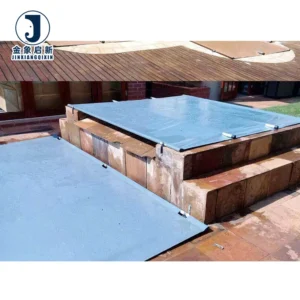
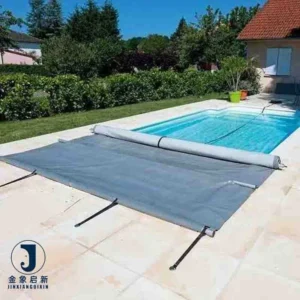
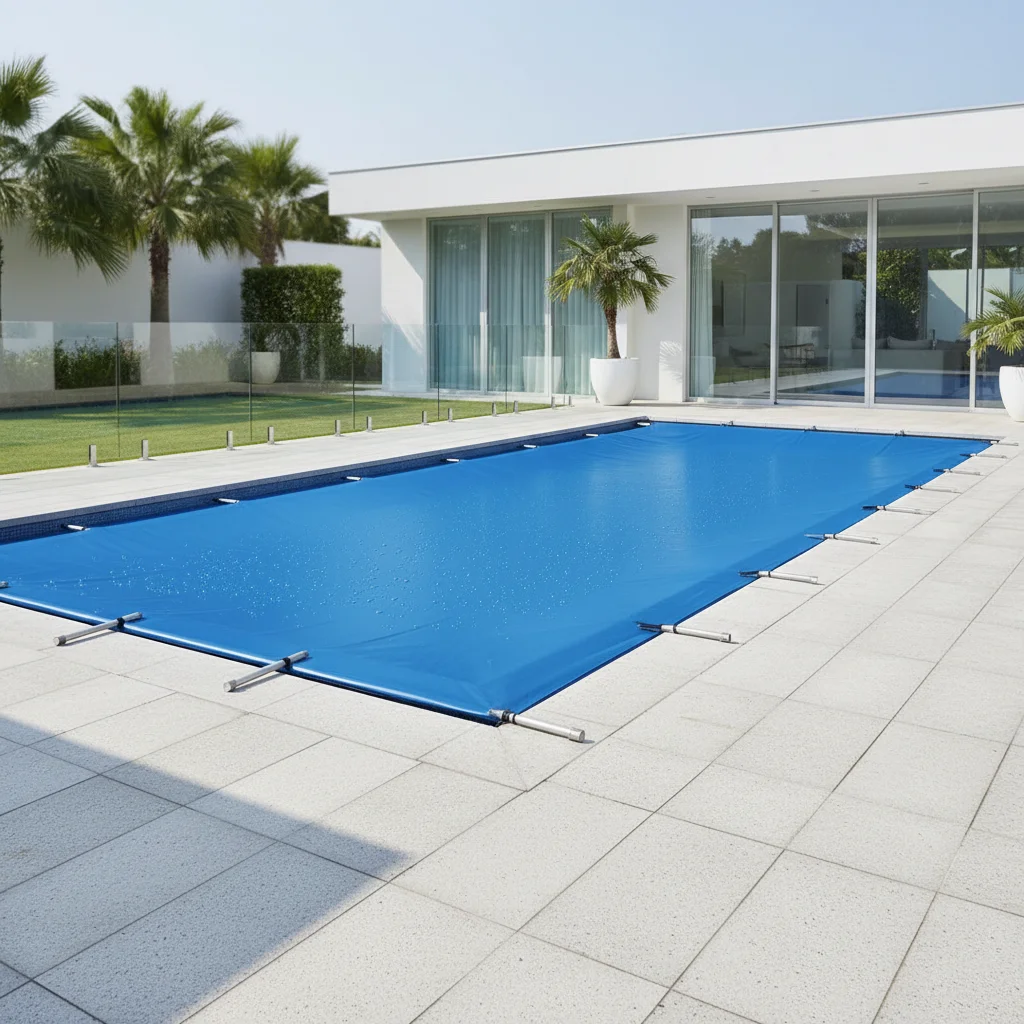
| Pool and water feature covers | Direct water contact, chlorine or chemical splash, debris shedding |
| Pet shelter and dog house covers | Abrasion from animal contact, ground moisture, temperature fluctuation |
Why Generic Tarps Fail as Pool Covers Within the First Season
A pool cover must seal the entire perimeter without gaps, and the material must resist pool chemicals and constant UV exposure simultaneously.
Pool owners often purchase off-the-shelf tarpaulins that appear waterproof but degrade rapidly when exposed to chlorine vapour and direct sunlight. The coating delaminates from the base fabric at the folds, and the hem stitching unravels under tension from the cover’s own weight when water pools on top. I have seen medium-grade covers fail at the weld lines where the fabric meets the tie-down points, leaving the pool exposed within weeks of installation [NEED_CITE: coated fabric degradation from pool chemical exposure].
Matching Fabric Weight to Pool Cover Span and Support Structure
When specifying a PVC Coated Tarpaulin for Truck and Transport Cover or pool cover application, the weight class must align with the unsupported span of the cover. A medium-weight fabric may perform adequately over a small plunge pool where the cover is supported along all edges, but will sag and collect standing water over a larger residential pool without intermediate support cables. The coating adhesion and base fabric denier together determine whether the material will resist the downward force of accumulated water or deform permanently.
Reinforced Edges Where Covers Meet Anchoring Hardware
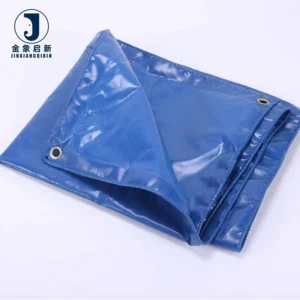
The perimeter of any pool cover experiences the highest mechanical stress, particularly at grommet locations where tie-down ropes or bungee cords attach. Without adequate hem reinforcement, the PVC coating cracks around the grommet holes after repeated tension cycles from wind uplift. The welded seam construction used in our covers distributes the load across a broader area of the base fabric, preventing the point-load failures that plague standard stitched hems.
Understanding How Coating Weight and Base Fabric Interact
The overall weight of a coated fabric results from both the PVC coating mass and the base fabric density, but these two components serve different functions. The coating provides waterproofing, chemical resistance and UV protection, while the base fabric provides tensile and tear strength. A heavier coating alone does not make the fabric stronger — it may actually reduce flexibility and increase the risk of cracking at fold points. The relationship between denier, thread count and coating thickness determines how the PVC Coated Tarpaulin for Truck and Transport Cover performs under real-world tension and environmental exposure [NEED_CITE: ISO 1421 test methods for tensile and tear strength of coated fabrics].
The Real Cost of Specifying Without Verified Material Data
Purchasing a pool cover or awning fabric based on quoted weight alone leads to on-site failures that are expensive to rectify. When the material arrives lighter than specified, the cover sags under water load and requires premature replacement. When anti-UV treatment is claimed without a supporting test report, the coating yellows and becomes brittle within a single summer season. Colour variation between rolls in the same order becomes visible once the cover is installed, requiring a full reorder to achieve a uniform appearance across the structure [NEED_CITE: batch colour consistency standards for coated fabrics].
Why Sourcing Through a Specialist Coating Facility Matters
Our facility operates three full production lines dedicated to PVC coated fabrics, with 36 sets of professional equipment supporting both roll-stock and custom cut-to-size output. The 10-person R&D team handles material selection and sample development, allowing you to confirm the fabric specification before committing to a full production run. Every roll undergoes dedicated QA/QC inspection at each production stage, with 100% pre-shipment verification confirming that the weight, colour and coating adhesion match the approved sample. This level of process control is only achievable through decades of focused experience in coated fabric manufacturing.
Documentation & Verification
- Material specification sheet confirming PVC coating type, base fabric construction and stated weight class
- Anti-UV test report matched to the treatment grade quoted for your specific order
- Pre-shipment inspection record with roll-by-roll weight verification and visual assessment
- ISO and CE certificates included with every shipment for customs and compliance purposes
- Roll packing list detailing dimensions, weight and colour reference for each unit in the order
Fabrication, Handling & Storage
- Heat-weld seams at temperatures appropriate to PVC coating thickness — test a sample piece before full production runs
- Reinforce all grommet locations with additional PVC patching to distribute tie-down loads across the medium-weight base fabric
- Store rolls horizontally on a flat surface to prevent permanent creasing of the PVC coating layer
- Allow cold-stored rolls to reach ambient temperature before unrolling to avoid coating crack damage
- Use only non-abrasive, non-solvent cleaners on the PVC surface to preserve the anti-UV treatment layer
Requesting a Specification That Fits Your Project
When you are ready to specify a PVC Coated Tarpaulin for Truck and Transport Cover or pool cover for your project, please share the total coverage dimensions, the type of support structure or anchoring system you plan to use, and the environmental exposure conditions at the installation site. If your market requires a specific flame retardant grade or compliance standard, confirm the exact classification so we can match the formulation to your regulatory requirements. We can also develop a sample piece for your approval before proceeding to full production.
Frequently Asked Questions
Q: How do you verify the weight matches the quotation when the rolls arrive?
A: Every roll undergoes pre-shipment inspection where the actual coating weight is measured and compared against the specification sheet. We provide a roll-by-roll inspection record with your shipment so you can verify that the medium-weight PVC coated tarpaulin you ordered is exactly what you received, eliminating the risk of lighter material arriving on site.
Q: Can I get a test report confirming the anti-UV treatment?
A: Yes, we provide test reports for anti-UV treatment based on the specific grade applied to your order. The test basis is documented and included with your shipment paperwork. For pool covers exposed to constant sunlight, we recommend requesting the report during the sampling stage so you can evaluate the treatment suitability for your local climate conditions.
Q: How do you ensure colour consistency when ordering multiple rolls?
A: Colour matching is controlled at the coating stage where pigment batches are measured and mixed under standardized conditions. Each production run is inspected against the approved colour reference, and rolls from the same order are grouped to ensure uniform appearance when installed side by side across a large pool or awning structure.
Q: What documentation ships with each order for compliance purposes?
A: Every shipment includes a material specification sheet, pre-shipment inspection record, roll packing list, ISO and CE certificates, and certificate of origin. For orders requiring flame retardant certification, the applicable test report is also included. This documentation package supports customs clearance and on-site compliance verification for your project.