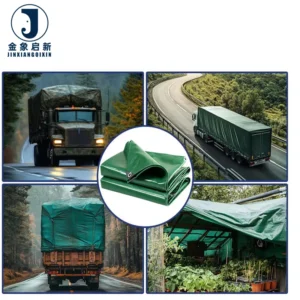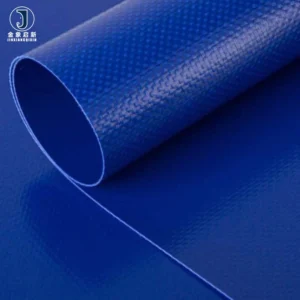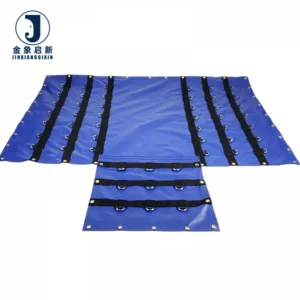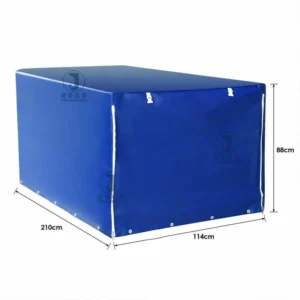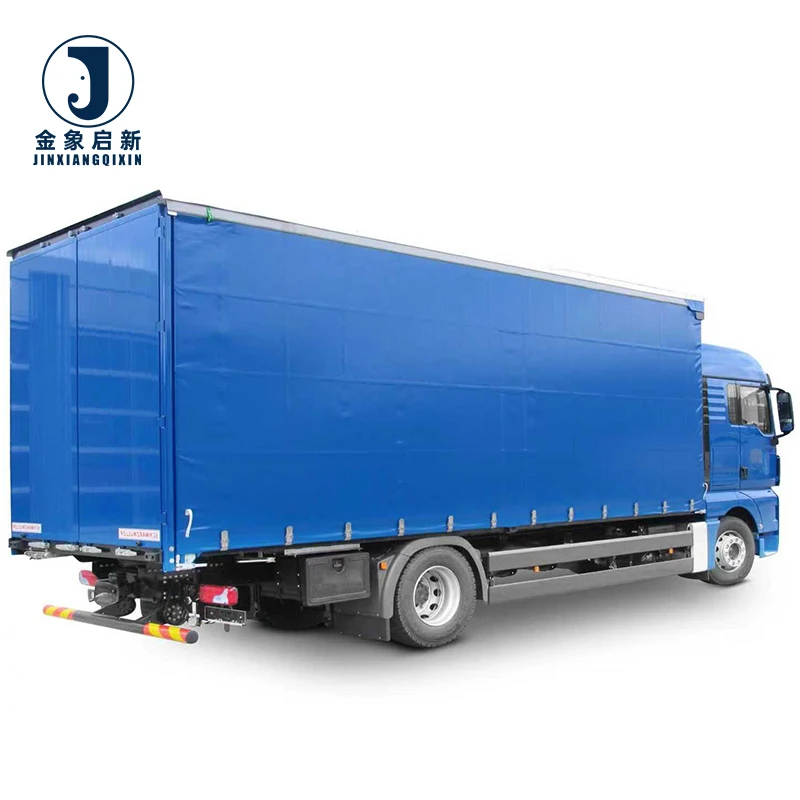
Custom Fitment Over Generic Sizing — Covers cut from model-specific templates eliminate loose fabric that flaps, abrades and fails at high-stress flex points on moving loads.
Technical Specifications
| Parameter | Value |
|---|---|
| Product Type | PVC Tarpaulin Truck Cover |
| Material | PVC coated tarpaulin |
| Surface Finish | Double-faced, uniform strength on both sides |
| Water Resistance | Water resistant, protects against water and mildew |
| UV Protection | Anti-UV treatment (grade confirmable per destination market requirement) |
| Flame Retardant | Flame retardant treatment available — confirm the grade required for your market |
| Color Options | Multiple colors available |
| Customization | Custom sizing, logo printing, advertising graphics supported |
| Standards | ISO, CE certified production facility |
Application Suitability
| Application | Exposure & Requirement |
|---|---|
| Curtain-side trailer side curtains | Constant flexing during load shift, road abrasion at contact points, prolonged UV exposure on long-haul routes |
| Flatbed truck covers | Wind lift at highway speed, tie-down strap abrasion, rain and road spray ingress prevention |
| Fleet advertising tarpaulins | Full-colour logo printing on exterior face, weather and UV exposure maintaining print legibility over distance |
| Tipper truck and container chassis covers | Heavy load contact, repeated deployment and folding, mechanical wear at fold creases |
Why a Generic-Size PVC Tarpaulin Truck Cover Fails Where Your Trailer Flexes Most
A cover that does not match your trailer’s actual dimensions transfers road vibration into the welded seams, not the fabric.
Fleet operators replace truck covers far earlier than the material itself should allow. The failure almost always starts at a seam or an eyelet — the exact locations where a poorly fitted cover concentrates stress instead of distributing it. I have reviewed returned curtains where the base fabric showed no visible degradation while the heat-welded joins had delaminated along the entire lower rail. The root cause was not the PVC formulation; it was a generic template that left excess material bunching at the corners, creating friction points that no coating weight can survive. [NEED_CITE: heat-welded seam integrity testing methods for coated fabrics]
Model-Specific Pattern Cutting Eliminates the Fit Gap
Every PVC tarpaulin truck cover produced here starts from a pattern developed against the specific trailer model drawing, not a standard width-by-length rectangle. Side curtains for tautliners, curtain-siders and sliding-post trailers each carry different tension profiles along the top rail, side buckles and lower strap anchors. The pattern accounts for these anchor positions so that eyelets and reinforced hems land precisely where the trailer frame demands them, removing the slack that causes fabric flutter on motorways.
Reinforcement Positioned at Actual Abrasion Zones
High-flex zones on a trailer side curtain — typically the lower third near the load bed and the corners where the curtain wraps around the rear posts — receive additional reinforcement layers welded directly into the PVC construction. This is not a uniform extra layer applied across the entire panel; it is targeted material added only where road vibration and load contact cause the most wear. The double-faced coating ensures that both the road-facing and load-facing surfaces carry equal tensile resistance, so the inner face does not become a weak point when cargo shifts during transit. [NEED_CITE: reinforcement placement standards for transport side curtains]
Decoding What the PVC Coating Actually Carries
The double-faced PVC coating is not merely a colour choice — it determines how the fabric behaves when the curtain is rolled, folded or stacked during loading operations. A single-faced coating leaves the base fabric exposed on one side, allowing moisture ingress and fibre abrasion from the inside. Double-faced construction encapsulates the base scrim entirely, which directly supports weld integrity because the heat-welding process fuses coating to coating rather than coating to raw yarn. Water resistance follows from this complete encapsulation. The anti-UV and flame retardant treatments are applied as additional formulation inputs — request the specific test report for the batch you are ordering to confirm these properties meet your destination market’s regulatory threshold. [NEED_CITE: PVC coating formulation and UV stabiliser test protocols]
What Happens When Fitment and Finish Are Left to Chance
A truck cover that arrives in a generic size forces the installation crew to improvise — pulling fabric tighter at some points, leaving it loose at others. This uneven tension accelerates eyelet pull-out and creates standing water pockets on horizontal surfaces after rain. I have seen fleet operators receive multiple covers in a single shipment where the colour varied visibly between rolls, making the fleet look mismatched when parked together at a depot. Batch-to-batch colour consistency is not a cosmetic concern; it signals whether the coating formulation was controlled throughout the production run or whether raw material batches were mixed without verification. [NEED_CITE: colour consistency measurement methods for coated fabric batches]
Why Transport Operators Source This PVC Tarpaulin Truck Cover Here
Three full production lines and 36 sets of professional equipment support the volume demands of fleet-scale orders without sacrificing per-cover pattern accuracy. The 10-person R&D team develops trailer-specific templates and samples within days, allowing you to confirm fit and finish before committing to a full production run. Dedicated QA/QC inspection runs at every production stage, with 100% pre-shipment checking that covers dimensional accuracy against your trailer model template, GSM verification, seam strength and colour consistency across all rolls in your order. Nearly 30 years of coated fabric process control means the coating weight and adhesion values stated on your specification sheet are the values you receive on the finished cover.
Documentation & Verification
- Material specification sheet confirming base fabric denier, coating weight and PVC formulation per roll
- UV and flame retardant test reports matched to the specific production batch dispatched
- Pre-shipment inspection record with dimensional check against your trailer model template
- Roll packing list with individual cover dimensions, eyelet count and hem finishing detail
- Certificate of origin and customs documentation for international transport shipments
Fabrication, Handling & Storage
- Heat-weld seams using temperature settings matched to the double-faced PVC coating thickness for full fusion
- Reinforce eyelet positions at high-flex zones with additional PVC patches before punching
- Store rolls upright on pallets to prevent permanent creasing across the PVC coated surface
- Unfold covers at ambient temperature to avoid stress cracking in cold-weather conditions
- Clean with mild detergent only; solvents will degrade the PVC coating and affect water resistance
- Repair minor field damage with compatible PVC adhesive patches applied to both coated faces
Requesting a Quotation
Provide your trailer make, model and year along with the anchor-point diagram or photographs of the current cover installed on the vehicle. Specify whether you require anti-UV or flame retardant certification and the regulatory standard your destination market enforces. Indicate the quantity per trailer model, colour references if matching an existing fleet, and whether logo printing is required on the exterior face.
Frequently Asked Questions
Q: How do I provide my trailer model details for a custom-fit truck cover?
A: Send the trailer manufacturer, model designation and production year along with photographs or a dimensioned sketch of the existing cover showing eyelet positions, buckle placements and hem lengths. If the trailer is a custom build, provide the frame drawing with anchor-point locations so the pattern can be developed accurately before sampling.
Q: What is the difference between a generic-size cover and a model-specific side curtain?
A: A generic cover is cut to a standard rectangle that must be tensioned unevenly across the trailer frame, creating stress concentrations at seams and eyelets. A model-specific curtain follows the exact contour and anchor layout of your trailer, distributing load forces evenly and eliminating the fabric flutter that accelerates abrasion on motorways.
Q: Can you match the colour of existing covers already installed on my fleet?
A: Provide a physical sample or a RAL colour reference from the existing cover. The production team will formulate a coating batch to match and send a swatch for your approval before full production begins, ensuring visual consistency across the entire fleet when vehicles are parked or operating together.
Q: Do the flame retardant and anti-UV claims come with test reports for my batch?
A: Yes. Request the specific grade or standard your market requires at the inquiry stage. The corresponding test report, referencing the exact production batch number on your shipment, will be included in the dispatch documentation so your compliance team can verify the treatment independently.
Q: What reinforcement is applied at the flex points where side curtains experience the most abrasion?
A: High-flex zones — typically the lower panel and rear-corner wrap areas — receive additional PVC layers welded into the double-faced construction. Eyelet positions in these zones are reinforced with welded patches before punching to prevent pull-out under repeated tie-down tension and road vibration.