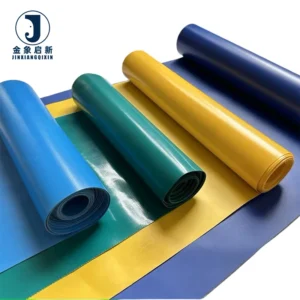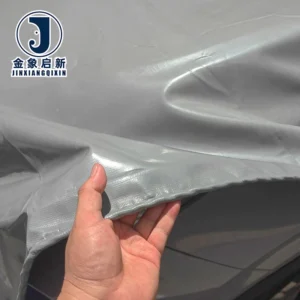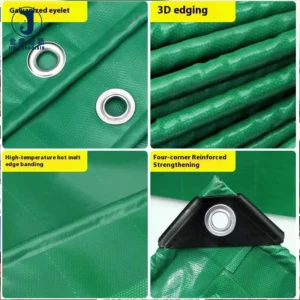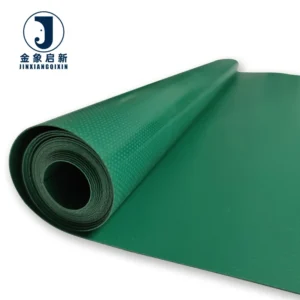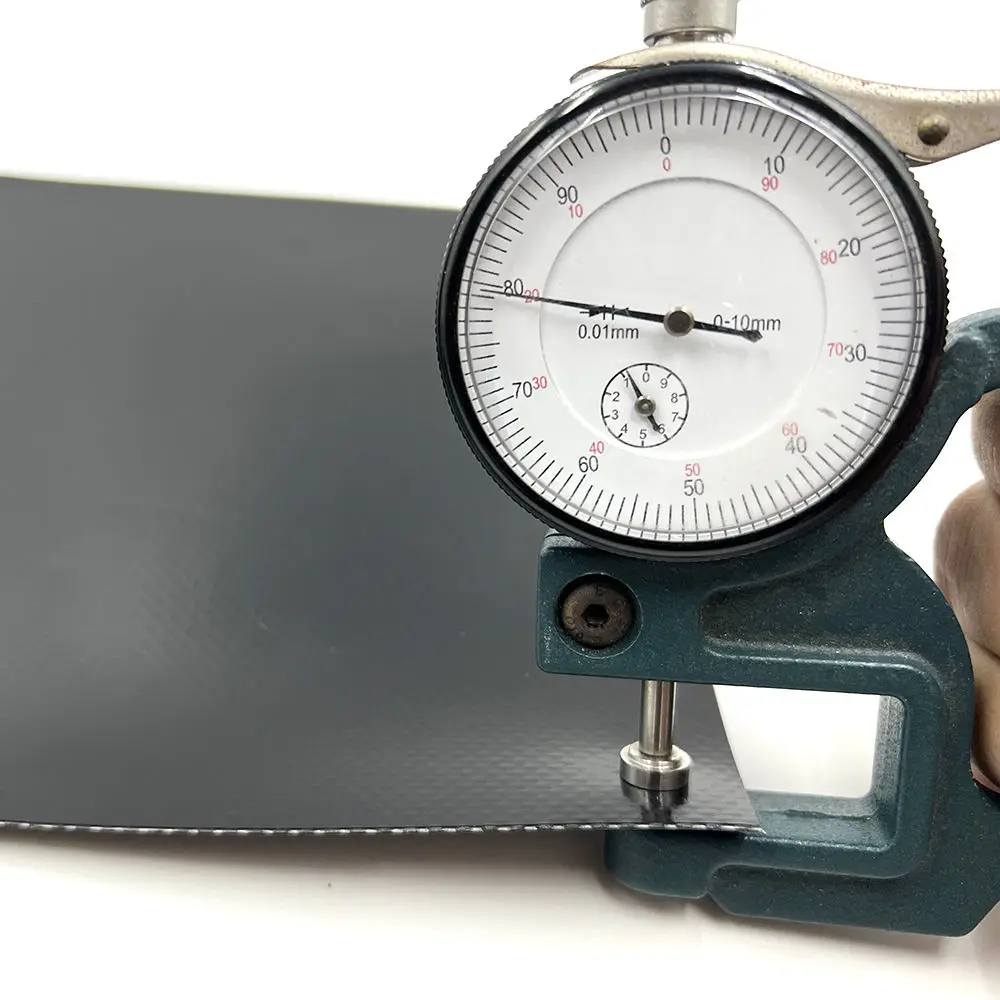
Proven Process Control — three full production lines and 36 sets of equipment maintain consistent coating weight and adhesion across every PVC Knife Coated Tarpaulin Heavy Duty Truck Cover Fabric roll produced.
Technical Specifications
| Parameter | Value |
|---|---|
| Product Type | PVC Knife Coated Tarpaulin Roll |
| Coating Method | Knife coated |
| Coating Material | PVC |
| Color | Gray |
| Tensile Strength | Excellent tensile resistance (test basis not stated in source) |
| Tear Strength | Excellent tearing resistance (test basis not stated in source) |
| Peeling / Adhesion Strength | Excellent peeling resistance (test basis not stated in source) |
| Flame Retardant Grade | Fire retardant (grade not stated in source — confirm the grade required for your market) |
| UV Treatment | UV resistance (test basis not stated in source — confirm applicable standard) |
| Anti-Bacterial / Anti-Mildew | Antibacterial and mildew proof |
| Oil & Stain Resistance | Yes |
| Acid & Alkali Resistance | Yes |
| Temperature Range | High temperature and cold resistance (values not stated in source) |
| Anti-Oxidation / Weather Resistance | Yes |
| Flexibility | Highly flexible, resistant to cracking |
| Self-Cleaning | Yes |
| Welding Options | HF, Hot Air, Sewing |
| Waterproof | Yes |
Application Suitability
| Application | Exposure & Requirement |
|---|---|
| Flatbed truck covers | Constant flexing at tie-down points, road debris impact, UV and weather exposure during long-haul transit |
| Curtain-side trailer fabric | Repeated folding and unfolding, abrasion against load edges, wind flap fatigue at highway speeds |
| Transport fleet tarpaulin | Multi-vehicle colour consistency, tie-down tension across varying load profiles, yard storage between runs |
| Portable storage structure covers | Static tension over frames, wind uplift loading, prolonged sun and rain exposure at logistics yards |
| Shade systems at depots | UV saturation, thermal cycling, requirement for clean appearance in visible yard areas |
Why Welded Seams Fail Before the Fabric Does on Truck Covers
Seam failure at flex points is the most common reason truck covers are replaced prematurely, not the base fabric wearing through.
When a PVC Knife Coated Tarpaulin for truck and trailer covers is tensioned over a shifting load, the highest stress concentrates at the welded or sewn joints — particularly where eyelet reinforcement meets the main panel. If the coating adhesion is weak or the welding temperature is mismatched to the material, the seam delaminates or cracks while the surrounding fabric remains intact. Fleet operators then face a choice: patch the seam repeatedly or replace the entire cover. [NEED_CITE: common failure modes in heavy-duty transport tarpaulin seams per industry field reports]
Crack Resistance at the Flex Points That Matter Most
Every time a truck cover is thrown over a load and strapped down, the fabric bends sharply at the edges and corners. PVC Knife Coated Tarpaulin for truck and trailer covers with knife-coated construction maintains flexibility through repeated folding cycles without developing micro-cracks along the fold line. This matters most at the hem and eyelet zones where the tarp is pulled tight against ratchet straps.
The gray PVC coating bonds to the base fabric through the knife-over-roll process, forcing the compound into the weave rather than sitting on the surface. This penetration is what gives the material its peeling resistance — a property that directly determines whether a high-frequency weld will hold under road vibration or start to separate after a few trips.
How Road Exposure Shapes the Material Requirement
Long-haul transport exposes covers to conditions that stationary structures never face: diesel exhaust residue, road salt spray, gravel impact at speed, and rapid temperature swings between daytime sun and overnight cold. The acid and alkali resistance specified for this fabric addresses chemical exposure from road treatment and industrial yard environments. [NEED_CITE: environmental stress factors on transport covers in temperate and arctic climate corridors]
Oil and stain resistance keeps the surface cleanable after contact with hydraulic fluid or cargo residue — important for fleet operators who need covers to present a professional appearance at delivery points. The self-cleaning surface characteristic reduces the maintenance burden between runs, where a full wash-down is rarely practical.
Reading the Specification Sheet Beyond the Headline Numbers
Tensile strength and tear strength are often quoted as single values, but on a truck cover the real performance depends on how those properties interact with the coating bond. A fabric with high tensile resistance but low peeling strength will separate at the weld before the base yarns reach their breaking point. That is why this PVC Knife Coated Tarpaulin for truck and trailer covers lists peeling resistance as a separate parameter — it is the property that determines weld integrity.
The knife-coated process produces a thicker, more uniform coating layer compared to dip-coated alternatives, which directly supports the high-frequency and hot-air welding options. When the coating is consistent through the cross-section, the welder can set a single temperature profile and maintain it across the full seam length, rather than adjusting for thin spots.
Temperature resistance across both high and cold ranges means the fabric does not become brittle in winter yard conditions or soften excessively when a dark-coloured cover sits in direct sun. This thermal stability is what allows the material to be specified for fleets operating across varying climate zones without changing the cover stock seasonally.
The Cost of Choosing the Wrong Specification for Your Fleet
Ordering truck cover fabric based on the lowest quoted GSM often leads to covers that need replacement within the first year of service. The material may pass an initial visual inspection, but under the cyclic loading of highway transport, an under-specified base fabric will develop tears that propagate quickly from eyelet holes. [NEED_CITE: premature replacement cycles in fleet tarpaulin procurement where specification verification was omitted]
Fire retardant claims without a stated grade create a different problem: the cover may pass the supplier’s internal check but fail the compliance inspection at the fleet’s operating jurisdiction. Confirming the applicable standard — whether M2, B1, NFPA 701 or another regional requirement — before production begins avoids costly re-ordering. Batch colour variation across multiple rolls becomes visible when covers are installed on adjacent vehicles in a fleet, making colour consistency verification at pre-shipment inspection essential.
What This Supply Source Brings to Your Truck Cover Programme
Nearly 30 years of focused coated fabric production means the process parameters for knife-coated PVC are established and repeatable, not experimental. Three full production lines and 36 sets of professional equipment support bulk roll output with consistent lead times for fleet-scale orders. The 10-person R&D team handles custom width and colour requests, developing samples within days when a fleet needs to match an existing cover colour or fit a new trailer model. Dedicated QA/QC runs at every production stage, with 100% inspection before shipment — not a spot-check on one roll from the batch. Custom sizing to specific trailer dimensions is supported, with reinforced hems and eyelet placement matched to the tie-down configuration of each vehicle type.
Documentation & Verification
- Material specification sheet stating exact coating weight, base fabric construction, and colour reference per roll
- Fire retardant and UV test reports matched to the grade and standard applicable in your operating market
- Pre-shipment inspection record documenting GSM verification, colour consistency, and surface quality roll by roll
- Certificate of origin and customs documentation prepared for cross-border transport cover shipments
- Roll packing list with individual roll weights and dimensions for container loading planning
Fabrication, Handling & Storage
- HF welding recommended for high-stress seams on knife-coated PVC; set temperature to coating thickness and test peel before full production run
- Reinforced hems with double-fold construction distribute tie-down load across a wider area of the gray coated surface
- Store rolls upright on pallets in covered, ventilated areas to prevent compression marks on the PVC coating
- Allow cold-stored rolls to reach ambient temperature before unrolling to avoid cracking the coated surface
- Clean with mild detergent and soft brush; avoid solvents that attack the PVC coating bond
- Cut panels with allowance for hem depth and eyelet reinforcement zone before welding or sewing
Before You Request a Quote
To specify the right PVC Knife Coated Tarpaulin for truck and trailer covers for your fleet, provide the trailer model or dimensions, the tie-down method used, and the climate range your vehicles operate in. If your jurisdiction requires a specific fire retardant grade for transport covers, state the standard so the correct treatment is applied. Indicate whether you need rolls for in-house fabrication or cut-to-fit finished covers with hem and eyelet reinforcement, and the quantity of vehicles to be covered.
Frequently Asked Questions
Q: How is GSM verified on arrival against the quoted specification for truck cover fabric?
A: Each roll is weighed and measured during pre-shipment inspection, with the actual GSM recorded against the specification sheet. The inspection report accompanies the shipment so you can cross-check on receipt. If your procurement policy requires independent third-party testing, this can be arranged before dispatch.
Q: What fire retardant grade and UV test basis can be supplied for transport fleet compliance?
A: Fire retardant treatment is available in multiple grades. The applicable standard depends on your operating market — confirm whether M2, B1, NFPA 701, DIN 4102 or another classification is required. UV resistance test reports are supplied based on the treatment level specified. Request the test basis that matches your fleet’s compliance framework.
Q: Which welding method is recommended for truck cover seams at flex points?
A: High-frequency welding produces the strongest bond for knife-coated PVC at high-stress joints, as it fuses the coating through the full thickness. Hot-air welding is suitable for field repairs and longer straight seams. Sewing with sealed thread is used where mechanical fastening is preferred. The choice depends on your fabrication equipment and seam geometry.
Q: How are eyelet spacing and reinforced hems specified for tie-down loads on different trailer models?
A: Eyelet spacing and hem reinforcement are set based on the trailer dimensions and the tie-down strap configuration your fleet uses. Provide the vehicle drawing or measurements along with strap positions, and the hem width, reinforcement layer count, and eyelet pitch will be matched to distribute load without fabric tearing.
Q: How is batch colour consistency controlled across multiple rolls for a fleet cover order?
A: All rolls in a single fleet order are produced in one production run using the same coating batch. Colour is checked against the approved reference at multiple points during production and again at final inspection. Rolls showing deviation outside the agreed tolerance are removed before packing.