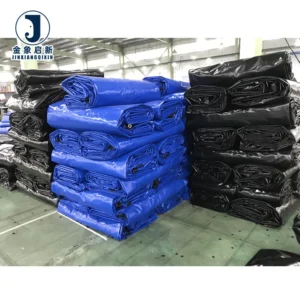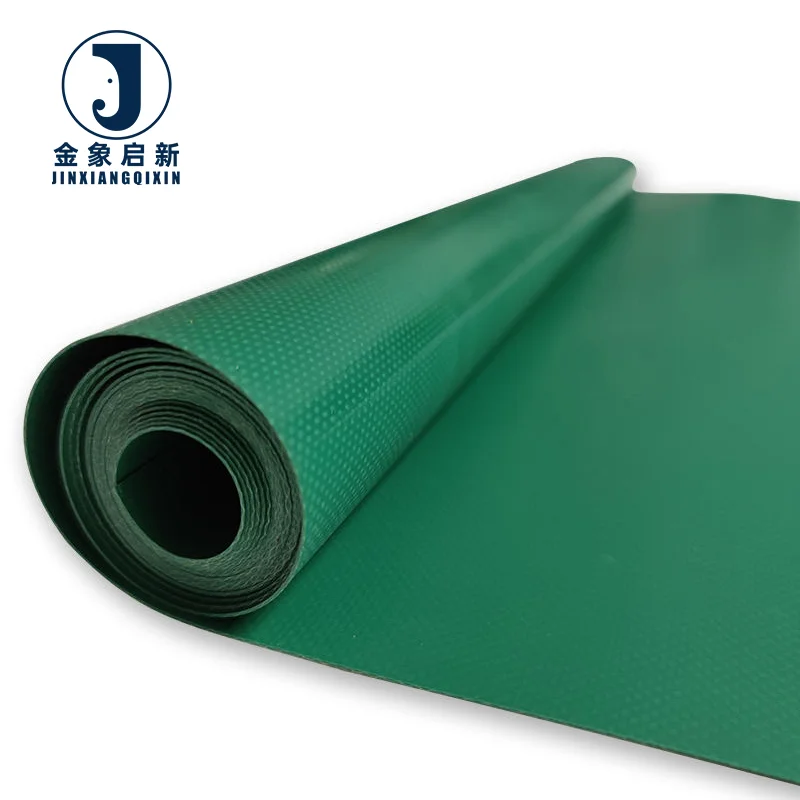
Roll-to-Roll Consistency — three full production lines and 36 sets of coating equipment maintain tight GSM tolerance and colour match across every roll shipped, eliminating visible variation once fabricated side by side.
Technical Specifications
| Parameter | Value |
|---|---|
| Product Type | PVC Coated Tarpaulin Roll |
| Material | PVC coating on polyester base fabric |
| Yarn Count Options | 500D×840D / 500D×1000D / 1000D×1000D / 1000D×1300D / 1300D×1300D / 1000D×2000D |
| Weight Range | 350 / 400 / 420 / 500 / 600 / 650 / 750 / 900 GSM |
| Total Thickness | 0.29mm / 0.32mm / 0.38mm / 0.44mm / 0.46mm / 0.55mm / 0.65mm |
| Mesh Count | 30×19 / 20×20 / 30×15 |
| Tensile Strength (Warp) | 1650N to 3900N (test basis not stated in source) |
| Tensile Strength (Weft) | 1600N to 3500N (test basis not stated in source) |
| Brittle Temperature | ≤ -50 to -60 °C |
| Softening Temperature | ≥ 80 °C |
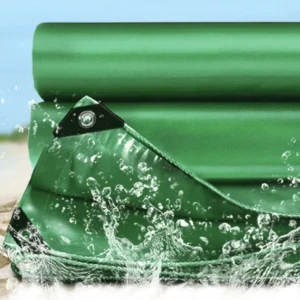
| Key Features | Water resistant, waterproof, available in flame retardant grades — confirm the grade required for your market, available in anti-UV treatment — confirm the test basis required for your application |
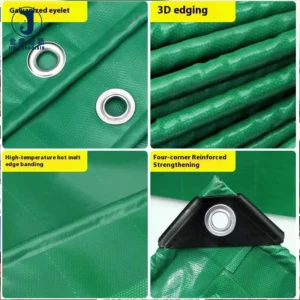
| Edge Finishing | High temperature heat sealed seamless edge wrapping |
| Eyelet | 3cm enlarged aluminum alloy buttonhole |
| Corner Reinforcement | Reinforced corners on all sides |
| Rope | 5mm thick rope without splicing |
| Standards | ISO, CE (specific certificate numbers not provided) |
Application Suitability
| Application | Exposure & Requirement |
|---|---|
| Truck side curtain fabric | Constant flexing at load points, road spray, UV exposure, abrasion from cargo contact |
| Flatbed trailer covers | Wind lift forces, tie-down tension at eyelets, multi-directional pull during transit |
| Container and load wrapping | Rain ingress prevention, friction against load edges, long-haul weather cycling |
| Industrial shelter and site covers | Prolonged outdoor standing, wind load on large unsupported spans, temperature fluctuation |
| Machine and equipment wraps | Dust and moisture ingress, handling and re-folding abrasion, storage yard UV exposure |
When Welds Fail Before the Fabric Does
Heat-sealed edge wrapping prevents the most common failure point on truck covers — seam separation under flex load.
A PVC coated tarpaulin roll may show excellent tensile values on paper, yet the fabricated cover fails first at the welded seam where the load flexes most. This happens when heat-sealing temperature or pressure does not match the coating weight, leaving a weak bond that opens under road vibration. Our high temperature heat sealed seamless edge wrapping is calibrated to the specific GSM grade, producing a bond that holds through repeated flex cycles. [NEED_CITE: heat seal peel strength testing methods for PVC coated polyester fabrics per ISO 1421]
Coating Adhesion and Seam Integrity on the Production Line
Coating weight and adhesion control across three production lines ensures that every roll of PVC coated tarpaulin for truck and transport applications leaves the factory with consistent peel strength between the PVC layer and the polyester base fabric. When adhesion is uniform, fabricators can set heat-sealing parameters once and hold them across the entire batch, rather than adjusting press time roll by roll. This eliminates the seam cracking that appears after a few loading cycles on poorly bonded material.
How Base Fabric Weave Dictates Tear Propagation
The available yarn count range from 500D×840D through 1000D×2000D determines how a puncture or cut propagates through the fabric under load. A tighter weave with higher denier yarns resists tear spread in both warp and weft directions, which matters most at tie-down eyelets where stress concentrates. Mesh count options of 30×19, 20×20 and 30×15 allow buyers to balance flexibility against dimensional stability for the specific trailer geometry they are covering. [NEED_CITE: tear resistance test methods for coated fabrics]
Reading GSM and Denier Together
GSM alone tells you how much material is in a square metre, but not how that weight is distributed between base fabric and coating. A 650 GSM roll built on 1000D×1000D yarns with a balanced coating will resist tearing differently than a 650 GSM roll on a lighter base with heavier coating applied to reach the target weight. The warp and weft tensile values — ranging from 1650N to 3900N and 1600N to 3500N respectively — reflect this balance. Selecting the right combination means matching yarn count and mesh density to the flex and abrasion conditions the truck cover will face. The brittle temperature of ≤ -50 to -60 °C and softening point of ≥ 80 °C define the usable thermal window, ensuring the PVC coating remains flexible in winter dispatch yards and stable under summer sun on loaded trailers.
The Cost of Overlooking Batch Consistency
Colour shift between rolls in the same order becomes visible the moment panels are installed side by side on a fleet of trailers. When one roll weighs lighter than the quoted GSM, the fabricated cover stretches and fatigues faster than its neighbours, forcing early replacement on a single vehicle while the rest of the fleet runs normally. Flame retardant treatment claimed without a supporting test report can halt a site inspection or delay a port clearance, turning a material saving into a compliance penalty. [NEED_CITE: pre-shipment inspection standards for coated textile rolls]
Why Buyers Source Rolls from This Facility
A 10-person R&D team handles material selection, pattern printing, custom sizing and sample development, meaning roll specifications can be adjusted before the production run rather than after a failed trial. Dedicated QA and QC checkpoints at every production stage with full inspection before shipment ensure that GSM, colour and coating weight are verified roll by roll, not sampled from the first roll only. Three full production lines and 36 sets of professional equipment provide the capacity to fill container orders within standard lead times while maintaining batch consistency. Samples for custom widths, colours and treatments are developed within days, allowing buyers to confirm fabrication behaviour before committing to the full order.
Documentation & Verification
- Material specification sheet stating GSM, base fabric denier and coating weight per roll
- Pre-shipment inspection record confirming roll-to-roll colour and weight consistency
- UV and flame retardant test reports supplied where applicable to the ordered grade
- Roll packing list with net weight and roll dimensions for container loading checks
- Certificate of origin and customs documentation for cross-border shipment clearance
Fabrication, Handling & Storage
- Set heat-seal temperature to match the specific GSM grade to avoid weak bonds at edge wrapping points
- Use the 3cm aluminum alloy buttonhole spacing specified for the roll’s tensile rating to distribute tie-down loads evenly
- Store rolls upright on pallets to prevent flat-spot deformation on the outer coating layer
- Unroll at ambient temperature above the brittle threshold of ≤ -50 to -60 °C to avoid micro-cracking
- Clean with mild detergent only — solvents can degrade the PVC coating surface and reduce water resistance
Starting a Roll Specification Inquiry
Provide the target GSM, the trailer or shelter dimensions you are covering, and the environmental exposure your end users face — such as UV intensity, winter low temperatures or flame retardant compliance requirements. Specify whether you need stock widths or custom roll widths, and confirm the annual volume so production can be scheduled across available line capacity.
Frequently Asked Questions
Q: How is GSM verified on arrival against the quotation specification?
A: Each roll undergoes weight sampling during the pre-shipment inspection, and the recorded values are documented on the inspection report that ships with the order. Buyers can cross-check these figures against the roll packing list and conduct their own scale verification on arrival to confirm the quoted GSM was maintained throughout the batch.
Q: What UV test basis supports the anti-UV claim for long-haul outdoor exposure?
A: Anti-UV treatment is available in multiple grades depending on the target market and exposure duration. We provide the specific test report for the grade ordered, so buyers can verify the treatment level matches their regional climate requirements rather than relying on an unqualified claim.
Q: Can truck covers be cut to fit specific trailer models rather than generic sizes?
A: Yes. Custom roll widths and lengths are produced to match specific trailer model dimensions, reducing waste at the fabrication stage and ensuring the finished cover fits the vehicle profile without excess material that flaps and abrades during transit.
Q: How is colour consistency maintained across multiple rolls in the same order?
A: Colour matching is controlled at the coating stage with in-process checks on every roll. The pre-shipment inspection includes a side-by-side visual comparison under standard lighting, and results are recorded before the order is packed and dispatched.
Q: What are the heat-sealing and eyelet reinforcement options for high-flex tie-down points?
A: The standard configuration includes high temperature heat sealed seamless edge wrapping, 3cm enlarged aluminum alloy buttonholes and reinforced corners on all sides. These work together to distribute tie-down tension and prevent seam separation at the points where the cover flexes most under load.