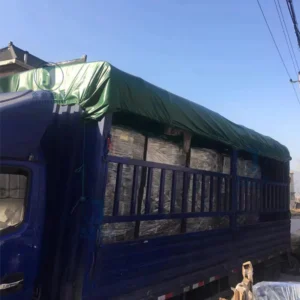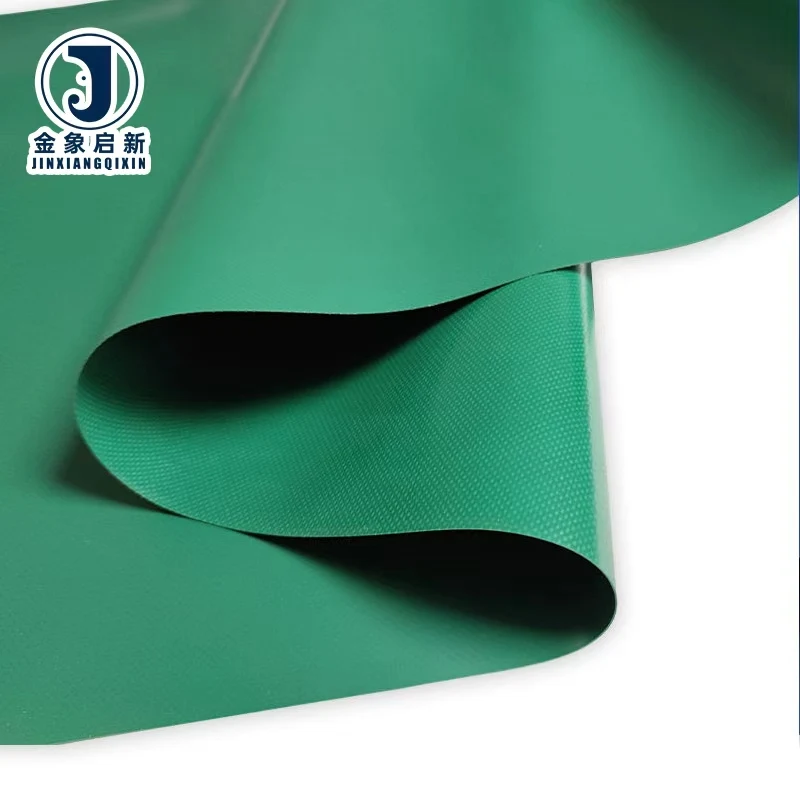
Truck-Covering Focus — roll stock cut and finished to exact trailer dimensions, eliminating generic sizing that leaves gaps at the corners and slack along the rails.
Technical Specifications
| Parameter | Value |
|---|---|
| Product Type | PVC Coated Tarpaulin Roll |
| Material Composition | PVC coating on polyester base fabric |
| Base Fabric Denier | 500D×500D (510Gsm variant) |
| Density | 30×19 (510Gsm variant) |
| Total Thickness | 0.38 mm (510Gsm variant) |
| Tensile Strength — Warp | 2050 N |
| Tensile Strength — Weft | 1900 N |
| Temperature Range — Brittle Point | ≤ −50 °C to −60 °C |
| Temperature Range — Softening Point | ≥ 80 °C |
| Melting Point | 212 °C |
| Edge Construction | High-temperature heat-sealed seamless edge wrapping |
| Eyelet Specification | 3 cm enlarged aluminum alloy buttonhole |
| Corner Reinforcement | Reinforced corners on all sides |
| Rope Reinforcement | 5 mm thick rope, no splicing |
| Key Features | Water-resistant, anti-UV treatment available, flame retardant grades available (confirm grade for your market) |
Application Suitability
| Application | Exposure & Requirement |
|---|---|
| Flatbed trailer side curtains | Continuous flexing at load points, road abrasion, tie-down tension on eyelets |
| Box truck top covers | Standing water, UV exposure, wind uplift during transit |
| Container roof tarps | Puncture from debris, thermal expansion and contraction across climates |
| Machinery and equipment covers on trucks | Impact from shifting loads, vibration wear at contact points |
| Custom-fit trailer enclosures | Precise dimension match to vehicle model, reinforced hems for repeated removal |
Why a 510Gsm PVC Coated Tarpaulin Roll for Truck Cover May Still Fail at the Seam
Fabric strength means nothing if the welded seam gives way before the cloth does.
Most tarpaulin failures on trucks do not happen in the middle of the panel. They happen where two sheets are joined and the load flexes most — at the hem, at the eyelet row, at the corner patch. A 510Gsm PVC Coated Tarpaulin Roll for Truck Cover that arrives with underweight coating will peel at the weld under repeated tension cycles, even when the base fabric itself holds. [NEED_CITE: weld seam integrity versus base fabric tensile per ISO 1421 test methods]
I have seen heavy-grade coated rolls fail at the weld line while lighter fabric beside it remained intact. The issue is rarely the GSM figure on the label — it is the coating adhesion and the heat-seal parameters used during fabrication.
Tensile Values That Matter When the Load Shifts
The 2050 N warp and 1900 N weft tensile readings on the 510Gsm PVC Coated Tarpaulin Roll for Truck Cover indicate how much direct pull the fabric can take before rupture. On a flatbed trailer rounding a corner, the side curtain experiences diagonal force that tests both axes simultaneously. A balanced warp-to-weft ratio keeps the fabric from splitting along a single thread line. The 500D×500D base fabric at 30×19 density provides a grid that distributes stress across multiple yarn intersections rather than concentrating it at one point.
Edge Construction That Survives Tie-Down Straps
The heat-sealed edge wrapping on this PVC coated tarpaulin roll prevents the coating from lifting at cut edges — a common starting point for delamination on truck covers that are removed and reinstalled frequently. The 3 cm enlarged aluminum alloy eyelets sit inside reinforced corners on all sides, spreading tie-down load across a wider patch area. Without this reinforcement, repeated strap tension works the eyelet loose until the surrounding fabric tears in a radial pattern.
Reading the Specification Sheet Beyond the GSM Number
A 510Gsm (15OZ) weight grade tells you how much PVC and polyester went into each square metre, but it does not tell you how those materials interact. The 0.38 mm thickness on this variant reflects the combined coating on both faces of the 500D base cloth. Coating weight and base denier must move together — a heavier coat on a lighter base creates stiffness that cracks in cold weather, while a light coat on a heavy base leaves the weave exposed to abrasion. The brittle temperature of ≤ −50 °C means the PVC compound retains flexibility on winter routes through northern corridors, reducing the risk of edge cracking when the tarp is folded in freezing conditions. The softening point at ≥ 80 °C confirms the material will not sag or stick to itself when a loaded truck sits in direct summer sun. [NEED_CITE: relationship between coating thickness and low-temperature flexibility in PVC coated polyester]
What Happens When Roll-to-Roll Consistency Breaks Down
A fleet operator ordering multiple rolls of PVC coated tarpaulin for truck cover fabrication expects every roll in the shipment to cut, weld and colour-match identically. When one roll runs lighter on coating weight, it welds at a different temperature, producing seams that are either under-fused or burned through. When colour shifts between rolls, the finished truck covers on the same trailer look mismatched once installed side by side — a visible problem for branded fleets. These inconsistencies are not caught by a GSM spot-check on a single sample; they require roll-by-roll inspection before the container is sealed. [NEED_CITE: batch colour consistency standards for coated fabrics in fleet applications]
Why Fabricators Choose This Roll Stock
Three full production lines and 36 sets of professional equipment maintain coating weight control across long production runs, keeping GSM variation within tolerance from the first roll to the last. The 10-person R&D team develops custom widths and cut-to-model samples within days, so transport equipment builders can confirm fit before committing to a bulk order. Every roll passes 100% pre-shipment inspection with individual verification of weight, colour and coating adhesion — not a sampling protocol that leaves defects in the middle of a container load. Decades of focus on PVC coated fabric mean the production team adjusts coating formulation for specific end uses, whether the roll is destined for a side curtain that flexes constantly or a top cover that sits flat.
Documentation & Verification
- Material spec sheet confirming 510Gsm, 500D×500D base and 0.38 mm thickness per roll
- Pre-shipment inspection record with individual roll weight and visual check results
- UV and flame retardant test reports provided for treated grades upon request
- Roll packing list with batch numbers for colour traceability across the order
- ISO and CE certificates supporting customs clearance and project compliance
Fabrication, Handling & Storage
- Heat-seal at temperatures matched to the 0.38 mm coating thickness to ensure full adhesion without burning through the PVC layer.
- Space 3 cm aluminum alloy eyelets at intervals matched to tie-down strap width for even load distribution along the hem.
- Store rolls upright on a flat surface to prevent permanent creasing in the 500D polyester base fabric.
- Allow cold-stored rolls to reach ambient temperature before unrolling to avoid cracking the PVC coating at brittle temperatures.
- Clean with mild detergent only — solvents degrade the PVC surface and reduce water resistance over time.
- Plan cutting layout across the roll width to minimise offcut waste and reduce the number of welded joins on each truck cover.
Specifying Your Truck Cover Roll Order
Tell us the trailer models in your fleet, the operating climate range, and whether you need roll stock only or finished covers cut to vehicle dimensions. If your market requires a specific flame retardant grade, state the standard so we can confirm availability and provide the matching test report. Share your target colour reference and annual volume so we can plan batch-consistent production runs.
Frequently Asked Questions
Q: How do I verify GSM on arrival matches the quotation for my truck cover order?
A: Every roll ships with a pre-shipment inspection record stating the measured weight per square metre. You can cross-check this against your purchase order specification. We also retain production batch records so any roll in your shipment can be traced back to its coating run for independent verification.
Q: Can the tarpaulin be cut and finished to fit my specific trailer model dimensions?
A: Yes. Our R&D team develops cut patterns matched to your exact vehicle model, including side curtain panels, top covers and corner pieces. We produce samples first for your approval, then replicate the confirmed dimensions across the full production run with heat-sealed edges and reinforced eyelets in position.
Q: What eyelet spacing and hem reinforcement options are available for tie-down systems?
A: Standard configuration includes 3 cm enlarged aluminum alloy eyelets with reinforced corners on all sides and 5 mm rope hemming. Spacing can be adjusted to match your tie-down hardware layout. Send us your strap configuration and we will confirm the eyelet pattern before production begins.
Q: How do you ensure colour consistency across multiple rolls in a fleet-scale order?
A: Rolls for a single order are produced in the same coating batch using matched pigment formulation. Each roll is visually inspected against the batch reference before packing. The roll packing list includes batch numbers so you can trace any colour query back to the specific production run.
Q: What documentation accompanies shipment for customs and quality verification?
A: Your shipment includes a material specification sheet, pre-shipment inspection record, roll packing list with batch tracking, certificate of origin, and ISO and CE certificates. Flame retardant and UV test reports are included where applicable to the grade you specified during the inquiry stage.