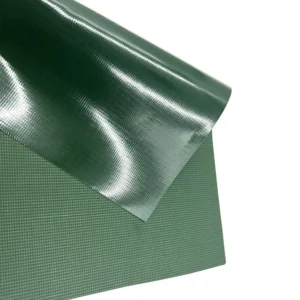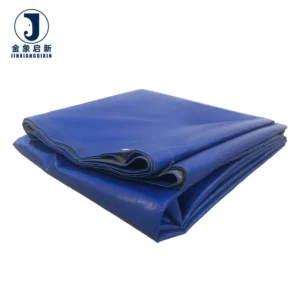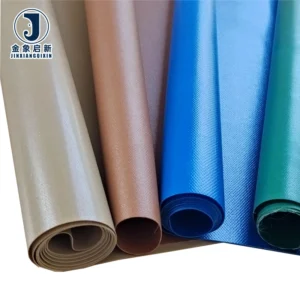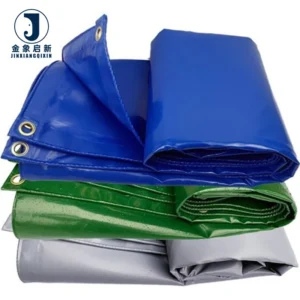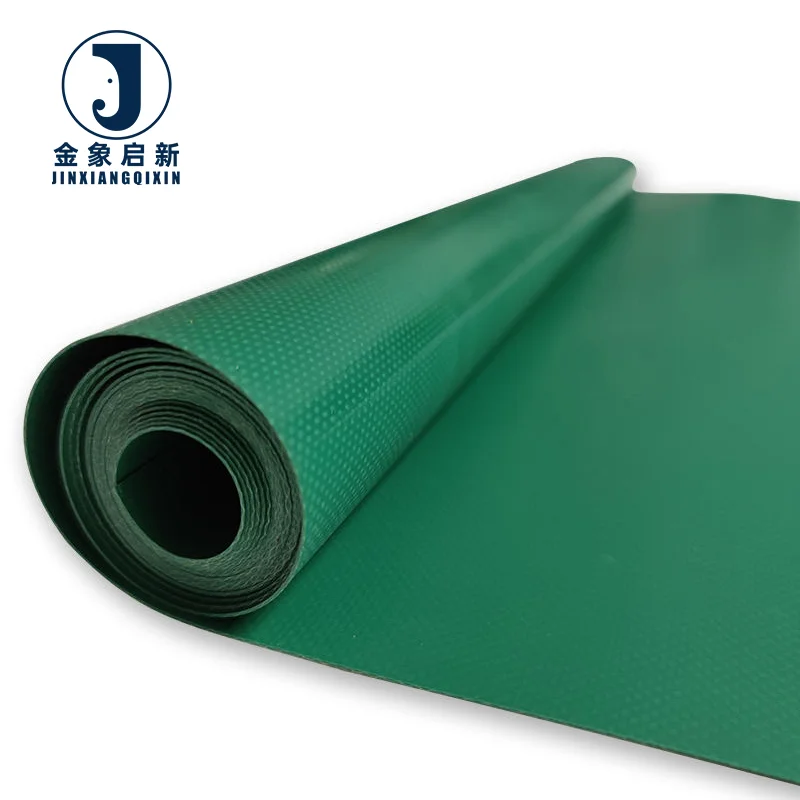
Specification Consistency — Every roll is produced under tight process control, with base fabric density, coating weight and GSM tracked across the batch to ensure the material arriving on your floor matches the agreed material specification sheet.
Technical Specifications
| Parameter | Value |
|---|---|
| Product Type | PVC Tarpaulin Roll |
| Material | PVC coated polyester |
| Yarn Count | 500D-500D / 500D840D / 1000D1000D / 1000D1300D / 1300D1300D / 1000D*2000D |
| Thickness | 0.29mm / 0.32mm / 0.38mm / 0.44mm / 0.46mm / 0.55mm / 0.65mm |
| Density | 1.15–2.00 g/cm³ |
| Tensile Strength (Warp) | 1650N / 1800N / 1850N / 2050N / 2500N / 2550N / 2750N / 3900N (test basis not stated in source) |
| Tensile Strength (Weft) | 1600N / 1700N / 1750N / 1900N / 2200N / 2250N / 2850N / 3500N (test basis not stated in source) |
| Brittle Temperature | ≤ -50 to -60 °C |
| Softening Temperature | ≥ 80 °C |
| Melting Point | 212 °C |
| Flame Retardant | Available in flame retardant grades — confirm the grade required for your market |
| UV Treatment | Anti-UV (test basis not stated in source) |
| Water Resistance | Water resistant / Waterproof |
| Certifications | ISO, CE |
Application Suitability
| Application | Exposure & Requirement |
|---|---|
| Truck and trailer side curtains | Constant flexing at load points, road debris abrasion, UV and weather exposure, wind loading |
| Flatbed and tipper load covers | Repeated tie-down cycles, tension at eyelet and hem points, rain and snow ingress |
| Transport equipment protective shrouds | Machine vibration, outdoor storage, chemical splash and dust contact |
| Industrial shelter and site enclosures | Wind load on large spans, prolonged UV exposure, rain and groundwater contact |
| Awning and canopy structures | Tension under frame tensioning, sun degradation, periodic wet-dry cycles |
| Tent and temporary structure fabric | Ground moisture, wind uplift, fire safety requirements in public spaces |
Why Generic-Size Truck Covers Fail Where the Load Flexes Most
The cover must be sized to the exact trailer model, not a generic dimension, so that stress concentrates on the fabric body rather than the seams.
Fleet operators frequently order covers by approximate measurement, only to find loose fabric flapping in transit. That flapping generates cyclic loading at every welded seam. Over repeated trips, the weld line fatigues and splits — not because the PVC coated tarpaulin for truck and trailer cover lacked strength, but because the seam geometry was wrong from the start [NEED_CITE: cyclic fatigue at heat-sealed seams in transport covers]. The result is premature replacement, load exposure and warranty disputes that could have been avoided with model-specific sizing and reinforcement specification.
Side Curtain Fabric for Fleet Operators and Equipment Builders
When specifying PVC coated tarpaulin for truck and trailer cover by the roll, the priority is batch-to-batch consistency. Side curtains are fabricated into complete sets, and a colour shift between rolls is immediately visible once installed side by side on a trailer. The coating process must hold colour reference and surface finish within tight tolerance across every roll in the shipment, so the fabricator does not face sorting, rejection or re-cutting on the production floor.
Tie-Down Reinforcement at High-Stress Zones
The points where straps, ropes and bungees connect to the cover experience concentrated pull in multiple directions. Eyelets set into standard PVC fabric without local reinforcement will tear through under sustained road vibration. Specifying enlarged aluminum alloy buttonholes with reinforced corner patches distributes that load into the surrounding fabric. The rope hem — a continuous 5mm cord without splicing — ensures tension is shared evenly along the entire edge rather than concentrating at individual grommet points [NEED_CITE: load distribution at reinforced hem construction in transport tarpaulins].
Reading the Specification Sheet Beyond GSM
GSM alone does not determine how a roll performs under tension. A 650 GSM fabric woven from 500D yarn with high mesh count will behave differently from a 650 GSM fabric built on 1000D*1000D base cloth with lower mesh density. The heavier denier yarn provides higher individual yarn strength and better tear propagation resistance, while mesh count determines how that strength is distributed across the weave. When reviewing quotations, compare the full specification — yarn count, mesh count and coating weight together — rather than treating GSM as a single performance proxy. The brittle temperature range of ≤ -50 to -60 °C and softening point of ≥ 80 °C define the operational window for cold-climate winter transport and hot-surface summer storage respectively.
The Hidden Cost of Batch Colour Variation
When multiple rolls in one order show visible colour variation, the fabricator must either sort and match rolls manually — slowing production — or accept mismatched panels on finished truck covers. For fleet operators, a trailer with two slightly different shade panels looks unprofessional and suggests poor procurement control. This problem originates at the coating stage, where pigment dispersion and plasticiser ratios must be held constant across the entire production run. Colour consistency is not a cosmetic preference; it is a process discipline indicator [NEED_CITE: batch colour consistency standards for coated fabric in transport applications].
Why Procure PVC Tarpaulin Roll Here
Three full production lines and 36 sets of professional equipment support bulk roll output with stable lead times, so fleet operators and fabricators can plan procurement around known dispatch schedules rather than uncertain availability.
The 10-person R&D team develops samples within days for custom width, colour and surface finish requirements, allowing buyers to verify material properties against their own test methods before committing to volume.
Dedicated QA/QC at every production stage, with 100% inspection before shipment, means each roll is checked against the material specification sheet for GSM, coating weight and surface quality before it leaves the facility.
Deep process control over coating weight and adhesion, built on nearly 30 years of coated fabric production, delivers roll-to-roll consistency that fabricators depend on when cutting and heat-sealing multiple panels from the same batch.
Documentation & Verification
- Material specification sheet stating GSM, base fabric denier, mesh count and coating type per roll
- Test report for UV and flame retardant grades where applicable to the order
- Pre-shipment inspection record confirming 100% check before dispatch
- Roll packing list with weight, roll count and dimensions for customs clearance
- Certificate of origin and customs documentation for cross-border shipment
Fabrication, Handling & Storage
- Heat-seal temperature and dwell time must be matched to the specific PVC coating thickness and GSM grade
- Store rolls upright on pallets to prevent flat-spot deformation of the coated surface
- Allow cold-stored rolls to acclimatise before unrolling to avoid coating crack at brittle temperature threshold
- Use high-frequency or hot-air welding for seam construction — solvent adhesives may soften the PVC coating layer
- Cut panels with allowance for hem fold and eyelet reinforcement zone to maintain edge strength
- Clean surfaces with mild detergent; avoid solvent-based cleaners that attack the plasticiser in the coating
What to Include in Your Inquiry
Provide the specific truck or trailer model, the required cover dimensions and the annual volume to enable accurate roll width and grade recommendation. Specify whether the end use requires flame retardant certification for your market and whether custom colour or printed branding is needed for fleet identity. Confirm whether you require roll stock only or finished cut-to-size covers with edge reinforcement and eyelet installation.
Frequently Asked Questions
Q: How do I specify truck cover dimensions to avoid a generic-size misfit?
A: Provide the exact trailer make, model and year along with measured body dimensions including any protruding fittings. The cover is then patterned to that specific vehicle with reinforcement placed at actual tie-down and flex points, rather than cut to a standard rectangle that leaves loose fabric flapping in transit.
Q: How is GSM verified on arrival against the quotation?
A: Each roll ships with a material specification sheet stating the agreed GSM, base fabric and coating details. You can verify by cutting a measured sample from the roll and weighing it on a calibrated scale. Any discrepancy against the stated value is covered under the pre-shipment inspection record.
Q: What documentation supports flame retardant and anti-UV claims?
A: Where flame retardant or anti-UV treatment is specified in the order, the shipment includes the corresponding test report. Confirm the grade required for your market — such as building code fire classification or transport UV exposure standard — at inquiry stage so the correct test basis is applied.
Q: How are welded seams protected from failing at flex points?
A: High temperature heat sealed seamless edge wrapping provides continuous adhesion along the hem without glue-line cracking. Reinforced corners and enlarged aluminum alloy buttonholes distribute tie-down load into the surrounding fabric, preventing concentrated stress that causes seam splitting under road vibration.
Q: Can colour be matched across multiple rolls in a single order?
A: Colour reference is set at the sample approval stage and held constant through pigment control across the production run. The pre-shipment inspection includes visual comparison of rolls side by side to confirm consistency before packing. Request a sample roll first if colour matching is critical to your application.