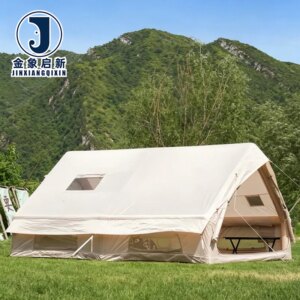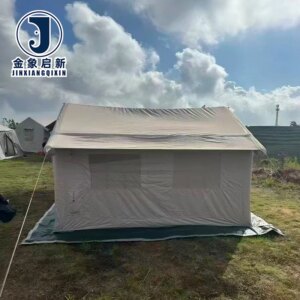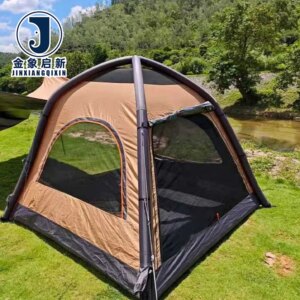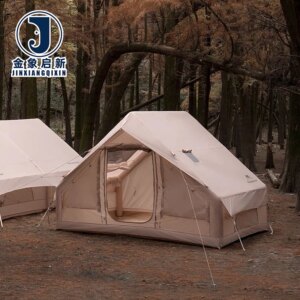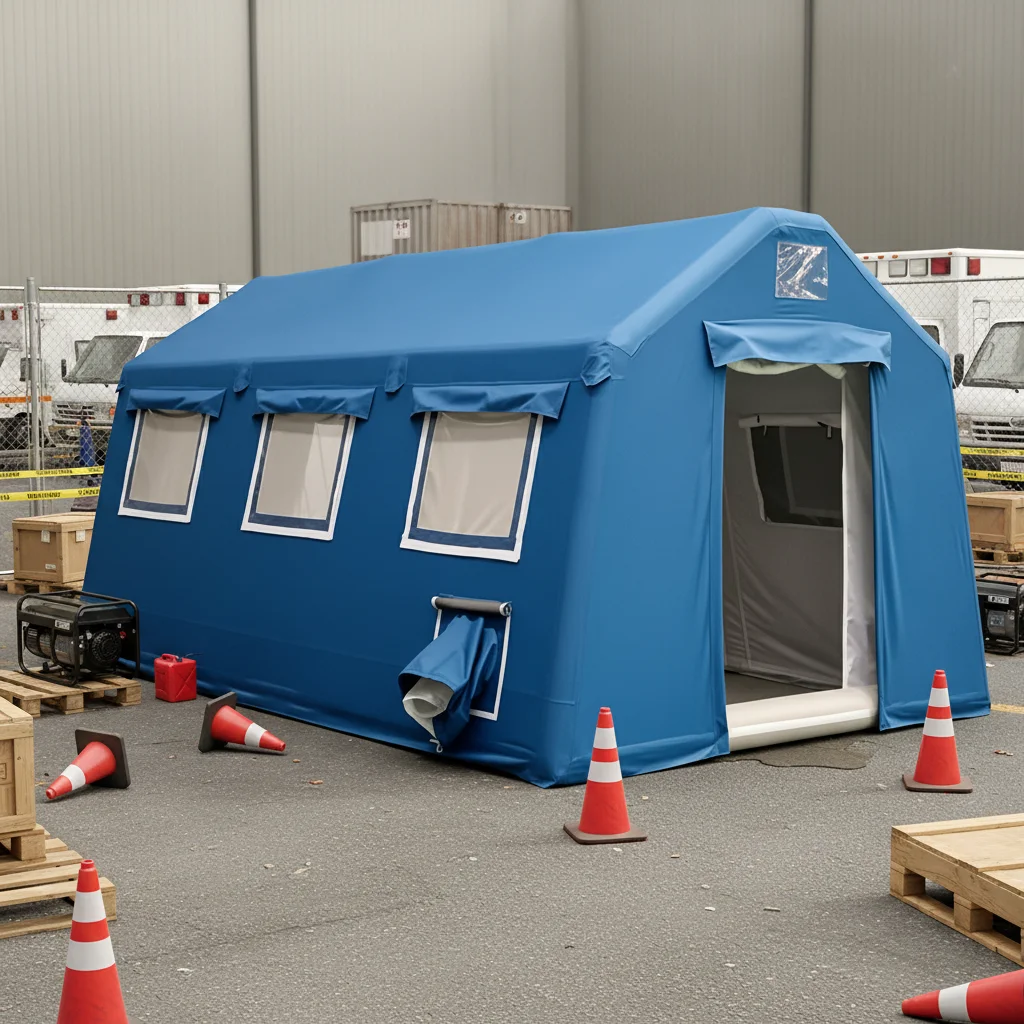
Deep Process Control Over Coating Weight — Each roll undergoes stage-by-stage inspection across three full production lines, ensuring the PVC inflatable tent fabric you receive matches the specification sheet down to the coating adhesion and GSM.
Technical Specifications
| Parameter | Value |
|---|---|
| Product Type | Inflatable Tent |
| Core Material | PVC tarpaulin |
| Key Performance | Waterproof, UV-resistant (test basis not stated), quick automatic opening |
| Product Forms | Single layer construction, extended type |
| Season Rating | Four-season |
| Certifications | ISO9001, ISO14001, ISO45001, CE |
| Customization | OEM & ODM, sample customization, pattern printing available |
Application Suitability
| Application | Exposure & Requirement |
|---|---|
| Fleet staging areas | Prolonged UV exposure, wind load, frequent relocation across depot yards |
| Mobile site offices | Weather ingress, ground moisture, daily crew traffic through entry points |
| Emergency command shelters | Rapid deployment under time pressure, variable terrain anchoring, all-weather durability |
| Equipment storage at remote sites | Condensation, dust ingress, UV degradation over extended outdoor siting |
| Roadside incident shelters | Traffic vibration, exhaust exposure, setup and breakdown within minutes |
What Happens When Tent Fabric Is Specified by Weight Alone
A PVC inflatable tent built on GSM without verified coating adhesion will separate at the weld before the fabric fails.
Fleet operators and site managers often receive inflatable shelters where the material feels lighter than what was quoted, and the seams open up at the flex points after a few deployments. The problem rarely traces back to a single defect — it is usually a chain of unchecked variables, from base fabric denier to coating method to the heat-seal parameters used at the factory [NEED_CITE: tensile and tear test methods for coated fabrics per ISO 1421]. When the inflatable tube flexes under wind load, the welded seam takes the highest stress concentration, and if the coating adhesion was never verified, the bond fails long before the PVC membrane tears.
Automatic Opening Meets Fleet-Scale Deployment
A PVC inflatable tent with quick automatic opening eliminates the hours a crew would otherwise spend on pole assembly, guy-line tensioning, and frame locking at a staging yard or roadside site. For fleet operators managing multiple depots or transport companies responding to in-transit cargo emergencies, the reduction in setup time translates directly into faster shelter availability and lower labour cost per deployment. The single-layer construction keeps packed volume manageable for loading onto service vehicles or storing in transport containers between uses.
Waterproofing and UV Resistance Under Continuous Outdoor Exposure
The PVC tarpaulin core material is selected for its waterproof construction, protecting cargo, equipment, and personnel from rain and ground moisture during extended outdoor siting. UV-resistant treatment is offered for prolonged roadside and depot exposure — confirm the test basis required for your operating region and market compliance before finalizing the specification [NEED_CITE: UV degradation test standards for PVC coated fabrics]. Four-season rating supports year-round deployment, but site-specific wind and snow load requirements should be verified against the structural performance of the inflated tube diameter and anchoring system.
Material Choices That Determine On-Site Behaviour
The base fabric denier and weave density govern how the inflatable tube resists puncture from sharp ground debris and how it handles repeated inflation cycles without developing micro-cracks at stress points. PVC tarpaulin coating weight and the method of application — whether knife-coated, laminated, or calendered — directly influence peel strength at welded seams, which is the most common failure point on inflatable shelters that see frequent transport and redeployment [NEED_CITE: peel strength testing for PVC coated fabric welds per ISO 1421]. Surface finish selection between glossy and matte affects cleanability at muddy construction sites versus dust accumulation at arid logistics yards, and also determines whether pattern printing for fleet branding will adhere sharply across multiple units.
The Cost of Getting the Specification Wrong
When a batch of inflatable tents arrives with colour variation between units, the mismatch becomes immediately visible once deployed side by side at a fleet yard, undermining professional appearance and triggering rejection. Welded seams that were heat-sealed at incorrect temperatures for the specific coating formulation will delaminate at the inflation point, leaving a shelter unusable mid-deployment and forcing costly emergency replacements [NEED_CITE: common weld failure modes in PVC inflatable structures]. Ordering without confirming UV-resistant test documentation can result in surface chalking and loss of mechanical strength after a season of outdoor exposure, particularly in high-sun transport corridors where shelters sit deployed for months.
Why Source Through This Supply Chain
Three full production lines and 36 sets of processing equipment support volume orders for fleet-scale inflatable tent procurement without sacrificing per-unit consistency. A 10-technician R&D team handles OEM and ODM sizing, matching shelter dimensions to specific staging area layouts or vehicle-based deployment systems. Dedicated QA and QC staff inspect every production stage, with 100% pre-shipment inspection before dispatch. Sample development within days allows custom sizing, colour, and pattern printing to be validated before committing to a production run. ISO9001, ISO14001, ISO45001, and CE certifications underpin the quality management framework supporting each order [NEED_CITE: ISO management system standards applicable to coated fabric manufacturing].
Documentation & Verification
- Material specification sheet stating PVC base fabric denier, coating weight, and colour reference per batch
- Pre-shipment inspection record with 100% inspection confirming weld integrity and dimensional accuracy
- ISO and CE certificates included in the dispatch documentation package
- UV-resistant test report availability to be confirmed per order and target market requirement
- Pattern printing artwork approval record for fleet branding consistency across units
Fabrication, Handling & Storage
- Heat-seal temperature and dwell time must match the PVC tarpaulin coating formulation to prevent weld delamination at inflation points
- Inflate the shelter fully before long-term storage to identify slow leaks at seams or valve connections
- Store deflated units flat or loosely rolled in shaded, dry conditions to avoid permanent creasing of the PVC membrane
- Clean with mild detergent only — solvent-based cleaners can degrade the PVC coating surface and compromise waterproofing
- Verify anchoring hardware compatibility with the shelter’s tie-down and hem reinforcement before field deployment
Moving Forward With Your Specification
To receive a precise recommendation, provide the intended deployment environment, typical wind and weather conditions, and whether the inflatable tent will serve as a semi-permanent site structure or a rapid-deploy emergency shelter. Specify any colour, pattern printing, or branding requirements for fleet identification, along with the quantity and sizing range needed. If your market requires documented UV-resistant or fire-performance testing, state the applicable standard so the correct test basis can be confirmed before production.
Frequently Asked Questions
Q: How is inflatable tent sizing matched to specific fleet staging layouts or vehicle platforms?
A: OEM and ODM customization allows the PVC inflatable tent dimensions to be developed against your site plans or vehicle footprint. The 10-technician R&D team produces samples within days so that tube diameter, floor area, and entry placement can be validated before production. Provide site drawings or vehicle dimensions for accurate sizing.
Q: What UV-resistant test basis supports the outdoor exposure claim for transport applications?
A: UV-resistant treatment is available for the PVC tarpaulin membrane, but the specific test standard and exposure duration should be confirmed per your operating region and compliance requirements. Request the applicable test report documentation when placing your inquiry so the correct grade is specified.
Q: How are welded seams reinforced at the high-flex points of an inflatable shelter?
A: Weld integrity depends on matching heat-seal parameters to the specific PVC coating formulation and base fabric denier. The 100% pre-shipment inspection process checks seam strength at inflation stress points. Ask for the inspection record to verify weld quality before your shipment leaves the factory.
Q: What anchoring and tie-down options are available for fleet and roadside deployment?
A: Anchoring hardware selection depends on the deployment surface — ground stakes for soil, weighted ballast for paved yards. Specify the typical site conditions so the hem reinforcement and tie-down configuration can be matched to the expected wind load and relocation frequency.
Q: How is colour consistency controlled across multiple inflatable tents in a fleet order?
A: Each batch is produced with a stated colour reference on the material specification sheet. The QA team inspects across the production run to identify variation between units before dispatch. For fleet branding, request a pre-production sample to confirm colour match before the full order proceeds.