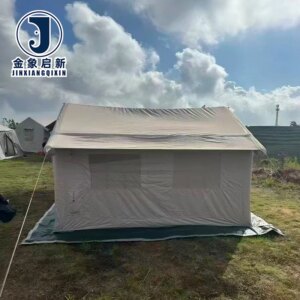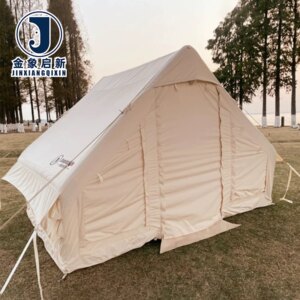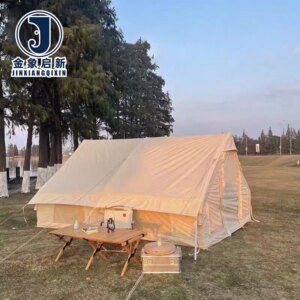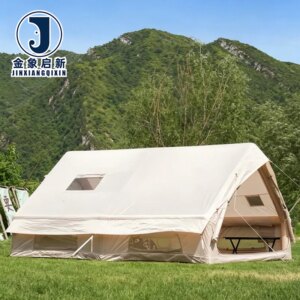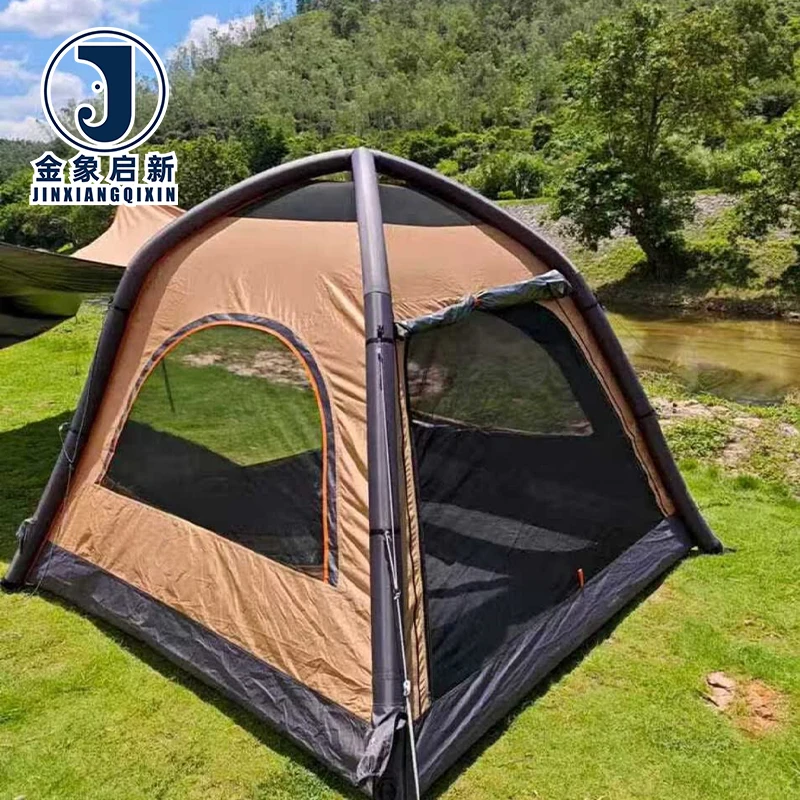
Coated Fabric Process Control — deep expertise in PVC knife-coated tarpaulin production ensures consistent coating adhesion and structural integrity across every inflatable tent unit manufactured.
Technical Specifications
| Parameter | Value |
|---|---|
| Product Type | Inflatable Tent |
| Core Material | PVC tarpaulin (knife coated PVC fabric) |
| Construction | Single-layer |
| Capacity | 8-10 Person |
| Season Rating | 4 Season |
| Waterproof Rating | ≥2000mm water column (test basis not stated in source) |
| Tensile Strength | ≥300N/5cm (standard not stated in source) |
| Key Features | Waterproof, UV-resistant, tear-resistant, fire-retardant, anti-static |
| Flame Retardant Standard Referenced | MEFB 1-1997 (grade not stated in source) |
| Customization | OEM & ODM, sample customization, pattern printing |
Application Suitability
| Application | Exposure & Requirement |
|---|---|
| Construction site temporary shelters | Wind load, rain ingress, heavy equipment proximity, rapid setup demand |
| Industrial event pavilions | Continuous UV exposure, crowd safety compliance, fire-retardant certification |
| Mobile fieldwork stations | Remote deployment, variable weather, structural stability without permanent anchoring |
| Emergency response command posts | Immediate inflation requirement, all-weather waterproofing, repeated pack-and-deploy cycles |
| Commercial outdoor operations | Prolonged outdoor exposure, abrasion from ground contact, branding visibility |
Why Generic Tents Fail Where Industrial Inflatable Tents Must Hold
Industrial sites demand verified performance, not consumer-grade assumptions.
Most inflatable structures sold into commercial environments were never designed for sustained wind loading, road-side vibration during transport, or the chemical exposure common on active construction sites. The seams split first — typically at the junction where the air beam meets the ground sheet — because the base fabric and the welded joint are not engineered for the same duty cycle [NEED_CITE: tensile and tear test methods for coated fabrics per ISO 1421]. When an Inflatable Tent for truck and transport operations fails mid-deployment, the cost is not the tent itself but the downtime, the exposed equipment, and the safety incident that follows. Buyers specifying shelter for industrial use need batch-specific test data, not brochure claims.
Structural Load Distribution Under Wind Conditions
An 8-10 person 4-season inflatable tent deployed on an exposed site must resist lateral wind forces that push against the entire envelope simultaneously. The PVC knife-coated tarpaulin construction provides a continuous coated surface where tensile loads transfer through the base fabric rather than concentrating at seam points. When the Inflatable Tent for commercial outdoor operations is correctly anchored, the single-layer design channels stress along the air beam geometry, reducing the point-load failures typical of stitched-and-taped consumer tents.
Fire Safety and Anti-Static Compliance on Regulated Sites
Mining, tunnelling and aviation-adjacent sites enforce strict flame-retardant and anti-static requirements before any temporary structure is permitted on the ground. This tent references the MEFB 1-1997 standard for flame retardancy, though the specific grade should be confirmed against your site safety protocol [NEED_CITE: DIN 4102 fire classification for building materials]. Available in flame retardant grades — confirm the grade required for your market and request the corresponding test report before committing to volume. Anti-static treatment is similarly available and must match the earthing requirements of your specific operational environment.
Reading the Specification Sheet Beyond Surface Claims
The stated tensile strength of ≥300N/5cm indicates how the base fabric responds to pulling forces, but this number alone does not predict tear propagation behaviour — a fabric can show high tensile values yet tear rapidly once a puncture initiates if the base weave density is insufficient. The knife-coated PVC manufacturing method bonds the coating into the fabric substrate rather than merely sitting on the surface, which improves peel strength at welded seams and supports reliable hot-air welding during fabrication. The ≥2000mm water column rating reflects hydrostatic pressure resistance under laboratory conditions; field performance depends equally on seam integrity and ground sheet contact. A 4-season rating implies the material remains flexible at low temperatures without becoming brittle, though the specific low-temperature threshold should be verified for your climate zone.
The Hidden Cost of Under-Specified Shelter Procurement
When procurement teams select inflatable tents based on capacity and price alone, the failures surface weeks into deployment. A tent that lacks verified UV-resistant treatment will show surface chalking and coating embrittlement after sustained sun exposure, leading to micro-cracks that compromise waterproofing [NEED_CITE: UV degradation mechanisms in PVC coated polyester fabrics]. Colour variation between batches — common when coating weights are not controlled at the production stage — becomes visible when multiple units are deployed side by side at an event site or construction compound. Welded seams that were not tested to match the base fabric strength will separate at flex points long before the main envelope shows wear, turning a repairable structure into write-off scrap.
Why Source Your Inflatable Tent Here
Three full production lines with 36 sets of professional processing equipment mean your custom-sized inflatable tent order is manufactured in-house without outsourcing the coating or welding stages. The 10-person R&D team develops samples within days, allowing you to verify material hand-feel, weld quality and dimensional accuracy before authorising bulk production. Every unit passes 100% pre-shipment inspection across dedicated QA checkpoints — not random sampling. Coating weight and adhesion are controlled through nearly 30 years of process refinement in PVC tarpaulin, reducing the batch-to-batch inconsistency that plagues generic suppliers. Material specification sheets and test documentation accompany each dispatch, giving your compliance team the traceability they require.
Documentation & Verification
- Material specification sheet stating base fabric denier, PVC coating type and weight values
- Waterproof and tensile test data provided per production batch
- Fire-retardant and anti-static certification matching your site safety standard
- Pre-shipment inspection record covering dimensional accuracy and weld integrity
- Roll packing list and certificate of origin for customs clearance
Fabrication, Handling & Storage
- Hot-air weld temperature must match PVC knife-coated fabric thickness to prevent coating burn-through at seams
- Ground contact areas benefit from additional abrasion protection given single-layer PVC tarpaulin construction
- Store deflated tent in dry conditions to prevent moisture entrapment between PVC coating layers
- Avoid sharp folds during packing to prevent permanent crease marks on the coated surface
- Clean with mild detergent only; solvent-based cleaners degrade the PVC coating bond
- Repair minor punctures with compatible PVC patch kits using heat-activated adhesive
Requesting a Quotation That Matches Your Project
Specify the deployment environment, expected wind exposure and any fire-safety standards your site enforces. Provide the required floor dimensions and confirm whether pattern printing or branded panels are needed for the project. Indicate the quantity and whether you require pre-production samples for performance validation before bulk commitment.
Frequently Asked Questions
Q: How is the waterproof rating of each batch verified before shipment?
A: Each production batch undergoes hydrostatic pressure testing to confirm the ≥2000mm water column performance. The test results are recorded in the pre-shipment inspection documentation and accompany your order. If your project demands a higher rating or a specific test standard, confirm this during the specification stage so the correct material grade is selected.
Q: What fire-retardant and anti-static certifications are available for site compliance?
A: The tent references MEFB 1-1997 for flame retardancy and offers anti-static treatment options. The exact certification package depends on your market and site requirements. Request the specific test report during the inquiry stage to verify the grade matches your regulatory framework before production begins.
Q: How are welded seams tested to prevent failure under flex load?
A: Welded seams are inspected during the 100% pre-shipment quality check, with peel strength evaluated against the base fabric specification. The knife-coated PVC construction supports consistent hot-air welding, and seam parameters are matched to the fabric weight. Sample units can be destructively tested on request to validate weld performance.
Q: What OEM and ODM customization options are supported?
A: Custom dimensions, pattern printing and branded panels are available through the in-house R&D team. Samples are developed within days for your approval before bulk production proceeds. Confirm your size, colour and printing requirements during the inquiry so accurate lead times and tooling requirements can be quoted.
Q: What lead time and minimum order apply to custom inflatable tents?
A: Lead times depend on customization complexity, order volume and current production scheduling across the three dedicated lines. Minimum quantities vary by specification — standard configurations carry lower minimums than fully custom sizes or printed designs. Provide your target delivery window and quantity during the inquiry for a confirmed production schedule.